When to replace furniture floor protectors
Furniture floor protectors should be replaced when their protective function depends more on a worn state than on effective floor contact. This maintenance decision depends on protector condition, furniture use, and performance changes rather than age alone. Age by itself is not enough to determine replacement.
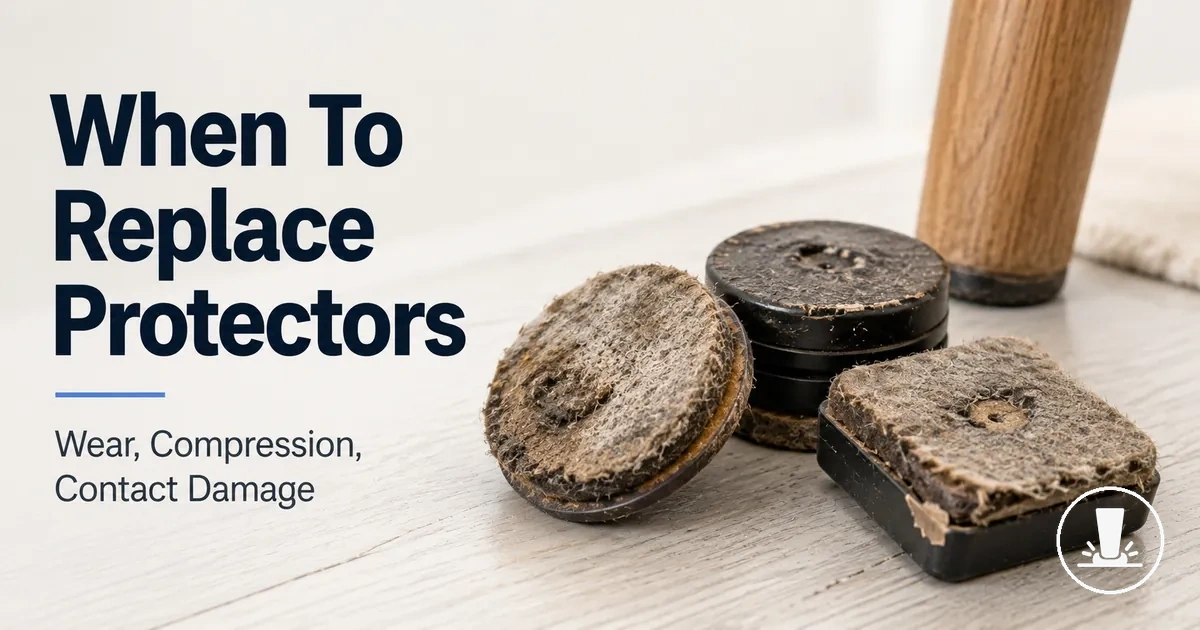
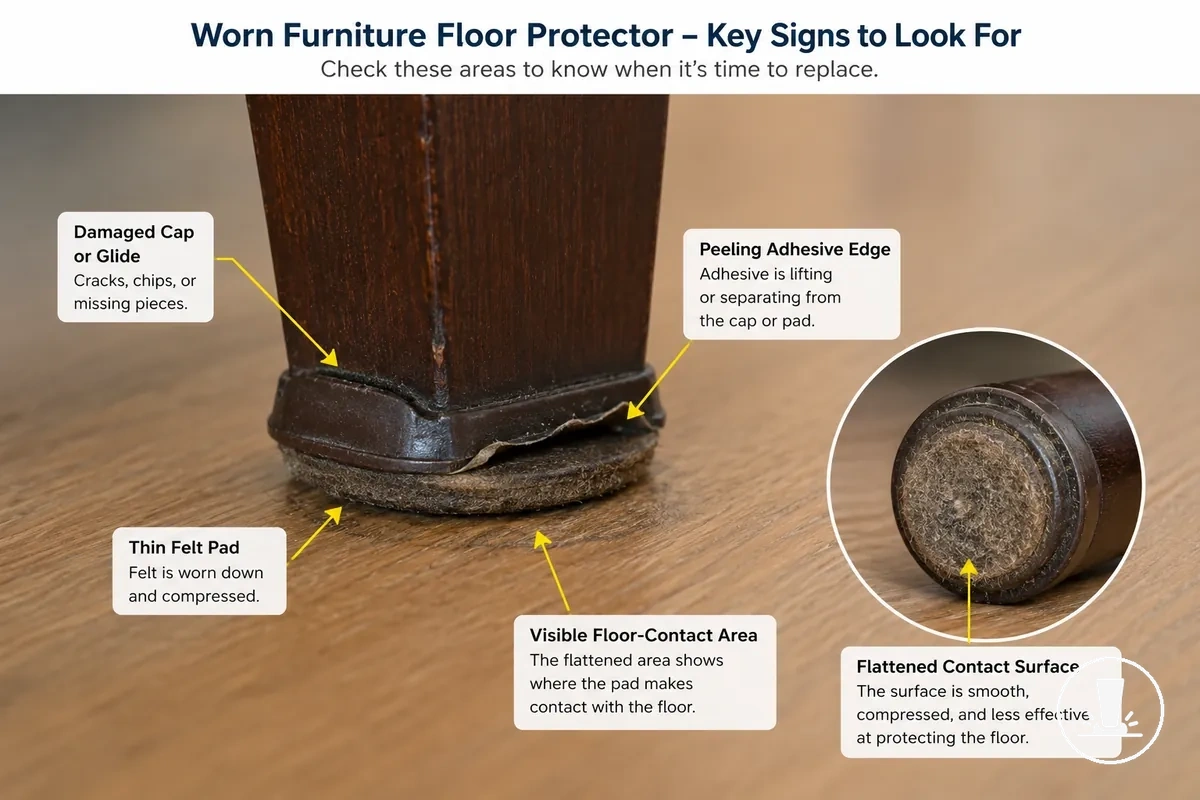
When to replace furniture floor protectors is usually determined by visible replacement signals. The image below highlights common signs such as compressed felt, damaged contact surfaces, and changes in the floor-contact area.
When furniture floor protectors show visible wear, chair movement becomes less smooth, or a louder sound develops during use, their ability to protect the floor may be reduced. Felt pads that appear thin, dirty, or uneven can indicate a change in floor contact, while chair leg caps and furniture glides may show damage from repeated movement. These signs often develop gradually through normal use. In many cases, replacement becomes a reasonable choice when visible wear affects how the protector interacts with the floor.
Furniture floor protectors are usually evaluated by their current condition rather than a fixed lifespan. Cleaning or refitting may help in certain situations, but a worn protector can reach a point where replacement is the more suitable maintenance decision. This condition-based approach is different from routine cleaning and separate from full troubleshooting.
What replacement means for furniture floor protectors
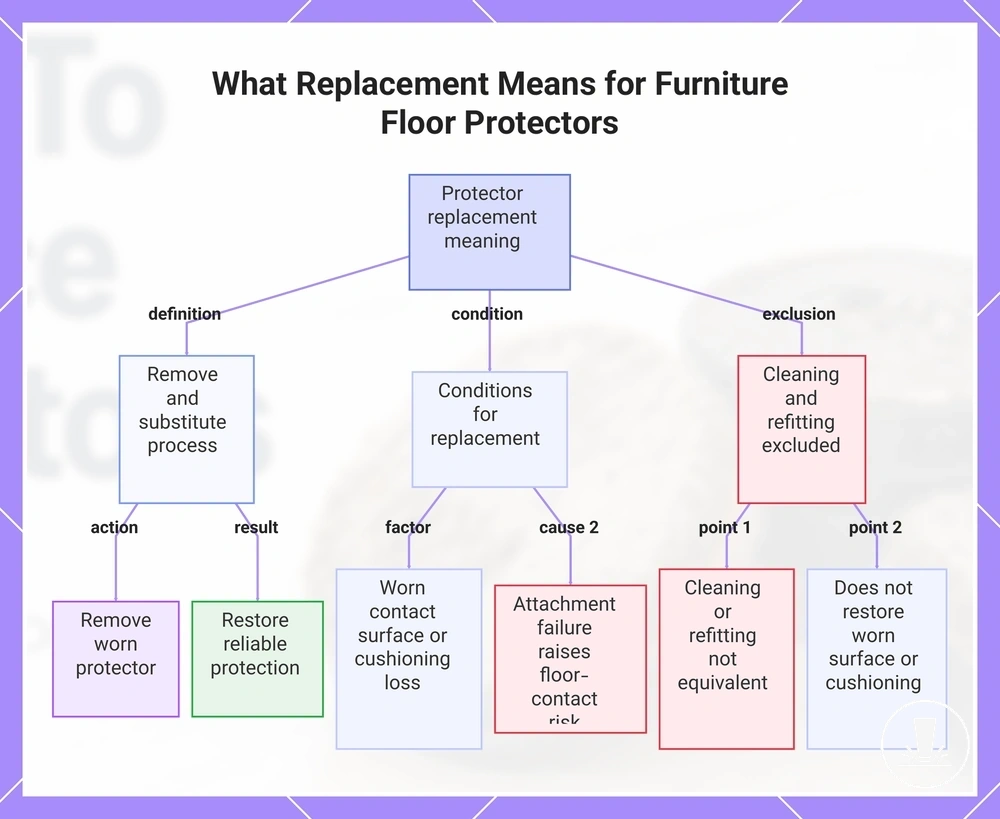
Furniture floor protector replacement is the process of removing a protector that no longer provides reliable protection and substituting it with a functional one. It applies when a worn contact surface, cushioning loss, or attachment problems reduce the protector’s ability to separate furniture from the floor. Replacement becomes the maintenance threshold when protection can no longer be relied on under normal floor contact.
A common misunderstanding is that cleaning or refitting serves the same purpose as replacement. Cleaning may improve surface condition, and refitting may help a loose protector as a temporary fix, but neither restores a worn contact surface or lost cushioning. When attachment failure, reduced cushioning, or a worn protector continues to increase floor-contact risk, replacement may be the more appropriate response. furniture floor protectors are designed to reduce floor-contact risk, so protector replacement is justified when that function can no longer be performed reliably.
This chart explains what furniture floor protector replacement means, when it is necessary, and how it differs from cleaning or refitting.
Visible wear that shows a protector is no longer working
Visible wear can justify a replacement decision when protection changes and a protector no longer maintains effective floor contact. A worn protector may remain attached while showing wear signs that reduce its protective function. The key consideration is whether the wear condition affects protection rather than appearance alone.
A felt pad with felt thinning, a flattened surface, cracks, or an uneven contact area may provide less cushioning between furniture and the floor. A contact surface that appears split, compressed, or distorted can change how pressure is distributed during movement. Peeling adhesive, damaged edges, or a loose attachment point may affect stable floor contact. These wear conditions do not guarantee damage, but they can increase floor-contact risk when protection is reduced.
Visible wear that shows a protector is no longer working is often easier to identify when functional wear is separated from cosmetic wear. Minor discoloration or light surface damage may be cosmetic, while contact wear that changes thickness, shape, cushioning, or attachment is more likely to affect the replacement decision. The image below labels common wear signs and shows how visible wear can support a replacement decision.
Use this mini-checklist to evaluate observable wear signs:
- Felt pad is thin, dirty, or uneven, which may reduce cushioning and change floor contact.
- Contact surface is flattened, cracked, compressed, or distorted, which may reduce consistent protection.
- Peeling adhesive exposes part of the protector and may affect attachment stability.
- Damaged edges on a pad, cap, or glide can create uneven contact wear.
- Dirt buildup remains embedded in the contact surface and may interfere with smooth movement.
- Contact-area distortion changes the protector shape and may increase floor-contact risk.
Thin, dirty, or uneven felt pads
Felt pads should be checked closely because their condition directly affects contact smoothness and cushioning. Thin, dirty, or uneven felt pads can support a replacement decision when wear changes how the pad surface meets the floor.
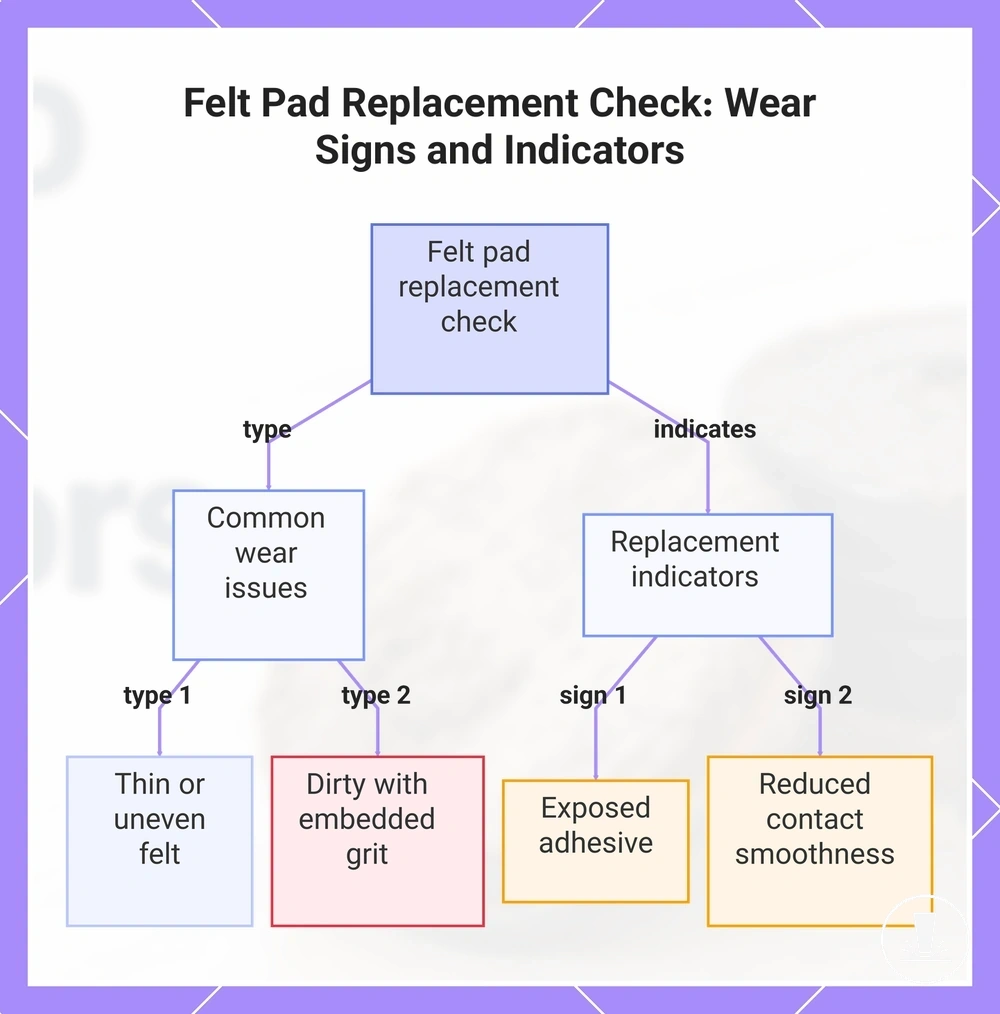
A felt pad with reduced thickness, embedded grit, or uneven compression may create a less consistent contact surface. Dirt alone does not always require replacement, but embedded grit can become abrasive when it remains trapped in the felt. If worn felt exposes adhesive, reduces contact smoothness, or develops an uneven surface, replacement may be more appropriate than continued use. For example, a dirty felt pad with embedded grit can feel abrasive even when the surrounding pad surface appears intact.
This chart shows the main felt pad wear conditions and the specific signs that indicate replacement may be needed.
Flattened, split, or peeling contact surfaces
The contact surface should be checked for conditions that reduce buffering between furniture and the floor. The points below distinguish common contact-surface conditions and the floor-contact risks they may indicate.
- A flattened contact surface may reduce buffering and change pressure distribution, especially when furniture weight is higher or movement frequency is greater.
- A split contact surface can expose damaged areas that reduce consistent floor contact and may qualify the protector for replacement when the condition continues to develop.
- Peeling surfaces and edge curling can expose underlying layers or create adhesive exposure that may affect stable contact during movement.
- Increased surface hardness on a worn surface may reduce cushioning and can increase floor-contact risk when floor sensitivity is higher.
Replacement urgency depends on the overall condition of the contact surface rather than a single wear sign. A flattened, split, or peeling surface may justify closer evaluation when furniture is moved frequently, supports greater weight, or is used on floors that are more sensitive to hard contact.
Loose caps, worn glides, and damaged leg tips
Chair leg caps, furniture glides, and damaged leg tips can become visible replacement signs when contact points no longer remain stable. Looseness, cracked caps, worn glide bottoms, or exposed parts may indicate that floor contact has become less consistent.
- Chair leg caps with cracked cap walls or looseness may shift during movement and create unstable floor contact.
- Furniture glides with worn glide bottoms or exposed nail-on or tap-on parts may reduce consistent buffering between the furniture and the floor.
- Damaged leg tips can expose hard contact points that may affect how the protector supports floor contact.
Visible wear and detachment should be evaluated separately. Cracked caps, worn glide bottoms, and exposed parts often support a replacement decision, while recurring detachment may indicate a fit or attachment issue beyond normal wear. If protectors falling off continues after replacement, additional troubleshooting may be needed beyond replacing the worn protector.
Performance changes that justify replacement
Performance changes can justify replacement even when a protector does not show obvious breakage. A replacement decision may be appropriate when movement changes, contact behavior changes, or protection feels less consistent during normal use.
Chair movement that produces a louder sound than before may indicate a worn contact point rather than a temporary surface issue. Drag during movement can suggest that the protector is no longer performing as intended, while reduced cushioning may change how furniture weight is supported. Slipping or wobble can also indicate that floor contact has become less stable, especially on frequently moved chairs, tables, or similar furniture. These performance symptoms should be considered together rather than treated as proof from a single sign.
Performance changes that justify replacement are often easier to diagnose when movement, noise, and contact behavior are assessed together. The diagram below shows how louder movement, drag, and reduced cushioning can reveal protector failure through use-performance symptoms rather than appearance alone.
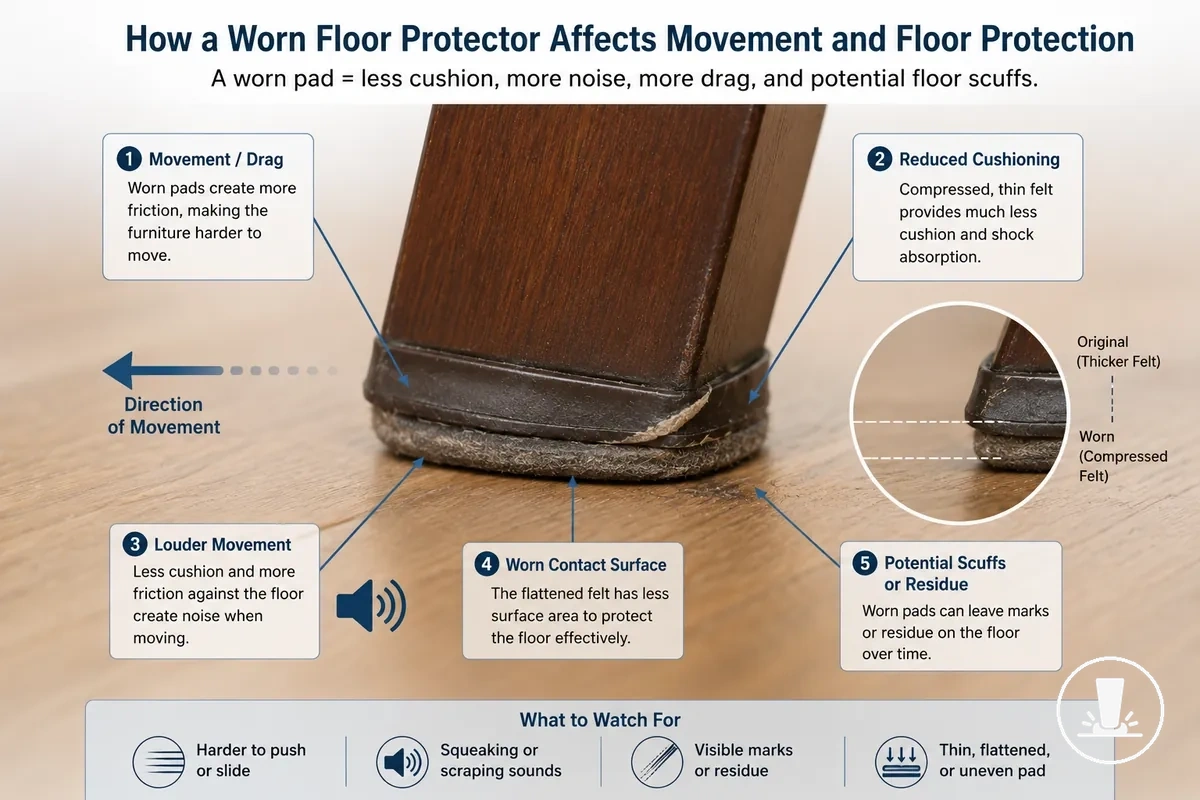
Use the checklist below to connect performance symptoms with a replacement decision. If multiple symptoms persist after inspection, replacement may be reasonable depending on furniture condition, use patterns, and protector performance.
- Louder movement develops during chair movement; inspect whether the protector contact point has become worn or less effective.
- Drag increases during normal movement; check whether the protector still maintains smooth floor contact.
- Reduced cushioning becomes noticeable under furniture weight; inspect whether support and contact remain consistent.
- Slipping or wobble occurs during use; check for unstable contact points or performance changes in the protector.
- New scuffs appear together with other symptoms; inspect protector condition before linking the marks to a single cause.
- Residue or repeated repositioning develops around the contact area; check whether the protector remains stable during movement.
Louder chair movement and weaker floor cushioning
Louder chair movement can indicate reduced cushioning when felt compression, hard contact, or repeated sliding changes how the protector interacts with the floor. Noise alone is not proof of failure, but louder chair movement together with weaker cushioning, drag, or loss of friction control may suggest reduced protector performance.
When chair movement creates persistent noise after the floor surface and protector fit have been checked, felt compression and hard contact may be contributing factors. For example, temporary debris can create movement sound that disappears after cleaning, while persistent worn-pad noise may continue during repeated sliding. Drag, cushioning changes, and noise should be evaluated together because sound can depend on debris, floor surface, fit, and contact condition.
Scratches, scuffs, residue, or marks from worn protectors
When scratches, scuffs, residue, or marks appear together with signs of protector wear, replacement may be appropriate. Marks alone do not confirm protector failure, but recurring floor marks can indicate that the contact surface is no longer performing as intended.
Residue, abrasion, and scuff behavior should be evaluated separately because they can point to different protector conditions. Old adhesive may leave surface residue, while trapped grit can contribute to scratches through repeated movement. Rubber transfer, exposed hard edges, and worn glides may create scuff marks or floor marks when contact conditions change. Use the checks below to connect the mark type with a possible replacement signal.
- Residue: Old adhesive or deteriorated pad material may leave surface residue and can indicate that the protector condition should be checked.
- Scratches: Trapped grit between the protector and floor may increase abrasion and can suggest that the contact surface is no longer clean or effective.
- Scuffs: Rubber transfer, exposed hard edges, or worn glides may create scuff marks that can indicate reduced protector performance.
- Repeated floor marks: Persistent marks from the same contact point may justify closer inspection and possible replacement when protector wear is also present.
If marks continue after the protector condition has been checked or replacement does not resolve the issue, protectors leaving marks may require deeper diagnosis beyond this local replacement assessment.
How long furniture floor protectors usually last
How long furniture floor protectors usually last depends on their condition, use intensity, and contact environment rather than a universal timeframe. Service life can vary between felt pads, chair leg caps, and glides. Replacement timing is usually determined by visible wear and performance changes rather than age alone.
When furniture is moved frequently, protector wear may develop faster than on furniture that remains mostly stationary. Felt pads can gradually compress through repeated movement, while chair leg caps and glides may wear through contact, attachment changes, or surface friction. Furniture weight, movement frequency, floor texture, and cleaning habits can all influence lifespan, which is why protector types often age differently under similar conditions.
The table below shows how protector type and use condition can influence replacement timing. These are condition-based signals rather than fixed lifespan rules.
| Protector type | Use condition | Replacement signal | Certainty note |
|---|---|---|---|
| Felt pads | Frequent movement | Compression or visible wear | Condition dependent |
| Chair leg caps | Repeated floor contact | Loose fit or damage | Varies by use |
| Glides | Regular sliding | Worn contact surface | Condition dependent |
| High-use furniture | Higher movement frequency | Earlier visible wear | Depends on conditions |
When replacement timing becomes unclear, visible wear is usually a more useful decision signal than age alone. A protector that still maintains stable floor contact may not require replacement simply because time has passed, while a worn protector may justify replacement regardless of age.
Why furniture use, weight, and floor contact change replacement timing
Replacement timing depends on furniture use, furniture weight, and floor contact conditions rather than the protector alone. Identical protectors can wear at different rates when movement patterns, pressure levels, and contact conditions change. A protector under rarely moved furniture may experience different wear than the same protector under high-friction daily-use furniture.
When replacement timing seems inconsistent, the reason is often a difference in wear conditions rather than a difference in protector type. Furniture weight can increase pressure on contact points, while chair movement can increase friction through repeated floor contact. Leg shape and contact area can affect how force is distributed across the protector, which may influence wear rate and attachment stress. Floor hardness, floor texture, and dust exposure can also affect abrasion when particles remain between the protector and the floor.
The criteria below organize the main conditions that can change replacement timing variables:
- Furniture weight: Higher pressure may increase compression and accelerate wear at the contact point.
- Chair movement: More frequent movement can increase friction and contribute to a higher wear rate.
- Leg shape and contact area: Smaller or uneven contact areas may concentrate pressure and affect protector fit.
- Floor texture, floor hardness, and dust exposure: Surface conditions and trapped particles can increase abrasion during movement.
- Attachment stress: Repeated movement and load changes may contribute to looseness and earlier replacement needs.
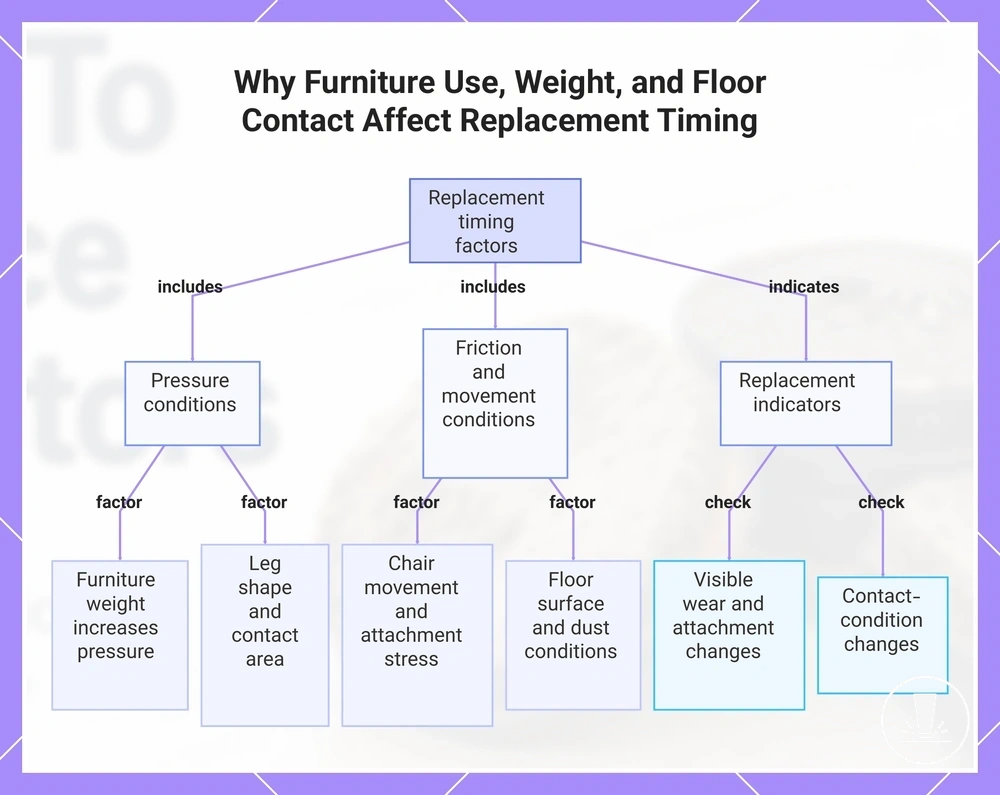
Replacement timing should usually be checked more often when furniture use intensity, movement, or floor contact stress increases. Visible wear, attachment changes, and contact-condition changes are often more useful indicators than age alone when deciding whether a protector requires replacement.
This chart organizes the wear conditions and replacement indicators that explain why protector replacement timing varies, highlighting the factors that influence wear rate.
Clean, refit, or replace the existing protector
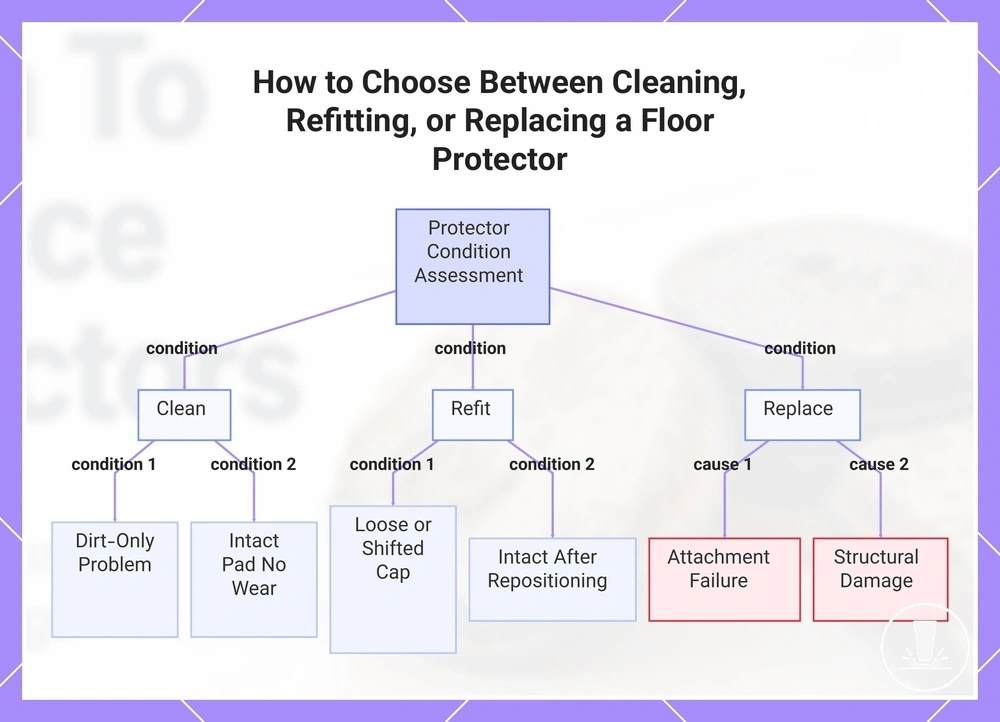
The correct replacement choice depends on the condition of the existing protector. Clean when the issue is a dirt-only problem, refit when the protector remains intact but has shifted, and replace when wear or damage affects floor contact. These maintenance actions address different conditions and should be evaluated separately.
Condition should guide the action. A dirt-only problem may respond to a clean when the contact surface remains intact. A loose cap may benefit from a refit if the cap remains stable after repositioning. Weak adhesive, a compressed pad, a damaged surface, or recurring movement issues may indicate that replacing the existing protector is a more appropriate response.
The checklist below separates common conditions into clean, refit, or replace decisions:
- Clean: Dirt-only problem with an intact pad or contact surface and no visible material wear.
- Refit: Loose cap or protector that has shifted but remains intact and stable after repositioning.
- Replace: Weak adhesive that may no longer maintain reliable attachment or may contribute to recurring movement issues.
- Replace: Compressed pad that no longer provides consistent cushioning or floor contact.
- Replace: Damaged surface, cracks, splits, or wear that affects contact performance.
Cleaning or refitting cannot restore worn material. A compressed pad, damaged surface, or failed attachment condition usually supports a replacement choice rather than additional maintenance action. For detailed routine care beyond this replacement-focused decision, see clean and maintain floor protectors.
This chart shows the condition-based decision process for choosing the correct maintenance action for a floor protector: clean, refit, or replace.
When cleaning is enough
Cleaning is enough when removable debris, light residue, or grit affects the contact surface while intact cushioning, stable attachment, and contact shape remain unchanged. Cleaning can improve contact conditions in these limited situations, but it cannot reverse material wear.
- Clean: Removable debris or grit is present, but the contact surface, intact cushioning, and stable attachment remain in good condition.
- Clean: Light residue affects the contact surface, while the protector keeps its original contact shape and cushioning.
- Check for replacement: Thin pad wear, compression, a changed contact shape, or attachment problems remain after debris removal.
Cleaning stops helping when wear affects the material itself rather than the surface condition. For example, cleaning can remove grit from a contact surface, but it cannot reverse compression in a thin pad or repair a cracked cap. When intact cushioning, stable attachment, or contact shape can no longer be maintained, replacement may be the more appropriate response.
When refitting no longer solves the problem
When repeated slipping continues after refitting, a failed fit or worn attachment condition may be the cause. Refitting stops being a useful maintenance response when a loose protector repeatedly shifts, detaches, or requires frequent repositioning.
Refitting can help when a protector has simply moved out of position, but repeated slipping may indicate a different condition. Stretched caps, weak adhesive, or a wrong size may contribute to recurring detachment during normal use. A worn glide base or leg-tip instability may also affect floor contact, making reattach or reposition attempts less effective.
Use the checklist below to separate loose placement from failed fit:
- Repeated slipping returns soon after refitting or repositioning.
- Stretched caps no longer maintain a stable hold on the furniture leg.
- Weak adhesive allows recurring movement or detachment.
- Wrong size may prevent the protector from remaining secure during use.
- Worn glide base or leg-tip instability affects consistent floor contact.
If detachment continues despite repeated refitting, see protectors falling off for deeper troubleshooting focused on persistent detachment.
Matching the replacement to the existing protector type
Matching replacement depends on the failed protector’s attachment method, contact surface, furniture leg, and floor-safety needs. A same-type replacement is often enough when the original protector format worked well and only normal wear caused the replacement need. A different protector format may be worth considering when the original design repeatedly struggled with fit, attachment, or floor contact conditions.
When replacing worn protectors, replacement felt pads, chair leg caps, and furniture glides should be matched to the function they previously performed. Felt pads typically depend on contact surface coverage and adhesive backing, while chair leg caps depend more on leg shape and fit. Furniture glides are often selected according to contact surface behavior and floor risk rather than appearance alone.
Matching the replacement to the existing protector type becomes easier when the failed protector format is identified first. The comparison graphic below compares common protector formats and the attachment or contact cues used for matching.
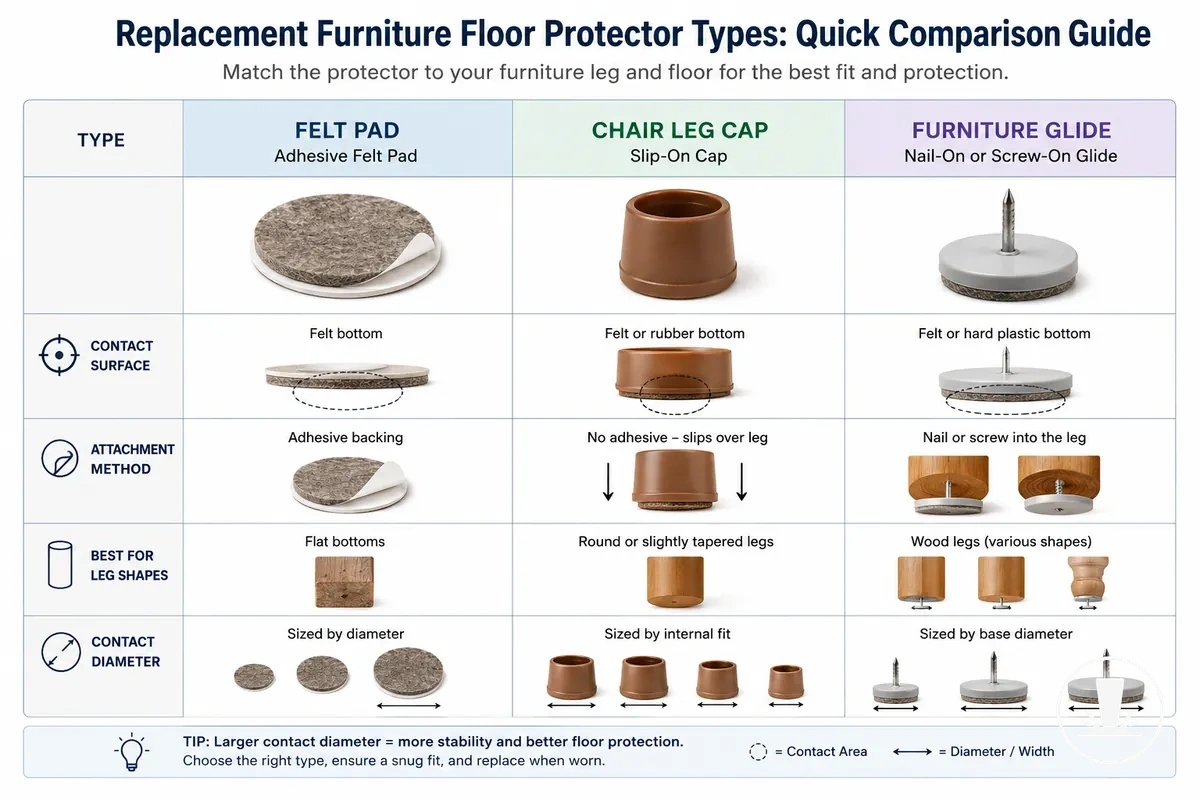
When evaluating a replacement type, compare the required attribute with the condition that caused the replacement need. The table below follows a protector type to attribute to replacement decision approach.
| Protector type | Attribute to match | Condition to check | Replacement decision |
|---|---|---|---|
| Replacement felt pads | Adhesive backing and contact surface | Wear, compression, or adhesive condition | Same-type replacement may be suitable when attachment and function remain appropriate |
| Chair leg caps | Leg shape and fit | Fit stability and cap condition | Match the cap format to the furniture leg when fit remains the primary requirement |
| Furniture glides | Contact surface behavior | Movement pattern and floor risk | Choose a glide format that aligns with floor-safety needs and floor contact conditions |
| Adhesive-backed protectors | Attachment method and contact diameter | Attachment reliability and contact area | A different protector format may be a safer option when attachment problems recur |
Replacement decisions are usually stronger when the failed function is identified before selecting a new protector. A same-type replacement may be appropriate when the original protector only reached the end of its service life, while a different protector format may be a safer option when floor-safety needs, leg shape, attachment reliability, or contact diameter requirements have changed.
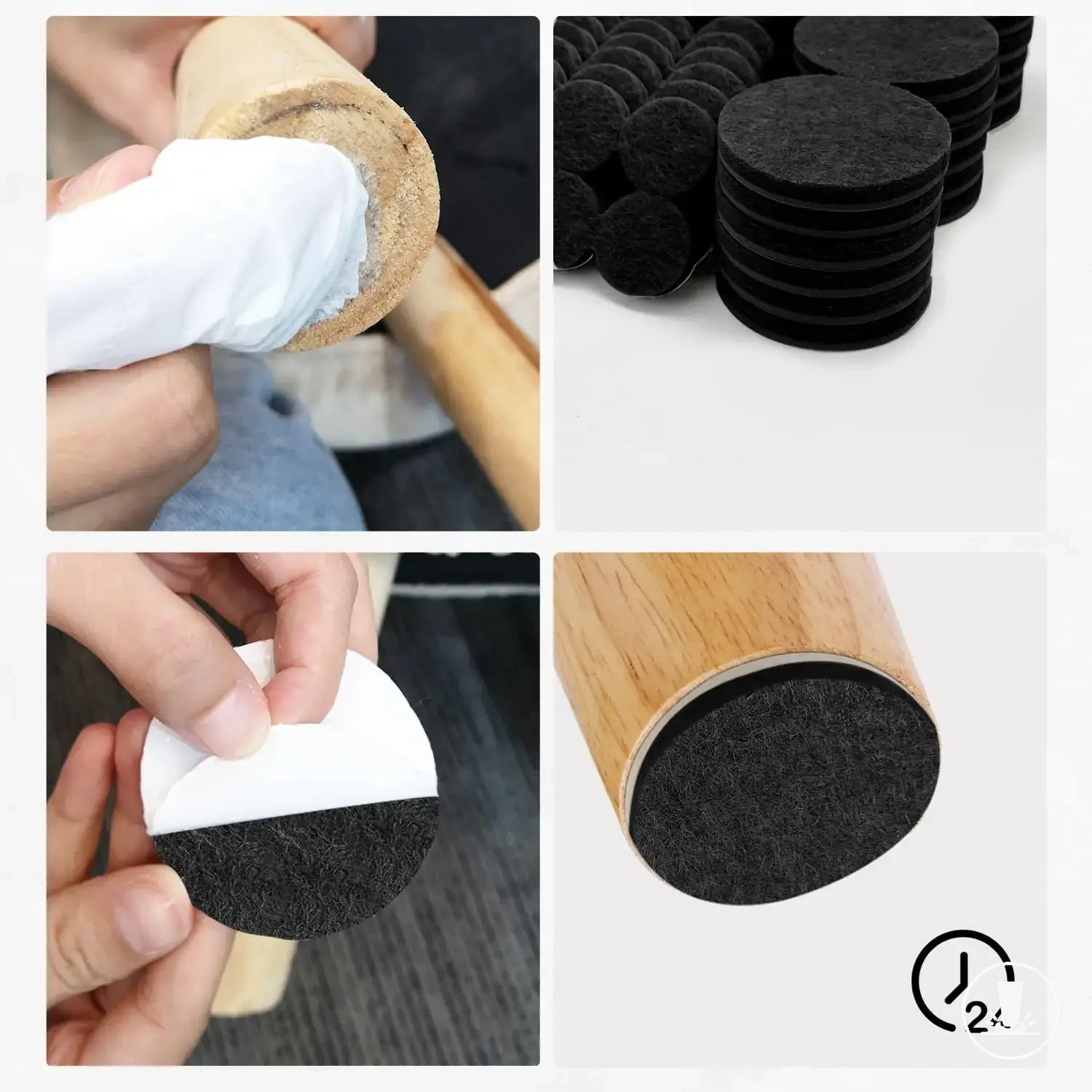
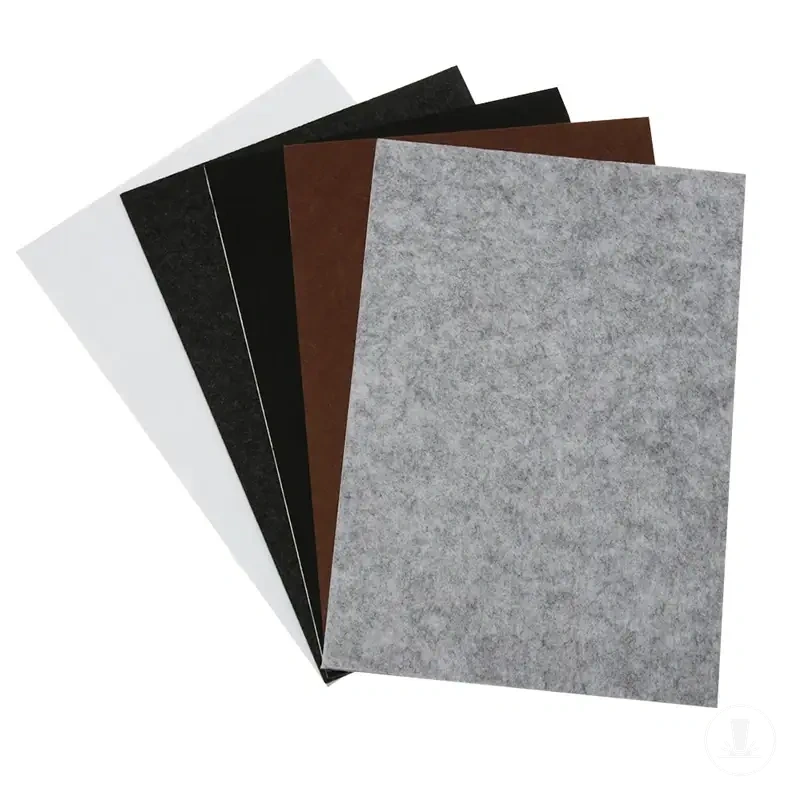
The products below are useful examples for comparing available options. Before buying, check that the compatibility criteria, key features, and product details match your needs.
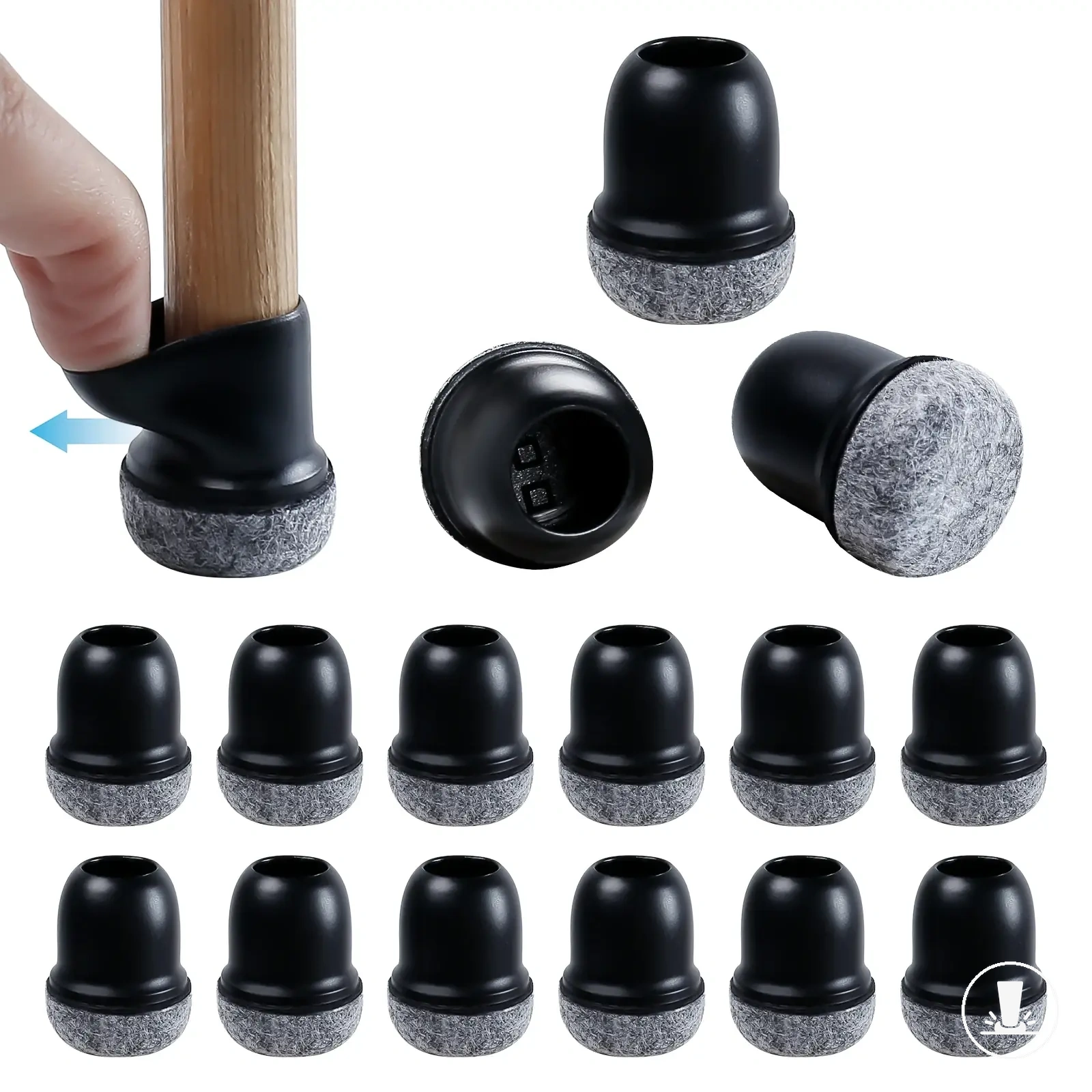
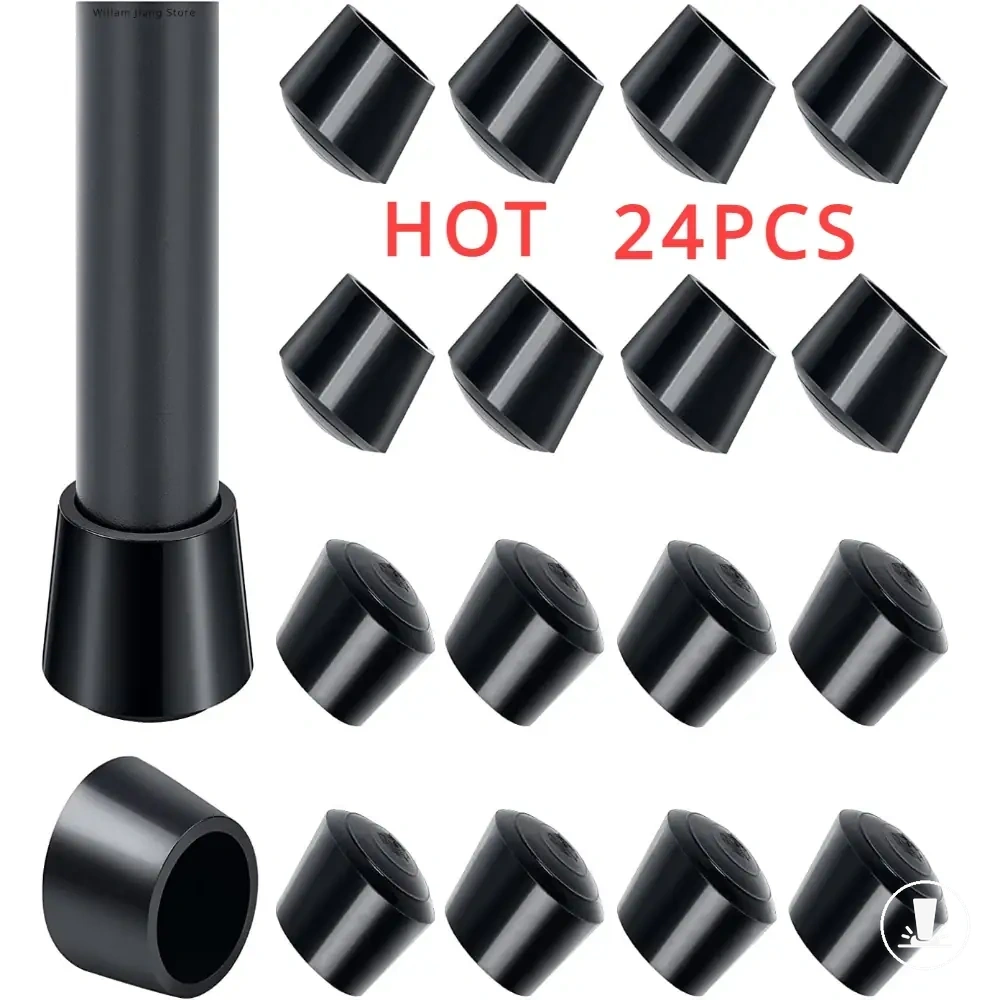
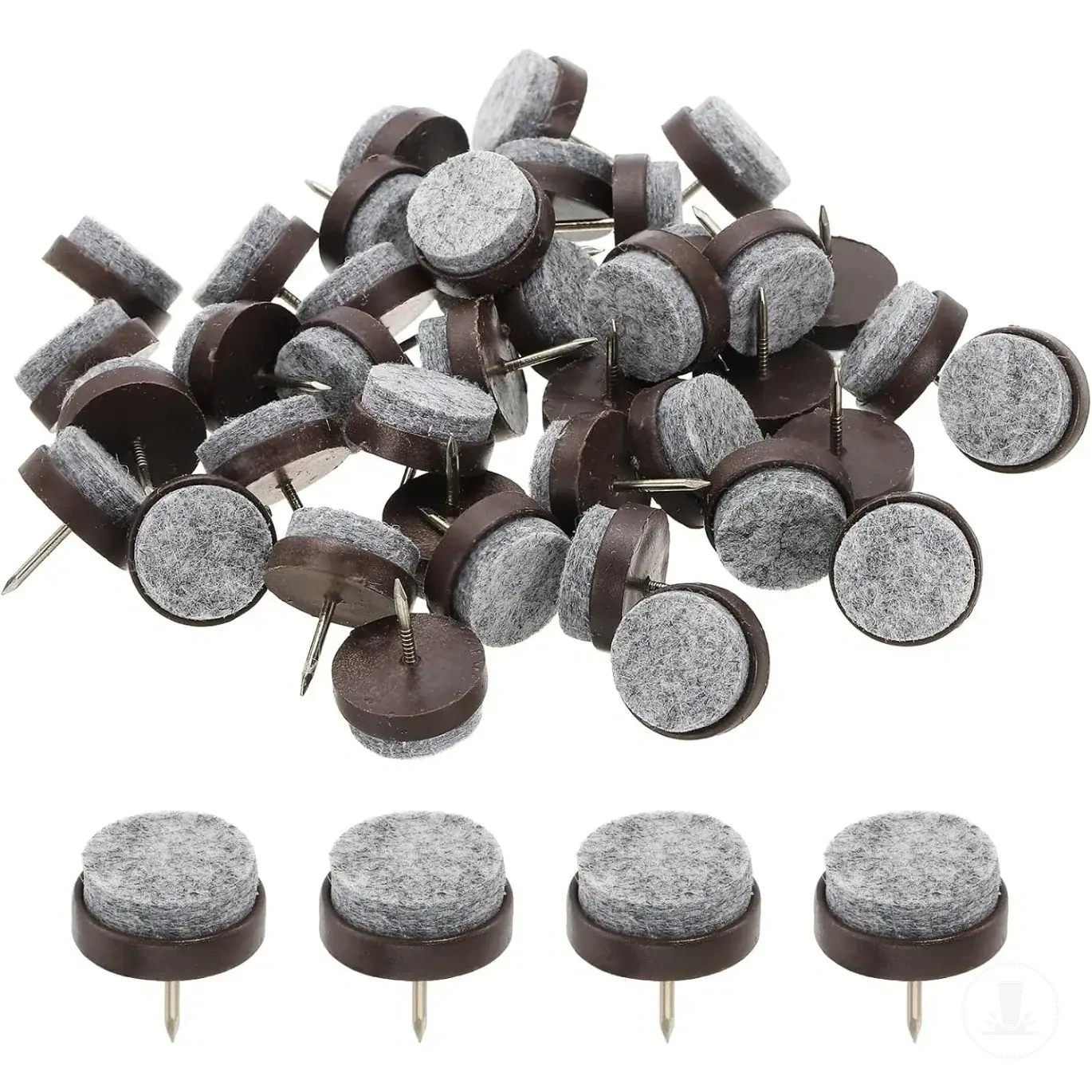
Replacement felt pads
Replacement felt pads depend on matching the worn pad’s contact surface requirements rather than changing protector format by default. Replacement felt pads should be checked against felt thickness, adhesive condition, pad diameter, furniture movement, and the condition of the existing contact surface.
Use the criteria below when assessing felt pad replacement:
- Felt thickness: Check whether compression has reduced cushioning or changed floor contact during furniture movement. A thicker replacement may be appropriate when compression contributed to the replacement need.
- Adhesive condition: Check whether old glue, attachment wear, or adhesive failure affected the contact surface. Adhesive felt pads may be suitable when the original attachment method remains appropriate.
- Pad diameter: Match pad diameter to the furniture leg contact area so the contact surface remains properly supported.
- Dirt retention: Worn felt that retains grit or debris may increase abrasion risk, especially during frequent furniture movement. In these cases, replacing worn felt may be more appropriate than continuing to use the existing contact surface.
For example, a felt pad with visible compression and dirt retention may justify felt pad replacement when cleaning no longer restores a cleaner contact surface. The replacement decision should depend on adhesive condition, felt thickness, pad diameter, compression, and furniture movement rather than on felt age alone.
Replacement chair leg caps and glides
Replacement chair leg caps and furniture glides depend on different selection criteria because caps are matched primarily by cap fit and leg shape, while glides are matched by floor contact behavior. Replacement chair leg caps focus on attachment stability, whereas furniture glides focus more on glide base wear, floor contact material, and the condition of the contact point.
The comparison below separates caps from glides by fit and contact behavior.
| Chair leg caps | Furniture glides |
|---|---|
| Cap fit should align with leg shape and stable positioning. | Glide base wear should be checked when floor contact behavior changes. |
| Attachment stability may influence whether replacement is appropriate. | Floor contact material may influence replacement decisions during regular movement. |
| Exposed hard parts may indicate that replacement is needed. | Exposed hard parts or worn bases may increase floor-contact concerns. |
When glide base wear or exposed hard parts affect floor contact, replacement may be appropriate. When repeated cap loss continues after replacement, the condition may indicate a cap fit problem related to leg shape or attachment stability rather than a replacement issue alone.
Replacement timing for high-use furniture
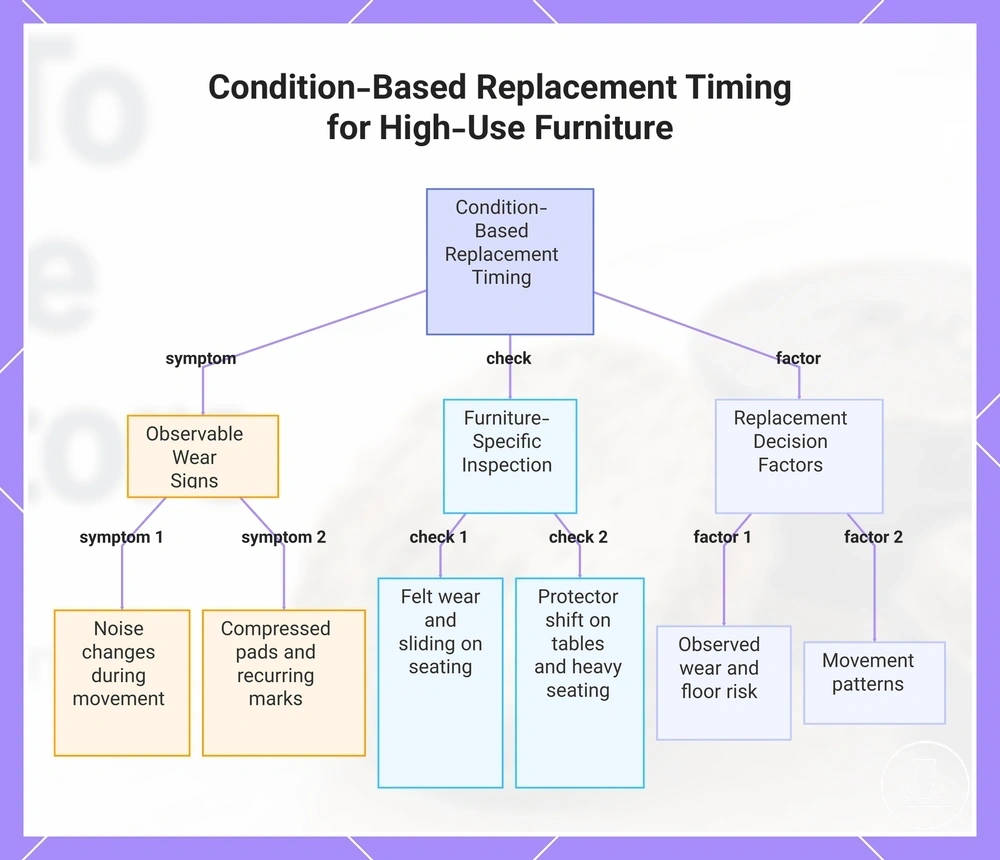
High-use furniture often benefits from condition-based inspection because frequent movement can accelerate wear signals before obvious damage appears. Dining chairs, office chairs, frequently moved tables, and heavy seating may experience repeated sliding that changes floor-contact conditions over time.
Repeated movement can make wear easier to identify through observable changes rather than product age. Noise changes during movement, compressed pads, and recurring marks may indicate that protectors are experiencing increased wear. Inspection is usually most useful when it focuses on wear patterns created by frequent movement and repeated sliding.
Replacement timing for high-use furniture should follow observed wear and floor risk. Daily-use furniture may require closer monitoring when condition changes appear, while protectors that continue to provide stable floor contact may not require replacement based on age alone.
The checklist below can help guide condition-based inspection.
- Inspect dining chairs for felt wear, compressed pads, or recurring marks that develop with frequent movement.
- Monitor office chairs for repeated sliding, noise changes, or visible contact-surface wear.
- Check frequently moved tables for shifting protectors, attachment changes, or uneven floor contact.
- Inspect heavy seating for pressure-related compression that may affect cushioning or contact stability.
- Look for recurring marks from the same contact points, especially when they continue after routine cleaning.
- Use observed wear, floor risk, and movement patterns to decide whether replacement timing should be adjusted.
This chart shows the key wear indicators to monitor, furniture-specific inspection points, and factors for deciding replacement timing based on condition rather than age.