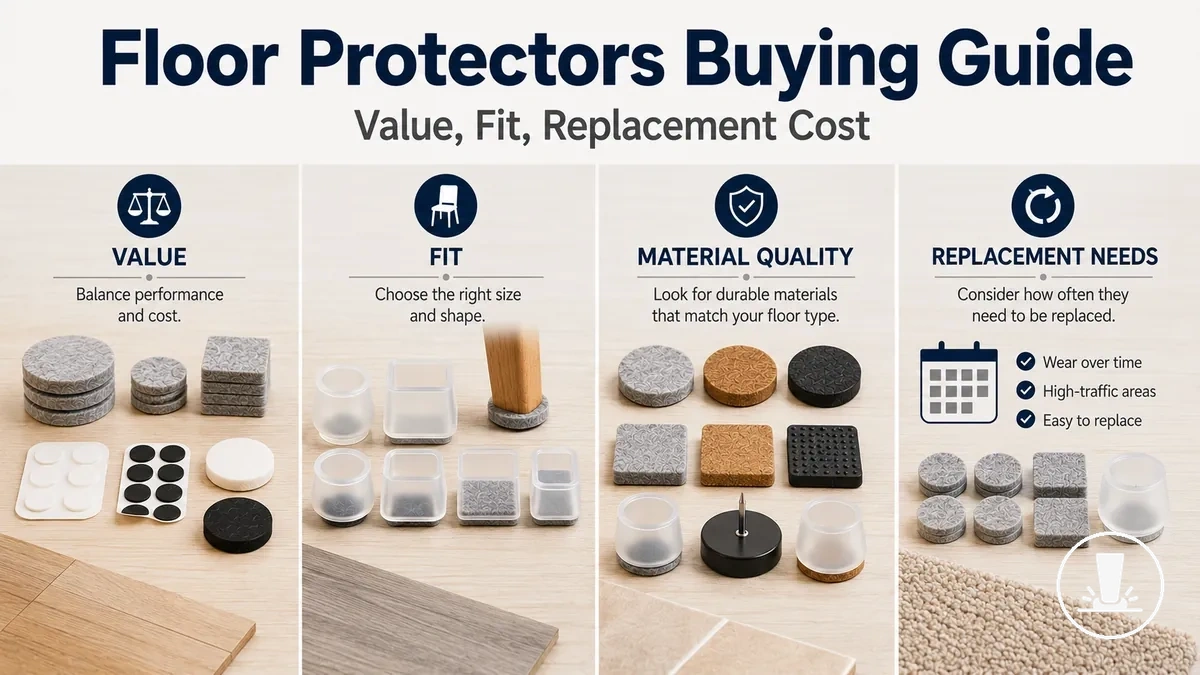
Furniture Floor Protectors Buying Guide for Cost, Fit, and Value
Furniture floor protectors are a purchase-support category where cost becomes meaningful only after fit, floor safety, and expected replacement needs are considered. A buying guide should evaluate how protector type, material, attachment method, and furniture leg compatibility affect everyday use rather than focusing on price alone. The overall value of a protector pack depends on how well it matches furniture legs and how much replacement risk may occur under real use conditions.
A good buy depends on usable protection rather than pack size alone. A protector pack with more usable pieces, appropriate coverage, and suitable material characteristics can provide better value than a larger set that leaves many pieces unused. For readers comparing furniture floor protectors, the practical decision is usually based on fit, floor-contact behavior, and replacement cost rather than total piece count.
In homes with mixed furniture legs, chair sets, or heavier furniture, value can vary because different leg shapes, floor conditions, and wear patterns place different demands on furniture pads and chair leg protectors. A floor protector set that works well for repeated leg sizes may not offer the same coverage for mixed sizes or varied contact areas. These differences make pack composition, material choice, and coverage important signals when evaluating value and preparing for deeper value comparisons.
Low cost can appear attractive, but exact price and durability expectations often require qualification because performance may depend on furniture weight, surface finish, adhesive quality, material compression, movement frequency, and overall use conditions. Instead of treating price as the primary metric, a stronger cost-value evaluation compares usable pieces, fit quality, floor safety, expected wear, and potential replacement frequency.
Furniture Floor Protectors Buying Guide for Cost, Fit, and Value
- Value: Focus on usable protection, coverage, and replacement economics rather than pack size alone.
- Price: Lower cost does not always mean lower long-term replacement cost.
- Fit: Furniture legs, contact area, and protector type should align to reduce wasted pieces.
- Floor Safety: Material choice and floor condition can influence suitability and wear outcomes.
- Durability: Performance may vary based on furniture weight, movement, adhesive quality, and use conditions.
Value Signals in Furniture Floor Protector Packs
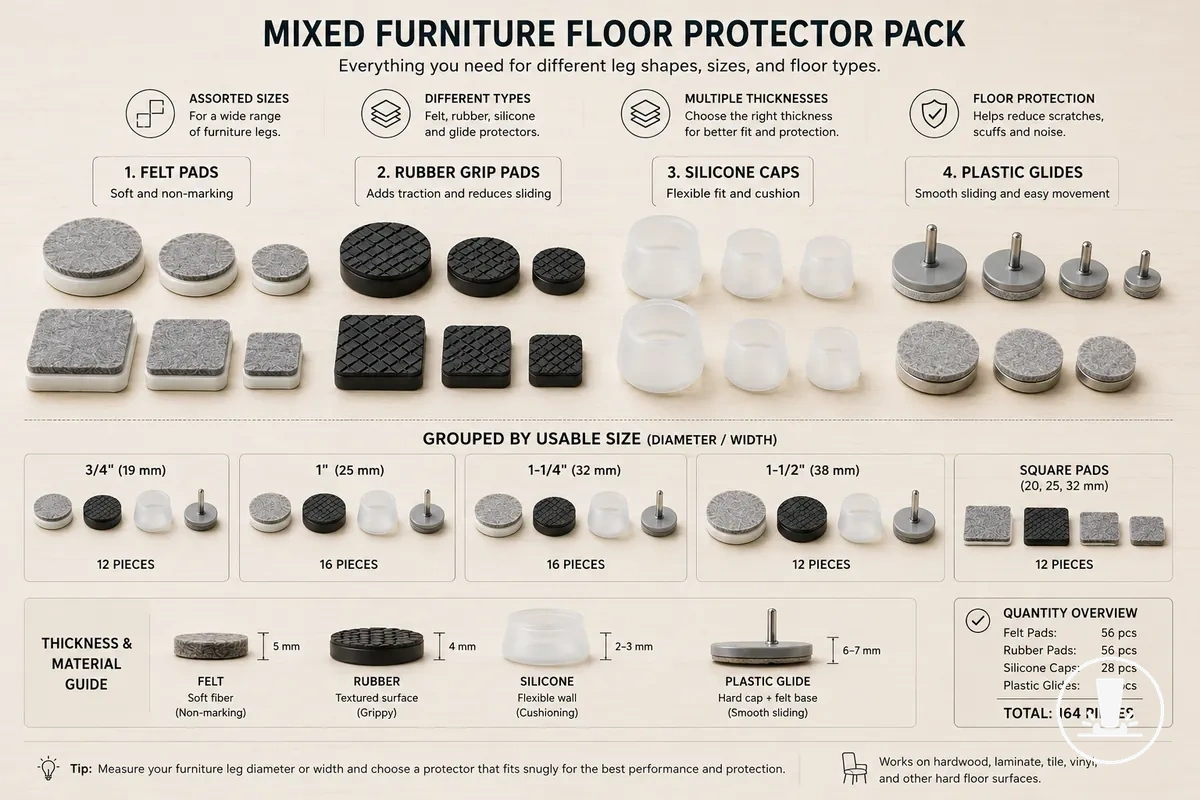
Value signals in furniture floor protector packs depend on how pack quantity, usable sizes, material density, adhesive quality, and replacement frequency work together in real use. A protector pack can provide stronger value when a higher share of the included pieces can be used on existing furniture legs, making usable pieces, coverage, fit, and durability more important than quantity alone. The most useful value signals appear before price enters the decision.
| Pack signal | What to check | Value effect | Risk if ignored |
|---|---|---|---|
| Pack quantity | Number of pieces relative to furniture needs | Can improve coverage when most pieces are usable | Unused pieces may reduce practical value |
| Usable sizes | Match between included sizes and furniture legs | Can increase usable pieces and reduce waste | Coverage gaps for common furniture sizes |
| Duplicate sizes | Quantity of repeated dimensions | May help when many furniture legs share one size | Extra pieces may remain unused |
| Material density | Resistance to compression during normal use | May support floor-contact durability | Earlier wear and more frequent replacement |
| Adhesive quality | Attachment consistency under normal use | Can influence replacement frequency | Higher maintenance and replacement cost |
In homes with mixed furniture legs, an assortment pack with broader usable sizes may provide better coverage because more furniture pieces can be fitted without leaving significant gaps. In contrast, a repeated chair-leg size across a dining set or office seating may benefit more from duplicate sizes in a furniture pads set. The same pack quantity can therefore create different value outcomes depending on whether flexibility or repeated fit is the primary need.
A common mistake is assuming that more pieces automatically create better value. When replacement frequency increases because of lower adhesive quality, reduced material density, or weaker floor-contact durability, the apparent savings may become less meaningful over time. A buyer-safe value rule is to compare usable pieces, fit, coverage, durability, and replacement economics before using pack quantity as the deciding factor.
Pack Quantity, Usable Sizes, and Coverage
Pack quantity is insufficient on its own because coverage depends on whether the included protector sizes match the furniture legs being protected. Usable sizes determine how many included pieces can actually be applied, while leg count, spare pieces, and size variation influence whether coverage is complete or whether waste occurs. For this reason, coverage is the practical metric.
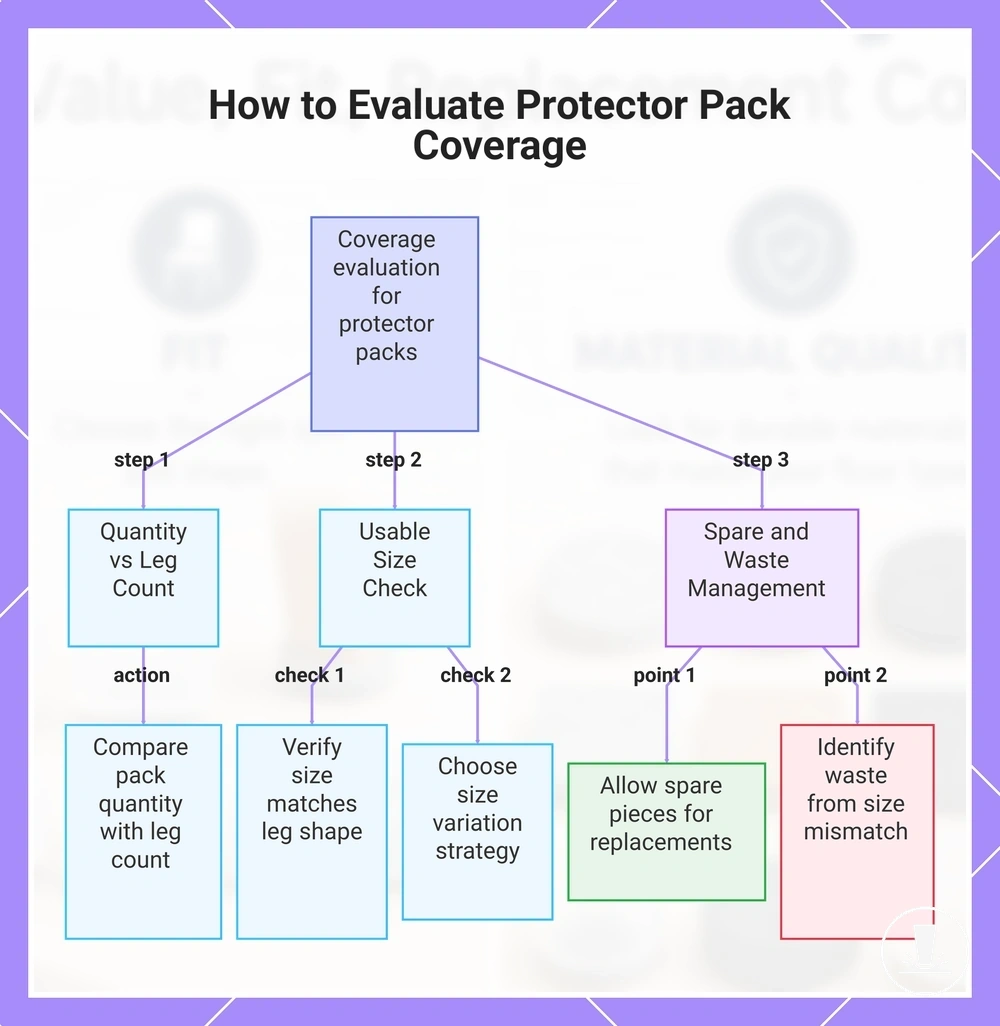
- Compare pack quantity with the actual leg count.
- Check whether usable sizes match furniture legs and leg shape.
- Review included protector sizes for mixed sizes or repeated sizes.
- Allow for spare pieces when future replacements may be needed.
- Identify pieces that may create waste because of size variation.
For a chair set with the same leg shape and size, duplicate protector sizes may provide broader coverage with fewer unused pieces. In rooms that combine chairs, tables, and mixed furniture legs, mixed sizes may improve usable coverage because more included pieces can match the available furniture. Before choosing by piece count alone, verify that protector size, leg count, and size variation align closely enough to reduce waste.
This chart shows how to evaluate a furniture leg protector pack by comparing quantity to leg count, checking size matches, and managing spare pieces and waste.
Thickness, Adhesive Strength, and Material Durability
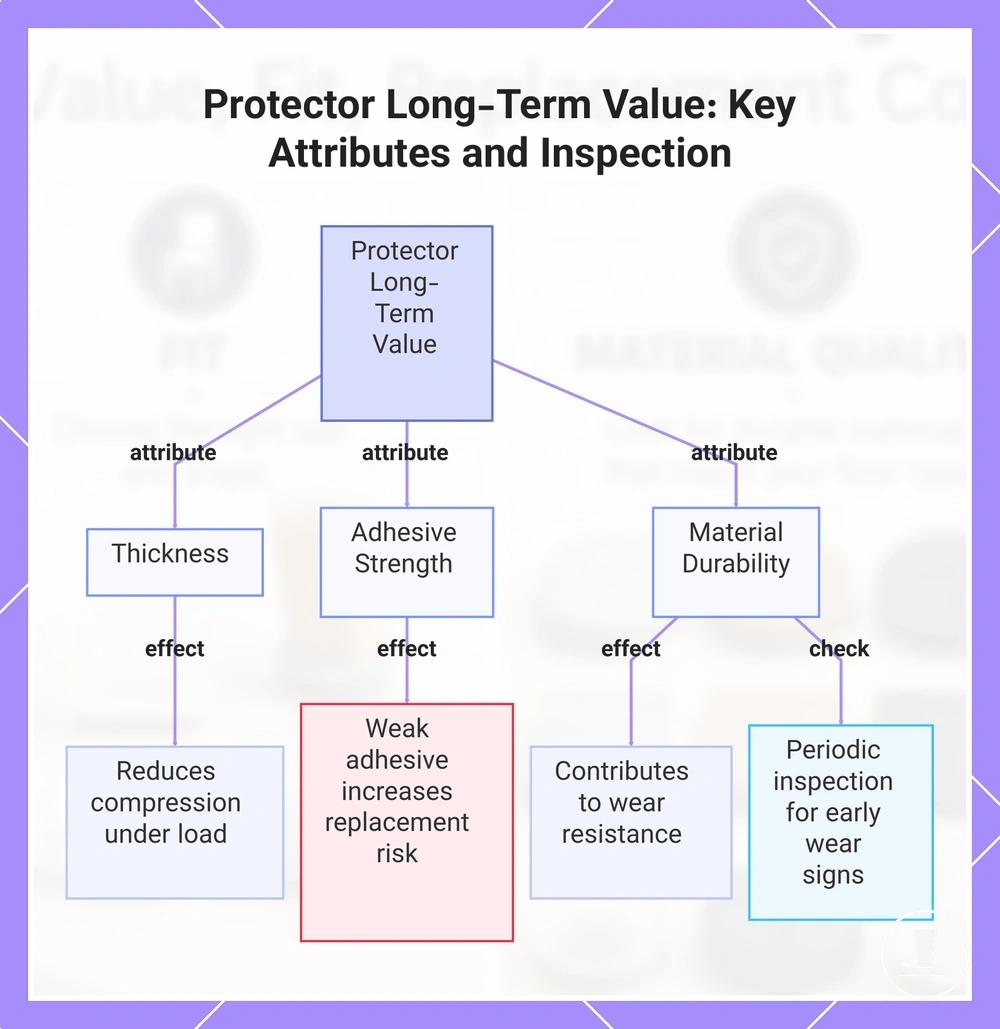
Thickness, adhesive strength, and material durability affect long-term value because these attributes influence how a protector material responds to furniture weight, sliding, and surface contact over time. Greater thickness may help reduce compression under load, while weak adhesive strength can increase replacement risk when dust, floor texture, or movement reduce adhesive hold. Material durability contributes to wear resistance, but actual performance depends on use conditions.
When protectors show early wear, peeling, or flattening, the cause is often related to the interaction between material durability, adhesive strength, furniture weight, sliding frequency, dust accumulation, or floor texture. Rather than relying on durability expectations alone, inspect protector surfaces and edges periodically for compression, peeling, or visible wear that may indicate increasing replacement risk.
This chart shows how thickness, adhesive strength, and material durability affect a protector's long-term value, and the recommended periodic inspection to detect replacement risk.
Fit Checks Before Buying a Protector Set
Fit checks determine whether a protector set is likely to provide usable coverage or create unnecessary waste. A protector set should be evaluated before purchase by matching the furniture leg, floor surface, and expected load conditions to a compatible protector type. The main compatibility variables are shape, diameter, contact area, floor surface, and furniture weight.
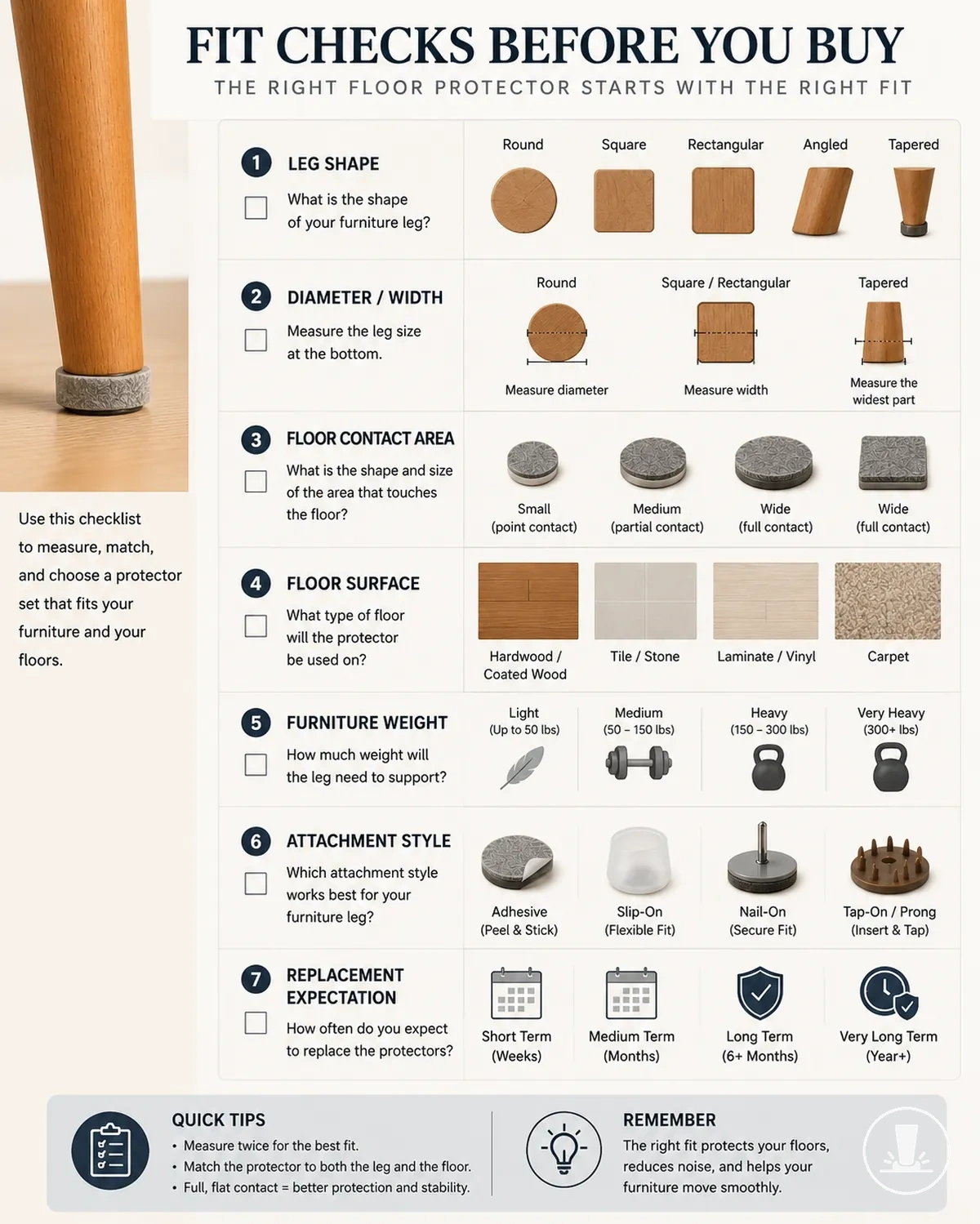
- Verify furniture leg shape and whether the compatible protector type suits that shape.
- Check leg diameter against the available protector dimensions.
- Review the contact area between the furniture leg and the floor.
- Match the protector type to the floor surface and floor compatibility needs.
- Consider furniture weight and expected movement patterns.
- Confirm the attachment style is suitable for the intended furniture leg.
- Allow for replacement expectations and spare pieces when practical.
For furniture legs with unusual shape characteristics or limited contact area, leg fit may become the primary purchase-readiness concern. A compatible protector type that appears suitable by diameter alone may still provide limited coverage if the furniture leg shape or contact area differs from the intended design. Reviewing shape, diameter, contact area, and protector fit together can reduce the risk of a wasted pack.
When floor surface and furniture weight are not considered, protector fit conditions may not align with expectations. A compatible protector type often depends on how the furniture interacts with the floor surface and how much weight is applied during normal use. Checking floor compatibility and weight-related conditions before purchase can help reduce mismatch risk.
A common misconception is that a protector set only needs the correct size to work well. In practice, buying-fit judgment also depends on floor surface, furniture weight, attachment style, and contact area. This section supports purchase readiness rather than serving as a full measurement instruction; for a broader selection process, see choose furniture floor protectors safely.
Furniture Leg Shape, Size, and Contact Area
Leg shape, leg size, and contact area determine whether a protector can stay centered and cover the floor-contact point effectively. Protector fit depends on how leg geometry interacts with the protector design, making contact area the main check when evaluating floor-contact coverage.
| Leg condition | Fit risk | Protector implication |
|---|---|---|
| Round legs | Coverage may vary with leg size | Protector fit depends on the contact patch |
| Square legs | Corners may affect positioning | Coverage should align with the floor-contact point |
| Angled legs | Off-center contact may occur | Protector behavior may vary by leg profile |
| Narrow tips | Smaller contact area | Coverage may be concentrated in one area |
| Wide feet or uneven contact points | Floor contact may be uneven | Protector fit depends on contact area distribution |
For round legs, square legs, angled legs, narrow tips, and wide feet, the floor-contact point may behave differently even when overall leg size appears similar. Uneven contact points can change how a protector sits against the floor, while angled legs and wide feet may alter the effective contact area. Evaluating leg shape, leg size, and contact area together can reduce fit uncertainty, but protector fit may still vary when contact conditions are uneven.
Floor Surface and Furniture Weight Conditions
Floor surface and furniture weight can change the value of the same protector set because grip, compression, marks, sliding, and noise may vary under different conditions. Compatibility depends on the interaction between floor surface, furniture weight, and protector material, making material risk, compression, marks, sliding, and noise the primary risk types.
| Condition | Protector concern | Value effect |
|---|---|---|
| Floor surface with lower grip | Sliding risk may increase | Replacement frequency may vary |
| Higher material risk conditions | Marks or floor-contact risk may change | Value depends on protector material suitability |
| Light furniture | Grip and stability may vary | Compression risk may remain lower |
| Heavy furniture | Compression and wear may increase | Replacement risk may rise over time |
| Repeated movement under weight load | Noise and sliding behavior may change | Long-term value can vary by use pattern |
When marks, sliding, noise, or compression become concerns, reviewing both floor surface and furniture weight can help identify the likely trade-off. A protector material that performs adequately under light furniture may behave differently under heavy furniture or changing surface conditions, which can affect grip, stability, and replacement risk. Because floor-contact risk depends on both surface condition and weight load, compatible fit and value outcomes should be viewed as conditional rather than certain.
Material and Type Trade-Offs That Change Cost
Material trade-offs and protector type choices depend on how upfront cost, durability, grip, floor safety, and replacement frequency balance against each other. A higher upfront cost may sometimes reduce replacement friction when the material choice aligns with furniture use conditions. The key comparison dimensions are upfront cost, durability, grip, floor safety, and replacement frequency.
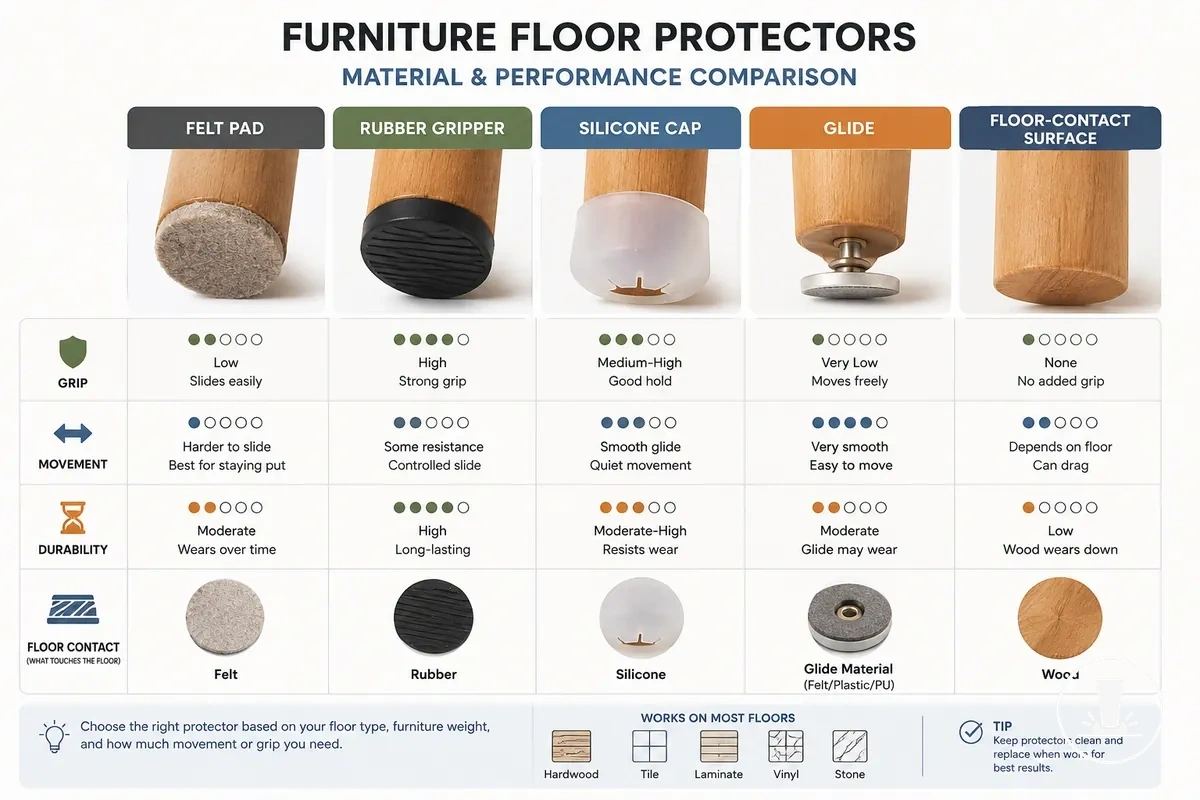
| Option | Main value factor | Trade-off | Better fit when |
|---|---|---|---|
| Felt pads | May support smoother movement | Replacement frequency can vary with use | Sliding movement is expected |
| Rubber grippers | Can increase grip | Movement may become more restricted | Stability is a higher priority |
| Silicone caps | May support fit and reuse | Fit outcomes can vary by furniture legs | Reusable coverage is preferred |
| Glides | Can support repeated movement | Hard contact characteristics may vary | Frequent repositioning occurs |
| Adhesive formats | Simple attachment approach | Attachment durability may vary | Surface-mounted protection is suitable |
| Slip-on formats | May reduce replacement friction | Fit depends on furniture leg shape | Leg compatibility is appropriate |
| Cut-to-size options | Flexible coverage potential | Preparation effort may increase | Standard sizes are less suitable |
When furniture experiences frequent movement, grip and floor-contact behavior often become more important than upfront cost alone. Felt pads may support easier sliding, while rubber grippers may emphasize grip. Silicone caps and glides can create different movement and contact characteristics, so the trade-off comparison depends on the intended use conditions.
A common misconception is that one material choice provides the strongest value in every condition. In practice, no single protector type consistently balances durability, grip, floor safety, and replacement frequency across all situations. Material trade-offs should be evaluated according to movement patterns, contact behavior, and furniture-leg requirements.
When replacement becomes frequent or maintenance effort increases, the lowest upfront cost may not always reduce long-term friction. A protector type with greater durability or reusable characteristics may lower replacement frequency in certain conditions, although outcomes depend on furniture use, floor-contact conditions, and fit requirements. The most suitable trade-off usually depends on how durability, grip, and replacement patterns align with expected use.
Felt Pads, Rubber Grippers, Silicone Caps, and Glides
Felt pads, rubber grippers, silicone caps, and glides differ in contact behavior, grip, movement characteristics, and replacement needs. Each material choice creates a different balance between floor contact, movement control, and maintenance, so the best-fit condition depends on furniture use and expected replacement needs.
- Felt pads: Felt pads may support smoother movement and sliding, but replacement needs can increase as wear changes contact behavior. Best-fit condition: furniture that is repositioned regularly.
- Rubber grippers: Rubber grippers can increase grip and reduce movement, although floor-contact behavior and the risk of marks may vary by conditions. Best-fit condition: furniture where stability is a higher priority.
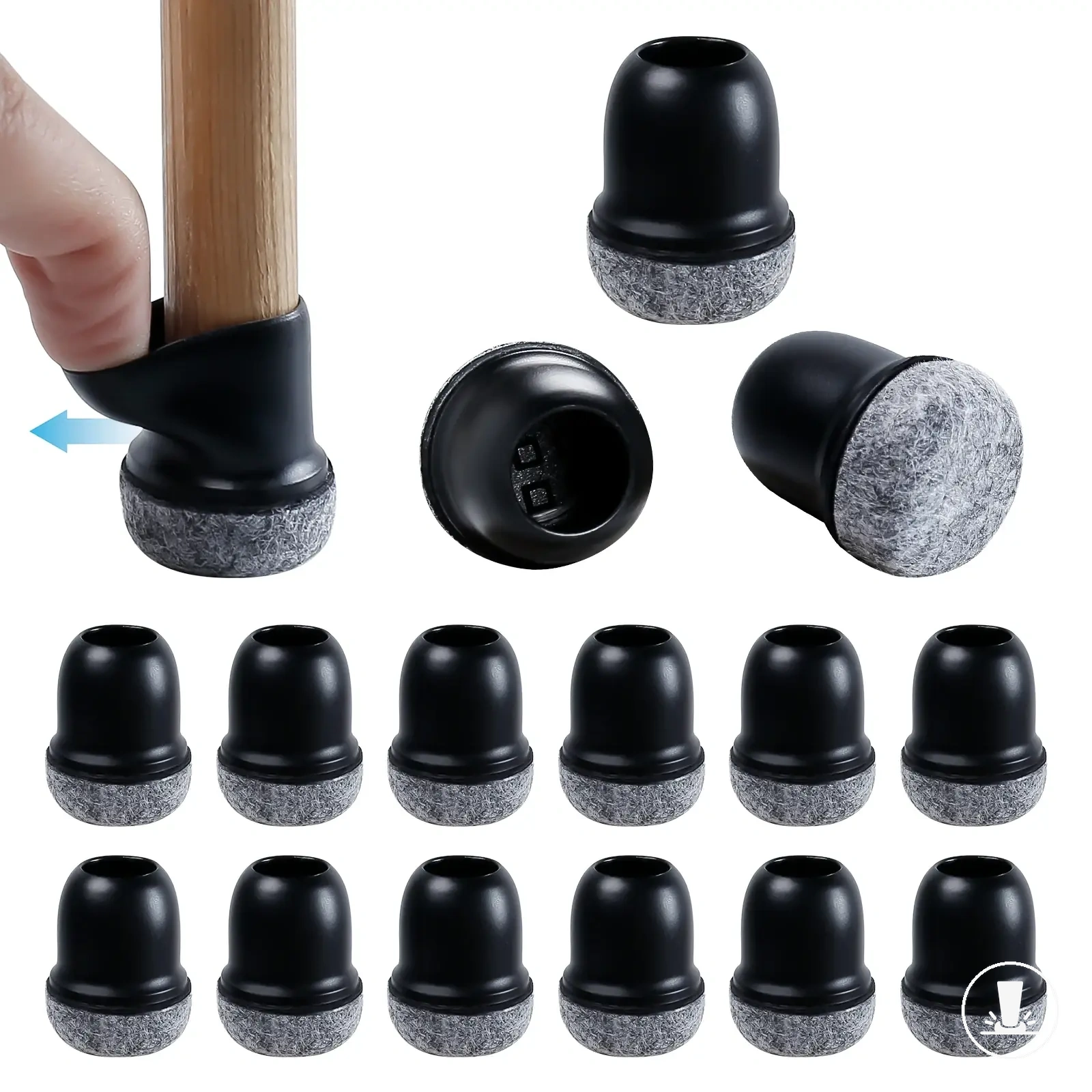
- Silicone caps: Silicone caps may combine fit and reuse potential for chair legs, but fit outcomes depend on furniture-leg dimensions. Best-fit condition: furniture requiring removable protection.
- Glides: Glides can support repeated movement and may offer durability advantages in certain conditions, although hard contact behavior can vary. Best-fit condition: furniture that is moved frequently.
When frequent movement is the main concern, felt pads and glides may create different sliding characteristics than rubber grippers or silicone caps. For example, a chair that is repositioned often may benefit from a protector type designed around movement rather than higher grip. These differences change the value implication according to contact behavior, replacement needs, and the intended use condition rather than creating a universal ranking.
Adhesive, Slip-On, Nail-On, and Cut-to-Size Options
Adhesive, slip-on, nail-on, and cut-to-size options differ in attachment format, staying power, reuse potential, and convenience. Each attachment format changes replacement value in a different way because failure risk, fit conditions, and long-term usability can vary. The main comparison lens is how attachment style influences staying power, reuse potential, convenience, and replacement value.
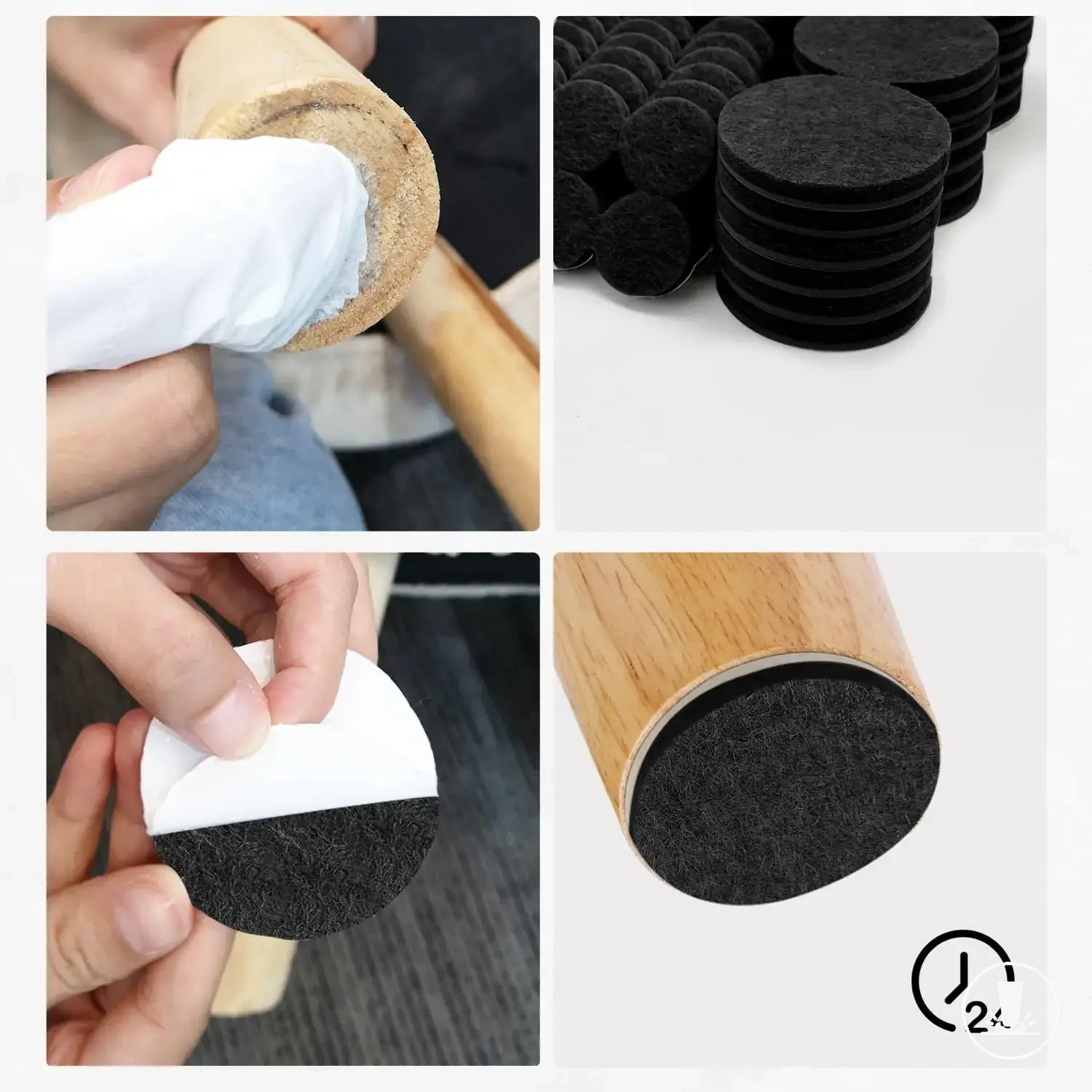
- Adhesive: Adhesive and self-adhesive pads may offer convenience, but failure risk can increase when dust, surface conditions, or peeling affect attachment. Buying decision: replacement value may depend on how consistently the pad remains attached.
- Slip-on: Slip-on formats and chair leg caps may provide reuse potential and convenience, although performance depends on leg fit. Buying decision: value often depends on maintaining suitable fit conditions.
- Nail-on: Nail-on formats and tap-on glides may offer stronger staying power in certain conditions, but permanence requires caution when future changes are expected. Buying decision: convenience may be lower when flexibility is important.
- Cut-to-size: Cut-to-size and trim-to-fit pads can improve coverage flexibility and reduce waste from size mismatch, although fit outcomes depend on sizing accuracy. Buying decision: value may improve when standard sizes leave unused coverage.
When repeated replacement or poor fit becomes a concern, choosing an attachment format that matches furniture conditions can improve usability. Adhesive formats may face peeling-related failure risk, slip-on formats depend on leg fit, nail-on formats involve a greater permanence consideration, and cut-to-size formats rely on appropriate coverage planning. Higher staying power does not automatically create higher value because permanence, fit, reuse potential, and convenience should all be weighed before selecting a format.
Furniture Floor Protector Prices and Pack Economics
Furniture floor protector prices are only meaningful after usable pieces and replacement interval are considered because pack economics depends on how much protection a pack actually provides. Pack price alone does not determine value; usable pieces, spare pieces, furniture count, replacement interval, and cost per protected contact point are the variables that reveal practical cost.
| Variable | What to count | Why it changes value |
|---|---|---|
| Pack price | Total pack cost | Forms the starting cost basis |
| Usable pieces | Protectors that fit furniture legs | Affects cost per usable protector |
| Spare pieces | Extra protectors remaining after installation | Can support future coverage needs |
| Furniture count | Total furniture legs or contact points | Determines coverage requirements |
| Replacement interval | Expected period before replacement | Influences long-term cost-value |
| Cost per protected contact point | Pack price divided by protected contact points | Reflects practical protection cost |
When many protectors are unusable because of size mismatch, the apparent price can create a misleading value impression. Pack economics improves when usable pieces align with furniture count and when spare pieces contribute future coverage rather than waste. Evaluating cost per protected contact point often provides a clearer measure of practical cost than relying on raw piece count.
If two packs have a similar pack price but one pack contains many unusable pieces, the lower apparent price may provide weaker pack value. For example, a larger pack may appear economical at first, yet cost per protected contact point can increase when only part of the pack fits the intended furniture. In that scenario, usable pieces become more important than total quantity.
A common myth is that more pieces automatically create better value. The practical truth is that pack economics depends on usable pieces, replacement interval, and coverage efficiency rather than apparent price alone. A safe price-checking principle is to compare pack price against usable pieces, spare pieces, furniture count, and expected replacement needs before judging value.
Low-Cost Packs, Value Packs, and Heavy-Duty Sets
Low-cost packs, value packs, and heavy-duty sets differ mainly by the buying situation they are intended to support. Set tier should be treated as a flexible category rather than a fixed price tier because typical attributes, fit condition, value risk, and value advantage can vary by pack contents. The comparison below clarifies how each set tier may fit different protection needs.
| Set tier | Useful when | Watch for |
|---|---|---|
| Low-cost packs | Single repair needs or limited coverage requirements | Value risk may increase when usable sizes provide limited coverage |
| Value packs | Whole-room coverage or multiple furniture pieces require protection | Value advantage depends on usable sizes matching furniture needs |
| Heavy-duty sets | Furniture weight, compression concerns, or durability priorities are higher | Fit condition, durability, and actual contents may affect value |
When the buying situation involves only a small number of contact points, low-cost packs may provide sufficient coverage with less unused inventory. When broader furniture count coverage is needed, value packs can offer an advantage if usable sizes align with the intended furniture. Heavy-duty sets may suit situations where furniture weight, compression, or durability concerns are more important, but value risk still depends on fit condition, usable coverage, and actual pack contents rather than the set tier alone.
Cost per Usable Protector Versus Pack Size
Cost per usable protector provides a safer value estimate than total pack price because unusable sizes do not contribute to protected furniture contact points. A simple pack calculation focuses on usable protectors rather than total quantity. Cost per usable protector = total pack price ÷ usable protectors. Excluding unusable sizes helps create a more realistic value estimate because pack size alone can mislead.
When unusable sizes create waste, the practical cost outcome may differ from what the total pack price suggests. For example, if a larger pack includes many protectors that do not fit the intended furniture, the usable-piece cost may be higher even though the pack size is larger. Comparing usable protectors against protected furniture contact points can provide a clearer pack calculation, although the result remains a practical estimate rather than a universal formula.
Replacement Cost and Durability Over Time
Replacement cost affects long-term value because replacement frequency depends on wear, material, movement, floor debris, and adhesive condition. A protector type that experiences faster wear or increasing protection loss may require earlier replacement, which can increase cost impact over time. The main durability variables are wear, material, movement, floor debris, and adhesive condition.
- Initial condition: Confirm that the protector type remains properly positioned and maintains intended floor contact.
- Wear development: Check for thinning, flattening, edge damage, or material breakdown that may contribute to protection loss.
- Floor debris accumulation: Monitor debris buildup because trapped particles may affect contact behavior and wear patterns.
- Adhesive condition changes: Review lifting, peeling, or loosening that may increase replacement frequency.
- Replacement decision: Consider replacement when wear condition, movement, or attachment issues may reduce protection effectiveness.
When wear, floor debris, repeated movement, or adhesive condition is overlooked, replacement cost may increase because worn protectors can remain in service after protection loss begins. A practical approach is to evaluate durability risk as part of buying economics by reviewing whether the protector type still provides suitable coverage, attachment, and contact behavior under normal use conditions.
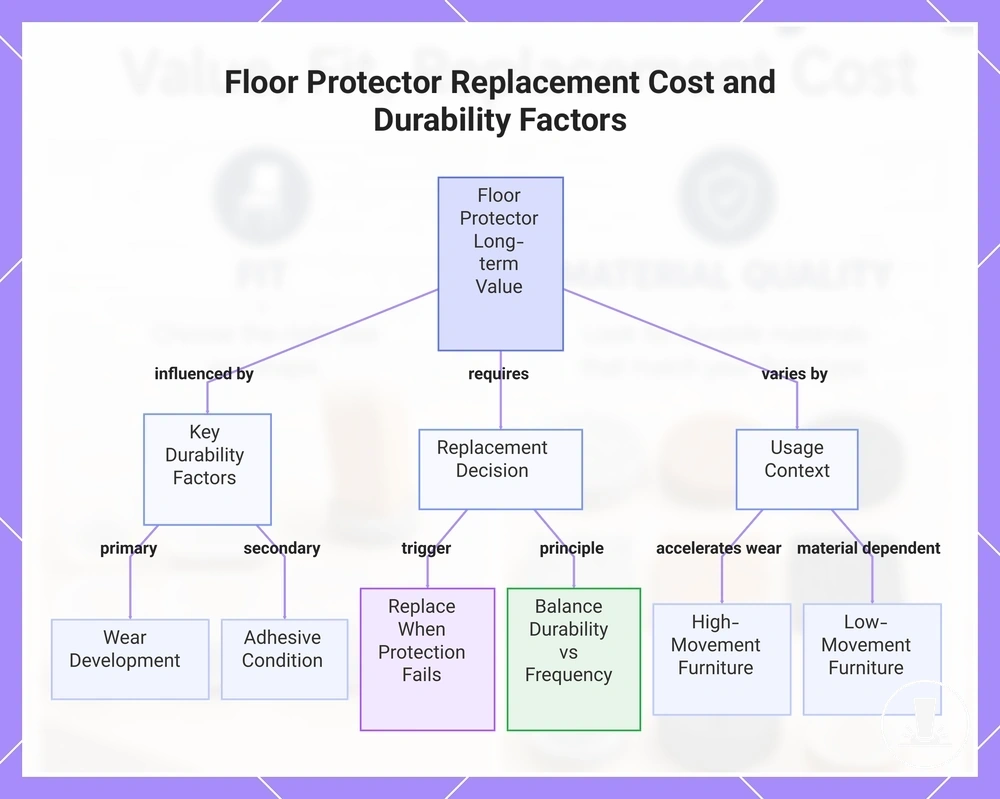
For high-movement furniture, replacement frequency may increase when repeated sliding or repositioning accelerates wear. For low-movement furniture, durability over time may depend more on material condition, compression, floor debris, and adhesive condition. These usage differences can change both replacement timing and cost impact even when the same protector type is used.
A common myth is that a more durable protector eliminates future replacement concerns. The practical truth is that long-term value depends on balancing durability over time against replacement frequency and wear conditions. When cost planning reaches the point of replacement timing, it may be useful to replace furniture floor protectors.
This chart shows the key durability factors influencing replacement cost, the replacement decision, and how usage context affects long-term value.
Wear, Peeling, Compression, and Lost Protection
Wear signals can reduce protection value before obvious floor-contact problems appear. Wear, peeling, compression, and lost protection affect replacement timing because each visible symptom may change how a protector maintains floor contact. The most useful monitoring lens is to connect the visible symptom to its likely effect and then decide whether to monitor or replace.
- Wear: Visible symptom: surface thinning or worn pads. Likely effect on floor contact: reduced protective material between furniture and floor. Decision: monitor or replace based on the degree of wear signals.
- Peeling: Visible symptom: loose adhesive or lifting edges. Likely effect on floor contact: less stable positioning. Decision: monitor minor peeling and replace when floor contact becomes inconsistent.
- Compression: Visible symptom: flattened felt or compressed material. Likely effect on floor contact: reduced cushioning and possible lost protection. Decision: monitor compression changes and replace when protection value appears reduced.
- Lost protection: Visible symptom: exposed contact or missing protective material. Likely effect on floor contact: less separation between furniture and floor. Decision: replace when exposed contact becomes the primary condition.
When wear signals, peeling, compression, or lost protection go unnoticed, replacement timing may become harder to judge and the cost impact of worn protectors may increase over time. A practical approach is to evaluate each visible symptom according to its effect on floor contact rather than assuming all worn protectors create floor damage. The final outcome should remain a symptom-based monitor-or-replace decision.
Reusable Caps Versus Disposable Felt Pads
Reusable caps versus disposable felt pads depends on replacement burden, fit tolerance, and long-term cost rather than reuse alone. Reuse changes value only when the reuse condition remains suitable and material reliability supports continued performance. The key comparison dimensions are replacement burden, fit tolerance, maintenance need, convenience, and long-term cost.
| Reusable caps | Disposable felt pads |
|---|---|
| Reuse condition depends on fit and material reliability | Replacement pads may be changed as wear increases |
| Fit tolerance can influence replacement outcome | Fit tolerance may depend more on pad coverage |
| Maintenance need may include monitoring fit and condition | Maintenance need may focus on wear and replacement burden |
| Convenience depends on continued secure fit | Convenience depends on straightforward pad replacement |
| Long-term cost varies by reuse condition and maintenance need | Long-term cost varies by replacement frequency and pad usage |
A common myth is that reusable caps are automatically cheaper than disposable felt pads. The practical truth is that reusable caps, silicone caps, felt pads, replacement pads, and reusable protectors create different outcomes depending on fit tolerance, material reliability, maintenance need, and replacement burden. When the reuse condition remains reliable, reusable caps may reduce replacement burden, but long-term cost still depends on fit, material condition, and maintenance requirements.
When a Furniture Floor Protector Pack Is Worth Buying
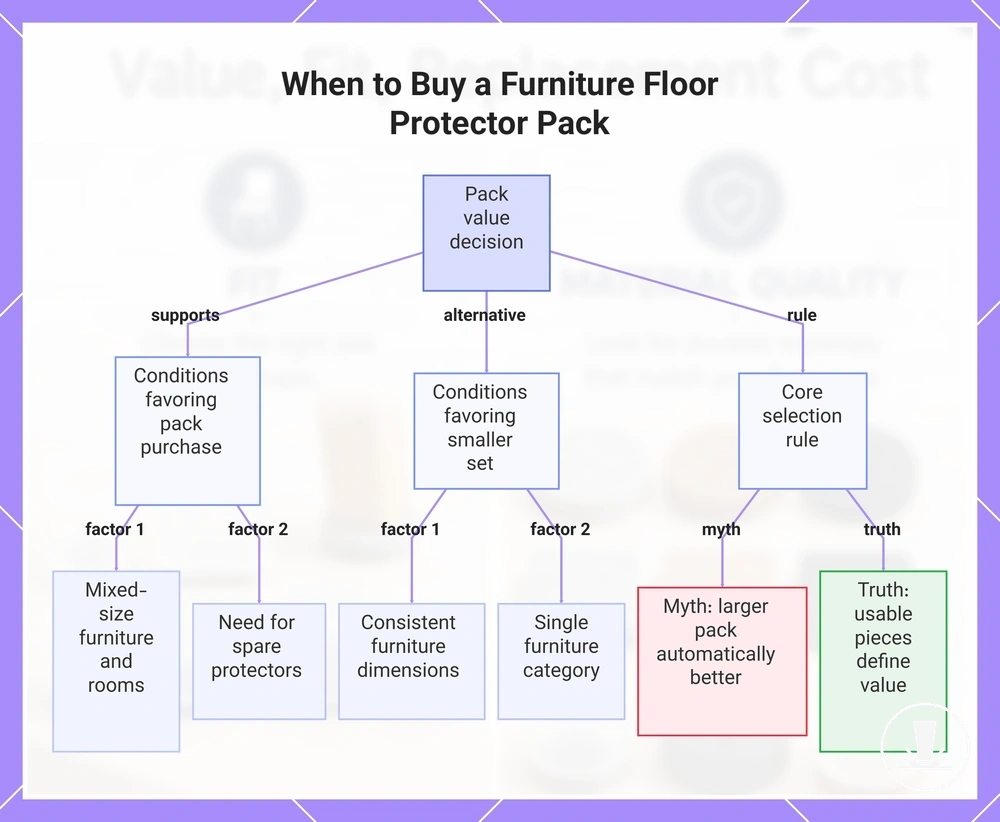
A furniture floor protector pack is worth buying when home setup, furniture variety, size distribution, floor risk, and replacement needs make broader coverage more practical than a smaller specialized set. Pack value depends on how many usable pieces match the furniture that needs protection. The core selection rule is to choose a furniture floor protector pack when expected usable coverage supports the buying decision better than a narrower alternative.
- Home setup: A protector pack may suit homes with multiple rooms or different furniture categories.
- Furniture variety: Pack value often improves when chairs, tables, and other furniture pieces require different protector sizes.
- Size distribution: A mixed-size pack may be more useful when furniture legs do not share the same dimensions.
- Floor risk: Broader coverage may help when multiple furniture pieces create floor-contact concerns.
- Replacement needs: Spare usable pieces can support future replacements when protectors wear over time.
- Buying decision: A furniture floor protector pack is often worth buying when most included pieces are expected to be usable.
For mixed-size homes, chair sets, heavy furniture, and recurring replacement needs, pack value may increase because size distribution and spare coverage become more relevant. Mixed-size homes may benefit from a wider assortment, while chair sets may increase the usefulness of having multiple matching protectors. Heavy furniture and repeated replacements can make usable spare pieces more valuable over time.
When furniture dimensions are highly consistent or only one furniture category requires protection, a smaller specialized set may provide a closer match than a larger assortment pack. In those situations, reducing unused pieces may become more important than increasing quantity. As a selection criterion, readers comparing narrow and broad coverage needs may also review best furniture floor protectors by use case.
A common myth is that a larger protector pack automatically creates better value. The practical truth is that pack value depends on usable pieces, furniture variety, size distribution, floor risk, and replacement needs rather than pack size alone. A furniture floor protector pack is worth buying when those conditions support broader usable coverage; otherwise, a smaller specialized set may be the stronger buying decision.
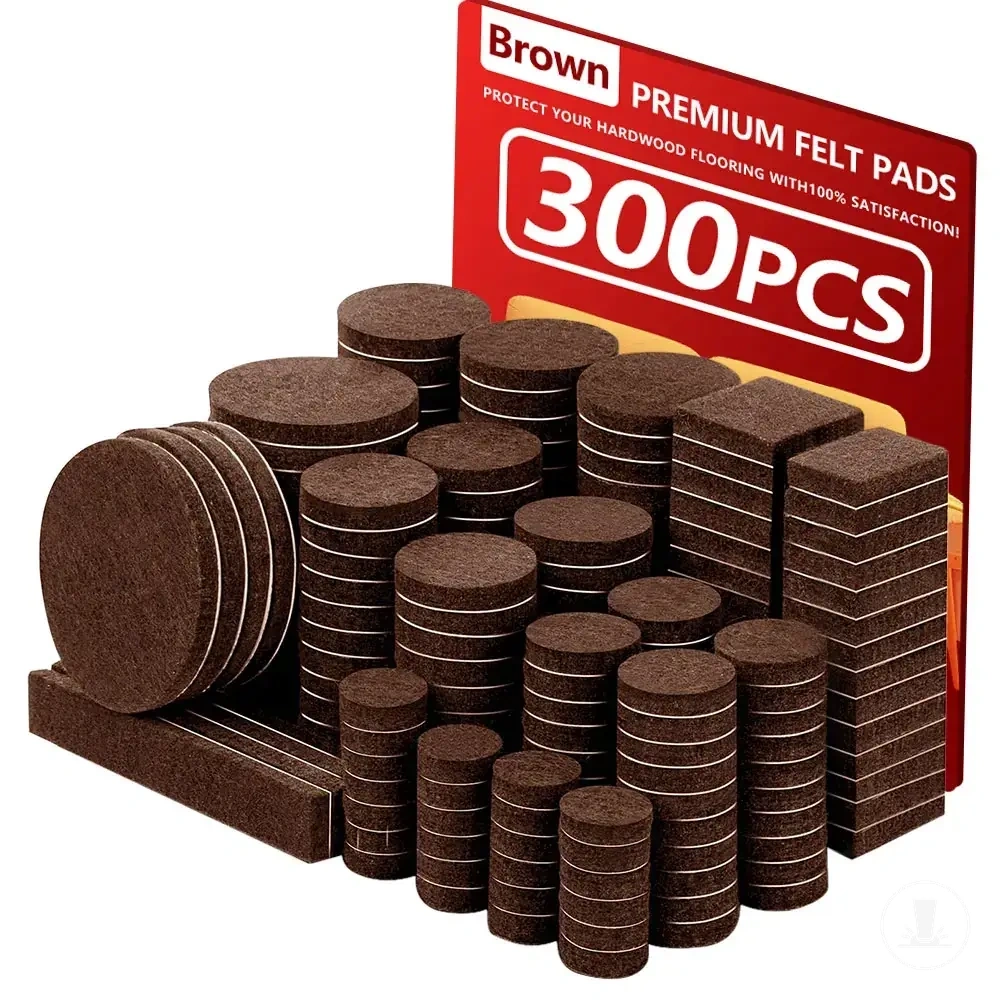
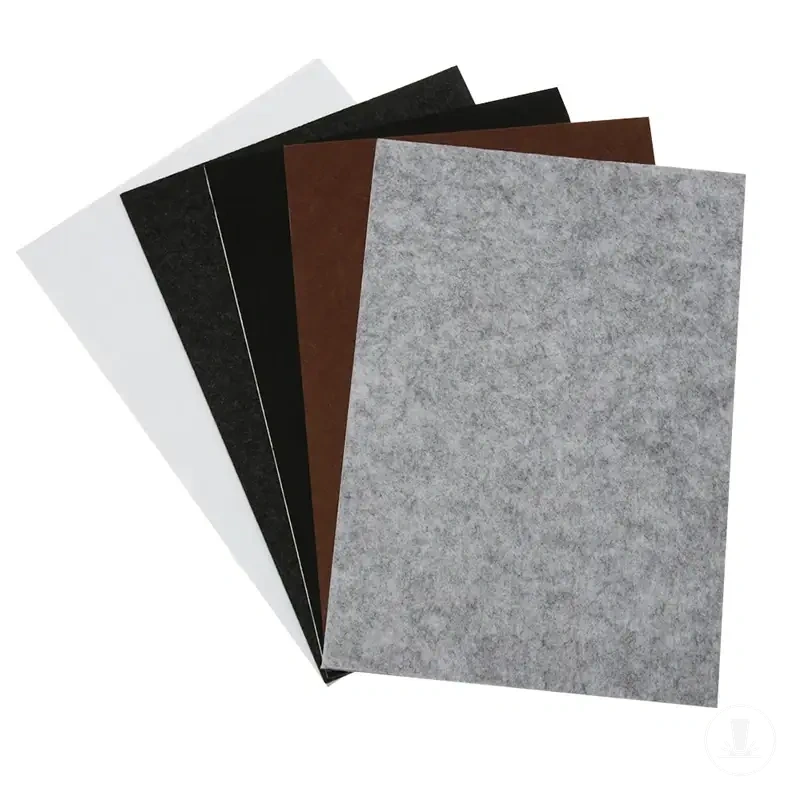
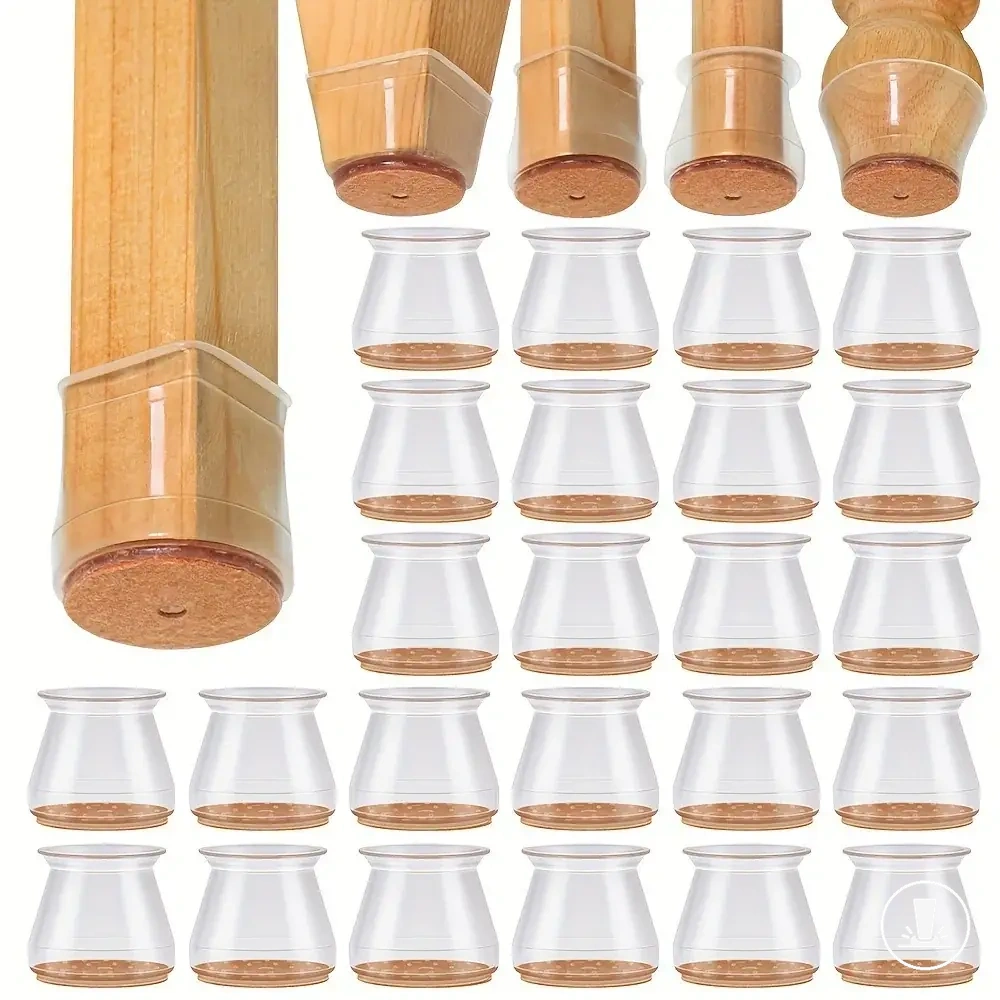
Here are product examples that may make comparison easier. Before buying, always review the compatibility criteria, essential features, and product details.
This chart shows the key conditions that determine whether a furniture floor protector pack is worth buying or a smaller specialized set is better.
Mixed-Size Homes, Chair Sets, and Heavy Furniture Needs
Mixed-size homes, chair sets, and heavy furniture needs often determine whether broad mixed-size packs provide more usable coverage than single-size sets. When furniture groups include different leg sizes, protector quantity requirements, or varying furniture weight, broad mixed-size packs may align more closely with actual coverage needs and improve usable coverage.
- Mixed-size homes: When multiple rooms contain furniture with different leg sizes, broad mixed-size packs may reduce size mismatch across furniture groups and improve usable coverage.
- Chair sets: When chair sets use repeated legs and similar dimensions, protector quantity may matter more than a wide size assortment because coverage depends on having enough matching pieces.
- Heavy furniture: When furniture weight is higher, protector type and compression considerations may influence whether broad mixed-size packs provide practical pack value.
- Multi-room furniture: When different furniture groups require different protector sizes, assorted packs may support coverage more effectively than relying on a single-size option.
- Mixed packs: When leg sizes vary across the home setup, mixed packs may reduce the need to coordinate multiple separate sets.
Broad mixed-size packs are often most useful when leg sizes, protector quantity requirements, and furniture weight vary across the home. When furniture uses similar dimensions and the same protector type throughout, single-size sets may provide a simpler alternative. The value outcome depends on how well usable coverage matches furniture variety, repeated-leg coverage requirements, and heavy furniture needs.
Cases Where a Smaller Specialized Set Gives Better Value
A smaller specialized set may provide better value when the buying decision is driven by one clear requirement rather than broad coverage needs. When furniture protection depends on an exact size, a specific material requirement, a floor risk concern, or a narrow fit requirement, a smaller specialized set can reduce unused pieces compared with mixed packs and align more closely with the clear requirement.
| Smaller specialized set | Mixed packs |
|---|---|
| Focused on a clear requirement | Designed for broader coverage situations |
| May suit an exact size need | May include multiple sizes |
| May match a material requirement more closely | May contain options that are not needed |
| Can reduce unused pieces when needs are specific | Can create more waste when requirements are narrow |
When a single use case centers on one exact size, one material requirement, or one fit requirement, a single-purpose set may create a better cost outcome than mixed packs. In these situations, mixed packs may contain unused pieces that do not contribute to the decision, while a targeted pack can align more closely with the intended use. The advantage depends on how well the smaller specialized set matches the requirement and results in reduced waste.
Furniture Floor Protectors Versus Moving Furniture Pads
Furniture floor protectors and moving furniture pads serve different primary use cases. Furniture floor protectors are intended for daily floor contact beneath furniture legs, while moving furniture pads are intended for temporary moving support during repositioning or transport. The correct floor protection decision depends on use duration and contact behavior, which is the main boundary between the two products.
| Everyday furniture floor protectors | Moving furniture pads |
|---|---|
| Designed for daily floor contact | Designed for temporary moving support |
| Used for ongoing protection beneath furniture legs | Used for short-term use during movement or transport |
| Contact behavior focuses on stationary furniture conditions | Contact behavior focuses on furniture movement |
| Supports an everyday floor protection decision | Supports a temporary movement task |
A common misconception is that moving furniture pads can serve the same role as furniture floor protectors. The practical distinction is that furniture floor protectors are intended for ongoing protection during daily floor contact, while moving furniture pads are intended for temporary moving support. The difference is primarily defined by use duration and contact behavior.
When buyers choose the wrong protection type, the intended task and product purpose may not align. The solution is to match moving pads and furniture moving pads to short-term movement needs and use furniture floor protectors when the goal is ongoing protection beneath furniture legs. This keeps the floor protection decision focused on everyday floor protection.
Common Buying Questions About Furniture Floor Protectors
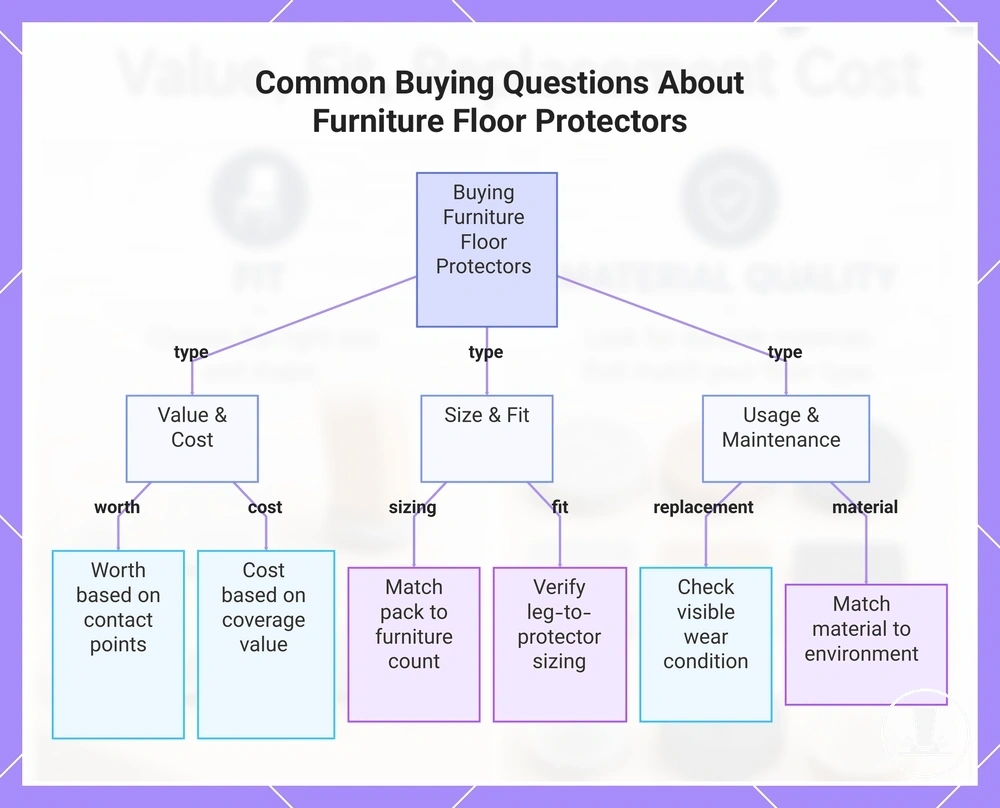
Yes, most buying questions about furniture floor protectors can be answered by reviewing worth, pack size, replacement timing, material choice, cost reasonableness, and fit uncertainty. These common questions usually relate to purchase friction that remains after the main buying decision has been narrowed.
Should I buy furniture floor protectors if my furniture rarely moves?
Yes, when daily floor contact still creates a protection concern. Furniture movement is only one factor, and floor surface conditions may also influence the buying decision. Consider whether ongoing contact points need protection.
What pack size makes the most sense?
It depends on usable pieces and furniture count. A larger pack may provide value when more furniture requires coverage, while a smaller pack may reduce unused pieces. Compare pack size against expected use.
When is replacement timing worth considering?
Replacement timing becomes relevant when wear, compression, or attachment condition may reduce protection value. Visible condition often provides a better cue than ownership time alone. Check wear before deciding on replacement.
How should I approach material choice?
Material choice depends on floor surface, furniture weight, movement patterns, and protection goals. Different materials may suit different contact conditions. Match the material choice to the intended use environment.
Is the cost reasonableness based only on price?
No, cost reasonableness also depends on usable pieces, replacement cost, and expected coverage value. A lower price may not improve value when coverage needs are not met. Use practical coverage as a price check.
What can I do about fit uncertainty?
Fit uncertainty may be reduced by comparing furniture-leg dimensions with protector sizing before purchase. A closer size match can help reduce unused pieces and replacement needs. Verify sizing before making a final selection.
For broader decision questions that extend beyond purchase friction, see the furniture floor protectors FAQ.
This chart groups the main purchase friction questions about furniture floor protectors into decision categories and shows the key answer or check for each.