
Furniture Floor Protector Selection for Safe Floor Contact
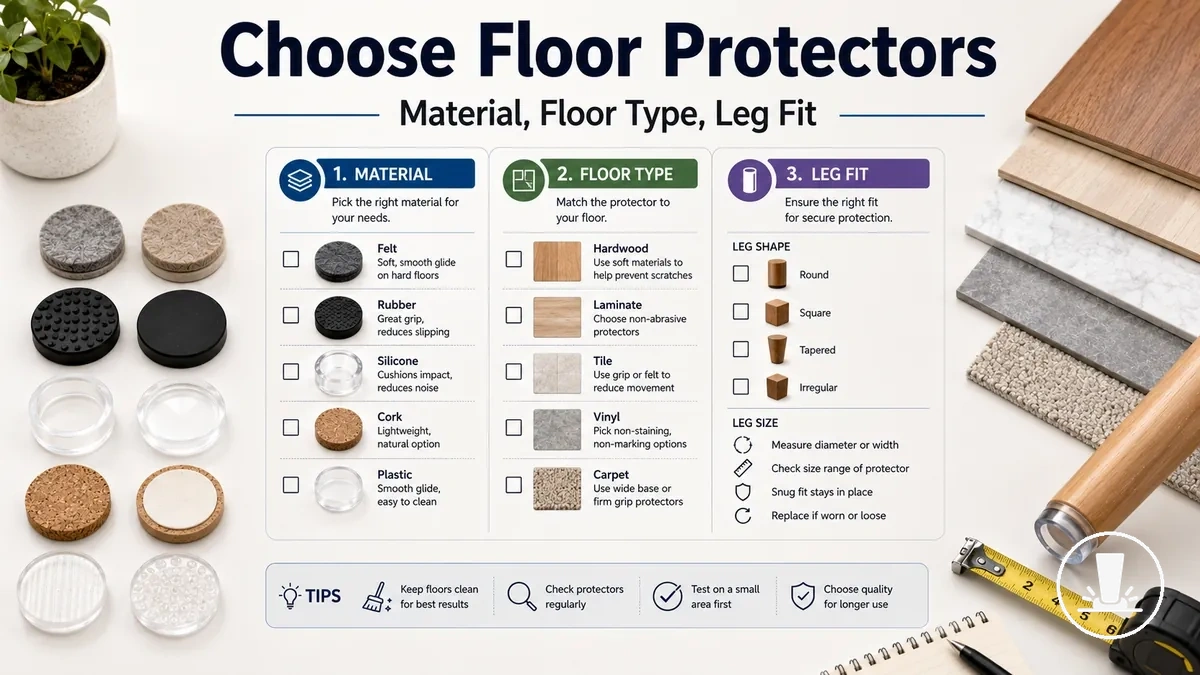
Furniture floor protectors depend on the floor surface, furniture movement, leg fit, protector material, and marking risk. The right selection is usually based on how the protector interacts with floor contact during everyday use rather than on a single feature. Main decision variables include floor surface characteristics, furniture movement patterns, leg fit, protector material behavior, and the balance between scratch risk, noise reduction, and grip.
Furniture floor protectors are floor-contact decision aids that help manage the interaction between furniture and the surface below it. Different furniture pads, chair leg protectors, and protective pads can create different contact conditions depending on material behavior, attachment style, and contact area. They may support noise reduction, grip, or smoother movement, but protectors reduce risk only when the material, fit, and floor condition match. Learn more about furniture floor protectors.
Poor selection can contribute to scratches, marks, unwanted noise, or detachment when the protector material, fit, and floor condition do not work together. Floor damage usually comes from material mismatch, poor sizing, dirt buildup, or weak attachment rather than from protector type alone. Finish sensitivity, residue potential, contact-area coverage, and movement frequency can influence scratch risk and marking risk. The next step is to filter choices by floor surface so floor-contact risks can be evaluated more accurately.
Identify the Floor Surface Before Choosing a Protector
Floor surface should be checked before protector material or price because the floor type changes how furniture floor protectors interact with the contact area. Surface hardness, finish sensitivity, and furniture movement can affect which selection signals deserve the most attention. Common risk types include scratch risk, dent risk, marking risk, reduced grip, and unwanted noise.
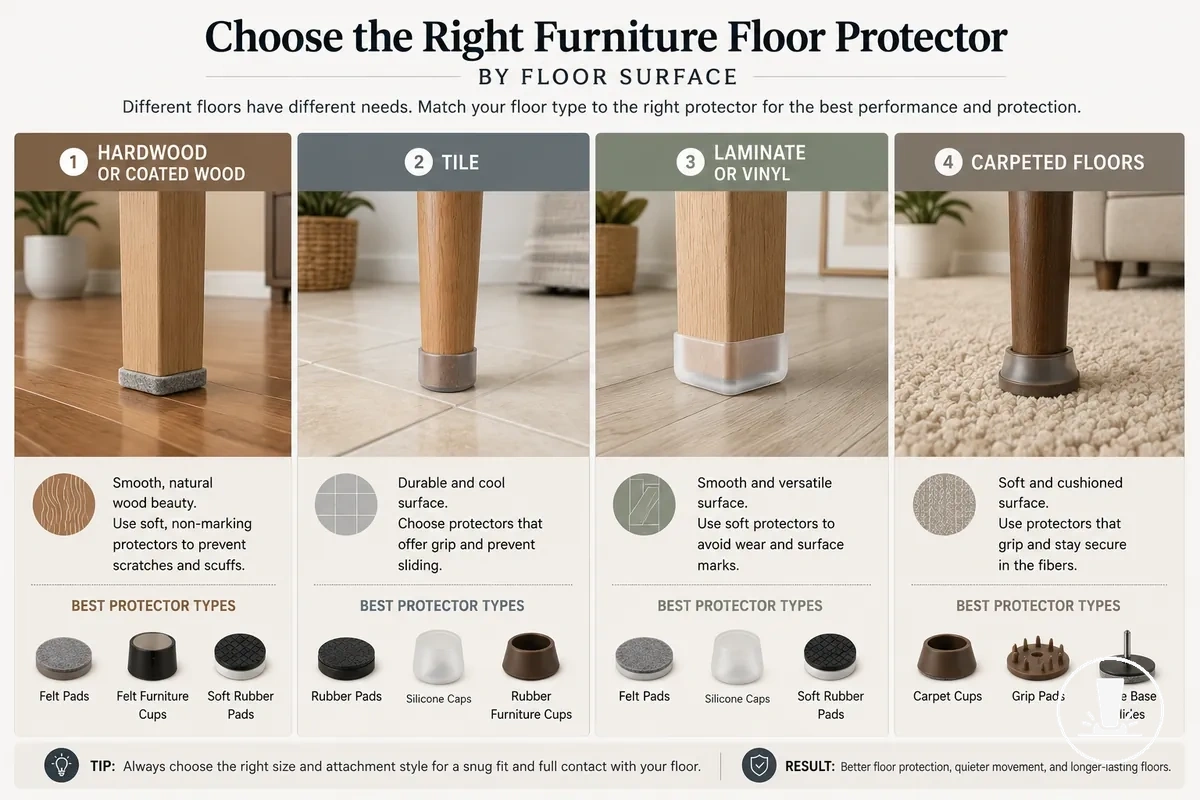
Hard floors such as hardwood, tile, laminate, and vinyl often respond differently to floor contact than softer or carpeted surfaces. Hardwood and a coated finish may require closer attention to finish sensitivity and scratch risk, while tile surfaces may place more emphasis on grip and noise during chair movement. Carpet can distribute pressure differently and may shift the focus toward stability and dent risk. Protector selection usually depends on how the floor surface and furniture movement interact in a specific setting.
Finish sensitivity and movement frequency can change the risk profile even when two floors appear similar. A coated finish may react differently to friction, residue, or repeated movement, while high-movement furniture can increase wear at the contact area. For a deeper assessment of surface-specific considerations, see hardwood floor compatibility.
Identify the Floor Surface Before Choosing a Protector by organizing surface risk before protector choice. The table below provides a short criteria split that helps separate selection signals from floor-specific cautions.
| Floor surface | Main risk | Better selection signal | Caution |
|---|---|---|---|
| Hardwood or coated wood | Scratch risk | Attention to finish sensitivity and floor contact | Material mismatch may increase surface wear |
| Tile | Noise | Grip during chair movement | Low grip may allow unwanted movement |
| Laminate or vinyl | Marking risk | Protector material suited to surface softness | Residue potential may vary by material |
| Carpeted floors | Dent risk | Pressure spread and stability | Fit and movement patterns can affect balance |
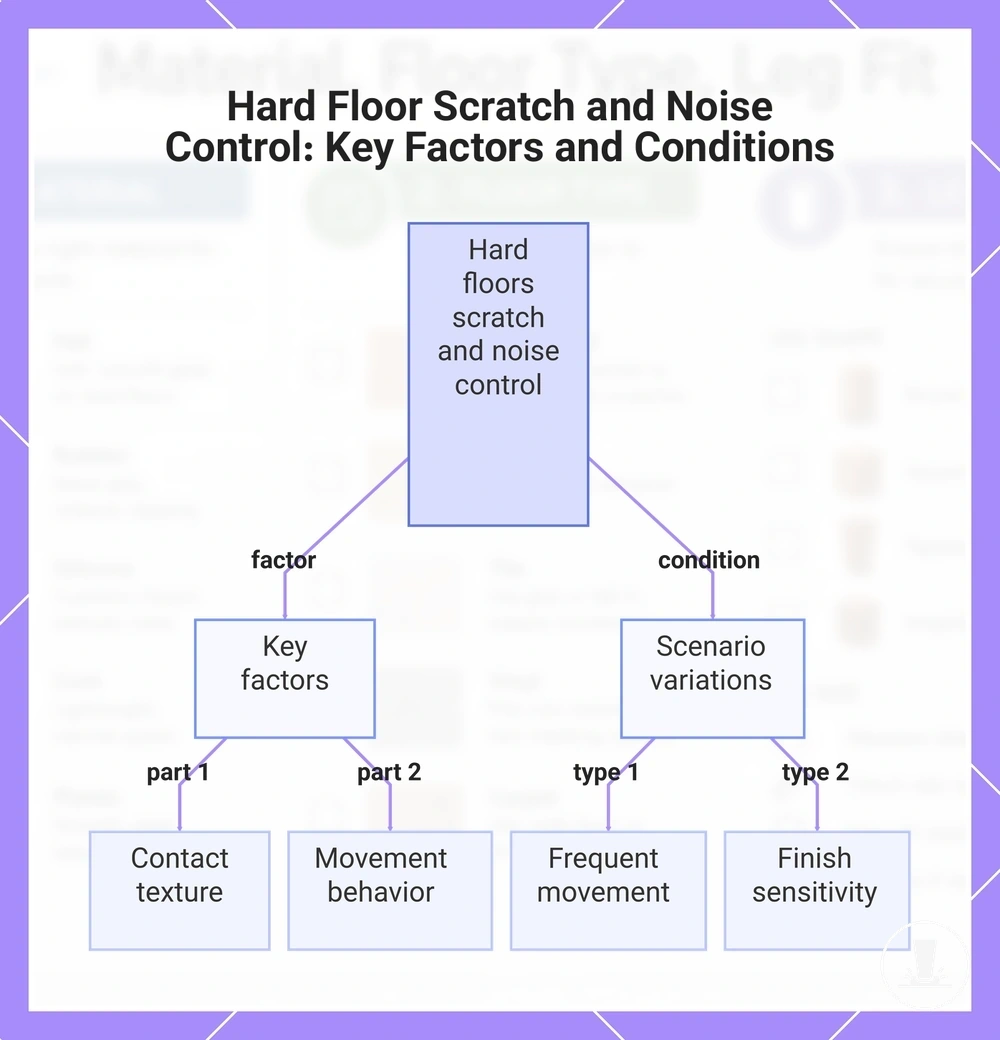
Hard floors that need scratch and noise control
Hard floors usually make scratch control, scuff risk, and noise control more prominent than compression-related concerns. Hard-floor compatibility depends on protector contact texture, furniture movement, and the way those factors affect floor contact. Finish sensitivity may increase the importance of selecting an appropriate contact texture for the floor condition.
Hard floors that need scratch and noise control are often evaluated through movement behavior and contact texture rather than through floor category alone.
- When chair movement is frequent on hard floors, scraping and noise may become more noticeable, so contact texture becomes a more important selection signal.
- When finish sensitivity is higher and grit is present, contact texture may influence scratch control and scuff risk.
- When smooth tile surfaces allow more sliding, grip characteristics may affect movement behavior and noise outcomes.
- When laminate surfaces experience repeated movement, pressure and contact texture may influence scuff risk over time.
- When furniture remains mostly stationary, stable floor contact may matter more than movement-related sound reduction.
This chart shows the main factors and conditions that influence scratch and noise control on hard floors, based on movement behavior and contact texture.
Soft or carpeted floors that need dent and movement control
Soft floors and carpeted floors depend on pressure spread, contact area, and movement control because compressible surfaces can respond differently to furniture weight than rigid surfaces. Stability usually becomes a more important compatibility consideration than scratch prevention alone. Dent risk and wobble may become more noticeable when furniture weight is concentrated on a smaller contact area.
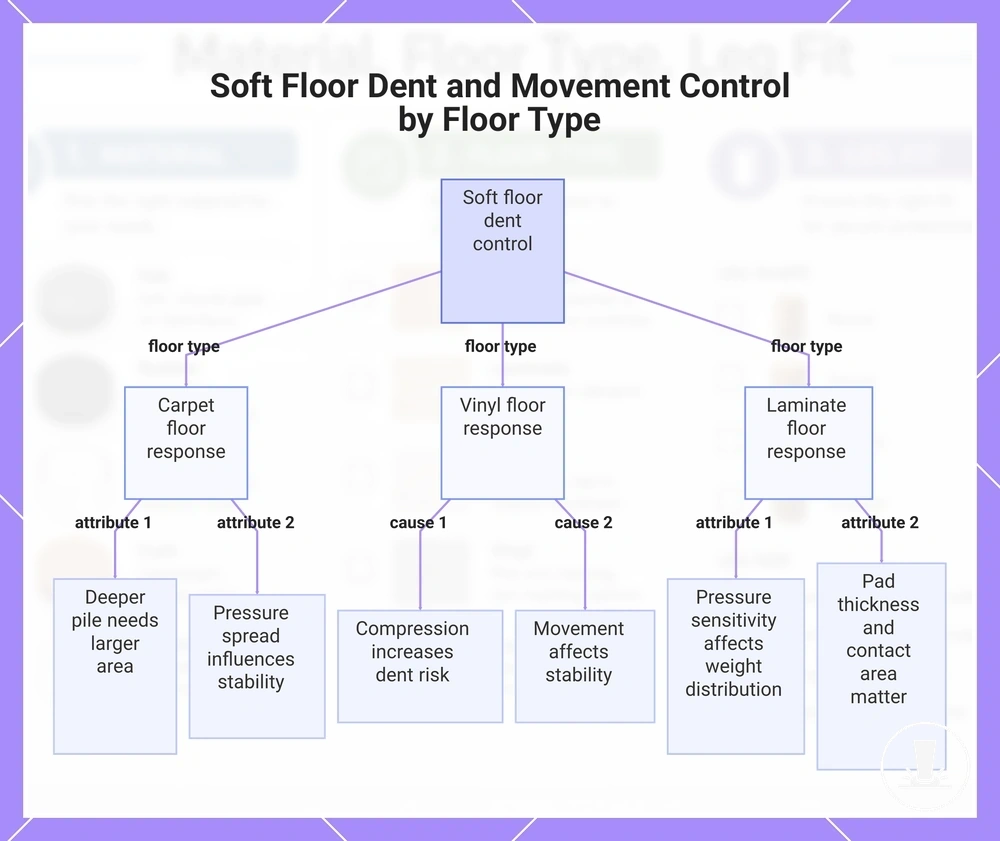
Soft or carpeted floors that need dent and movement control often require attention to how surface softness changes the protector’s role.
- When carpet pile is deeper, pressure spread may influence stability, and a larger contact area can help reduce wobble.
- When vinyl softness allows more surface compression, furniture weight may increase dent risk, while movement can affect stability outcomes.
- When laminate shows pressure sensitivity, contact area and pad thickness may influence how weight is distributed across the surface.
- When furniture weight and floor softness increase together, movement control depends on fit and contact area, so both should be checked.
This chart shows how different soft floor types (carpet, vinyl, laminate) influence dent risk and movement stability through specific pressure and contact area conditions.
Match Protector Material to Movement and Marking Risk
Protector material depends on furniture movement, friction requirements, and marking risk. Material choice can change sliding behavior, grip, residue potential, and floor contact characteristics. Common protector material families include felt, rubber, silicone, and plastic glide surfaces.
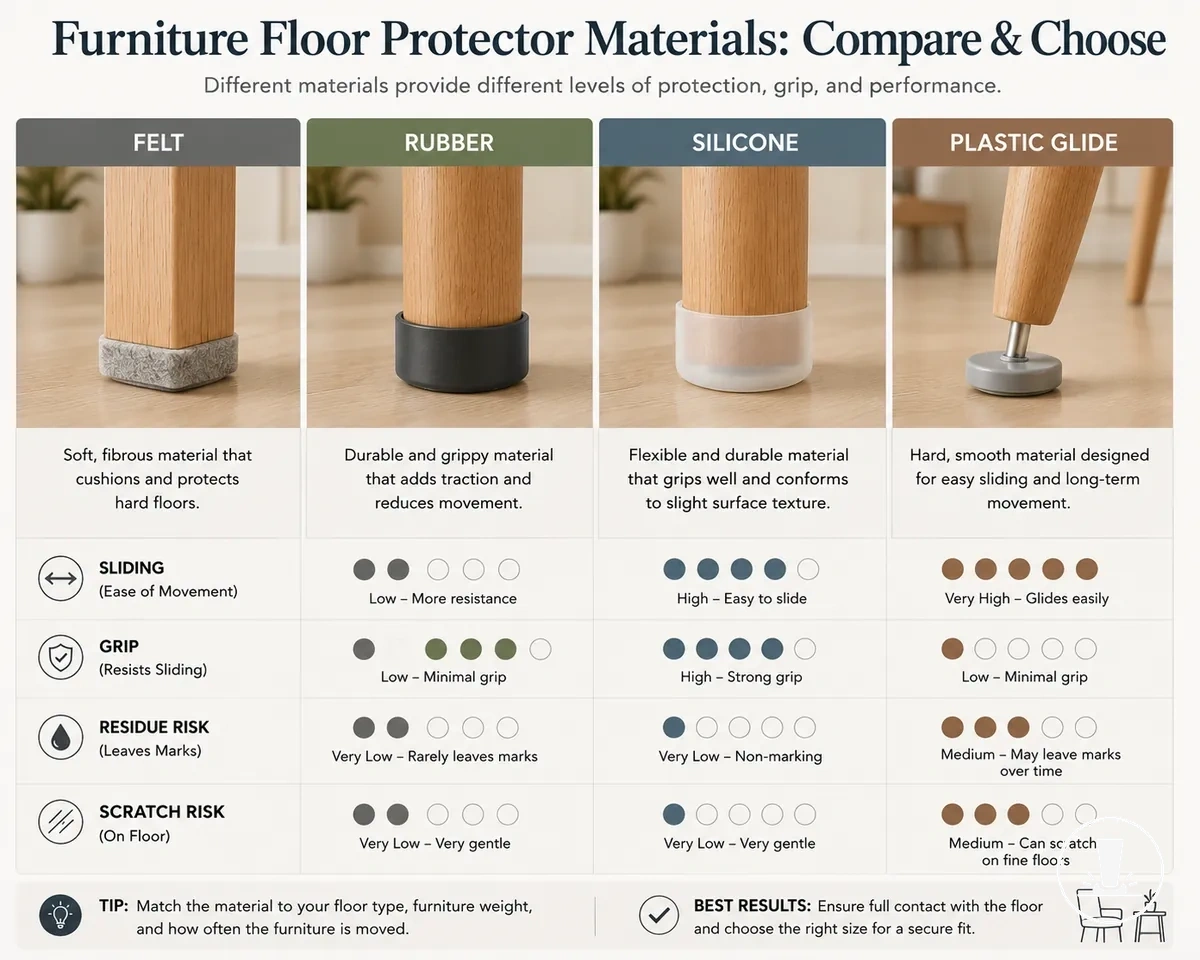
When furniture moves frequently, felt and plastic glide surfaces may support smoother sliding, while stationary furniture may benefit from greater grip. The same protector material can help or create tradeoffs depending on floor condition and movement patterns. Felt is often associated with chair movement and noise reduction, while rubber and silicone are more commonly considered for grip and position control. Material selection usually involves balancing sliding against grip.
Residue, trapped grit, and floor-finish sensitivity can influence scratch risk and marking outcomes over time. Even a non-marking protector material may require inspection when floor contact conditions change. For a broader comparison of material-specific characteristics, see material choice for furniture protectors.
Match Protector Material to Movement and Marking Risk by comparing how each material influences movement behavior and floor-contact outcomes.
| Material | Movement behavior | Floor-risk caution | Better use signal |
|---|---|---|---|
| Felt | Often supports smoother sliding | Trapped grit may increase scratch risk | Frequent chair movement and noise reduction |
| Rubber | Higher friction and grip | Residue potential may vary by floor condition | Stationary furniture needing movement control |
| Silicone | Moderate grip during floor contact | Marking risk depends on surface condition | Situations balancing grip and movement |
| Plastic glide | Can promote smooth movement | Sliding may increase on certain surfaces | Furniture that moves regularly |
Felt for movable furniture and smoother sliding
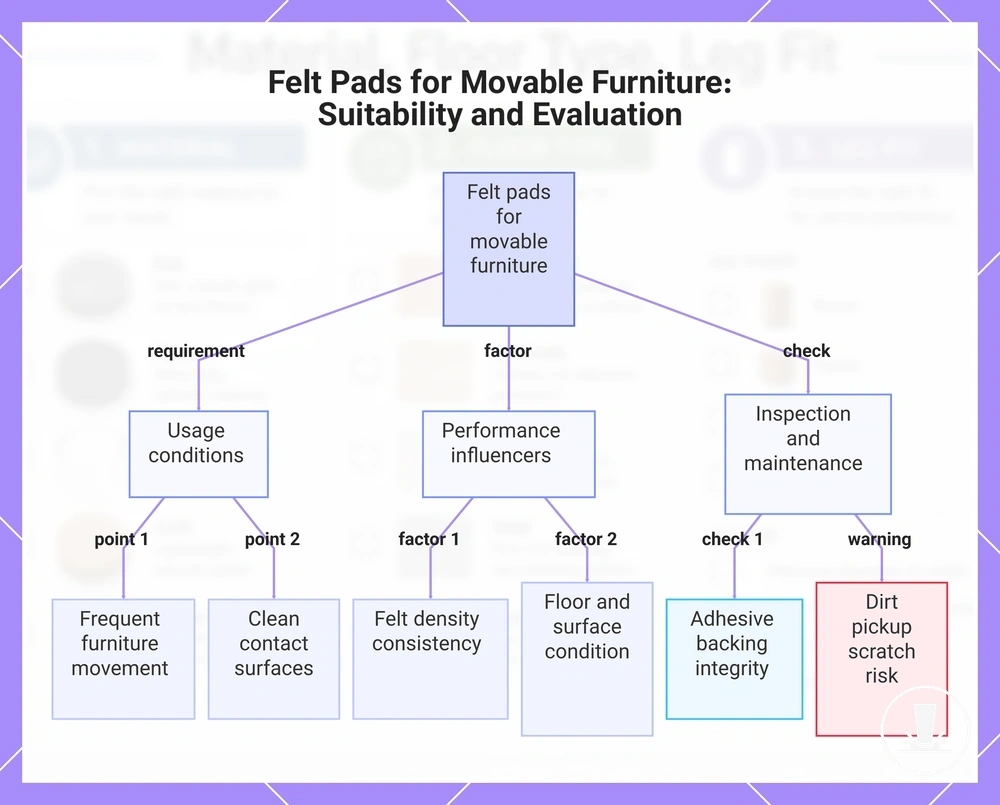
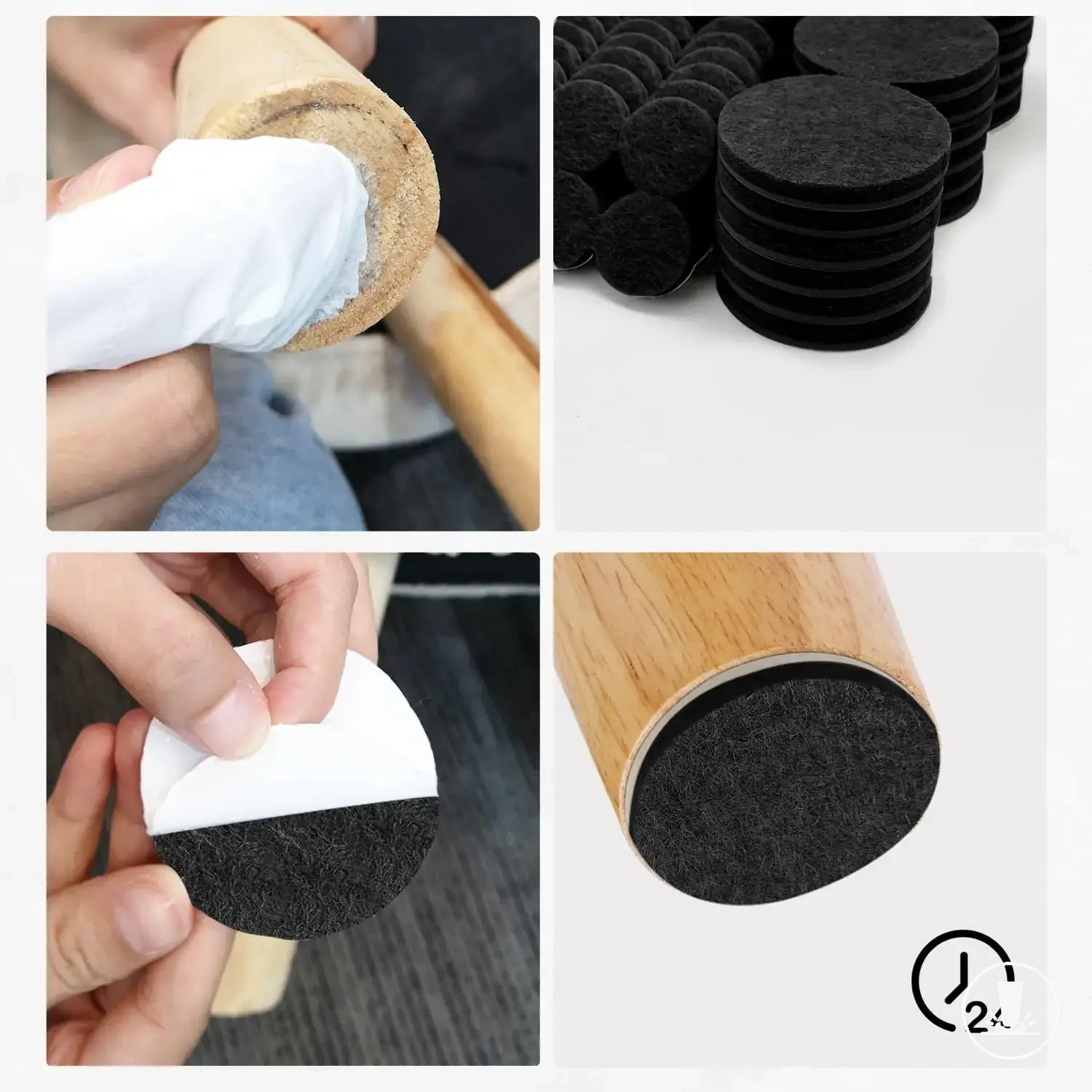
Felt pads are suitable for movable furniture that is repositioned often because they can support smoother sliding and may help reduce scraping during chair movement. Felt density can influence how consistently felt pads maintain floor contact, while performance depends on movement patterns, floor condition, and the condition of the felt surface. Felt pads are generally most suitable when contact areas remain clean and furniture movement is frequent.
When evaluating felt pads, check these conditions:
- For movable furniture, felt density may affect smoother sliding and how consistently the pad supports chair movement.
- For adhesive backing, attachment quality depends on the condition of the leg underside, and shifting may occur if the backing loses adhesion over time.
- For floors exposed to dirt pickup, trapped grit may increase scratch risk, so felt pads may require periodic inspection and replacement.
This chart shows the key usage conditions, performance factors, and evaluation checks for felt pads on frequently moved furniture.
Rubber or silicone for grip and stationary furniture
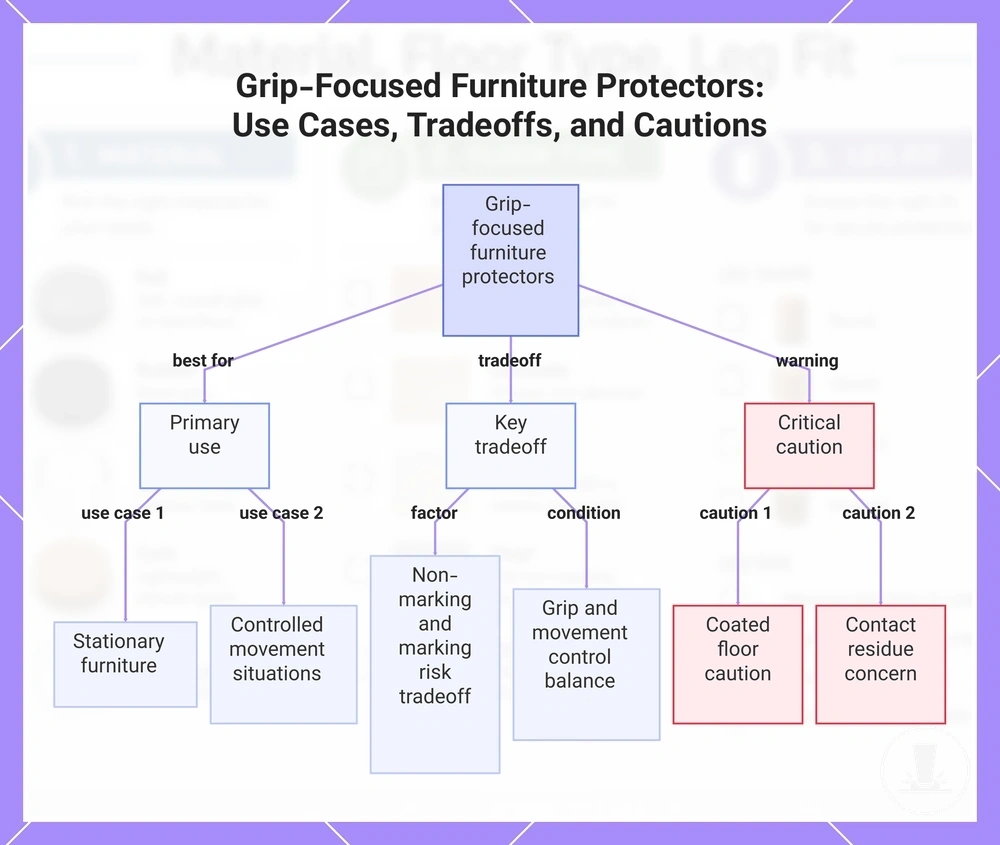
Rubber pads and silicone protectors are suitable when grip and sliding prevention are more important than smoother movement. They are often chosen for stationary furniture, controlled movement situations, or furniture that should remain in place during normal use. Grip can support stability, but the tradeoff between non-marking performance and possible marking risk depends on material type, floor finish, and contact conditions.
When furniture is expected to stay in position, rubber grippers and silicone caps may help with movement control and vibration reduction in certain conditions. Silicone protectors and rubber pads can differ in grip level, contact residue potential, and floor-contact behavior, so outcomes may vary by product and surface. Extra caution may be appropriate on coated or finish-sensitive floors because material interaction can differ depending on the floor finish and contact conditions.
Consider these conditions when evaluating grip-focused protectors:
- For stationary furniture, higher grip may support sliding prevention, but movement control depends on floor condition and furniture weight.
- For coated or sensitive floor finish surfaces, non-marking claims should be treated cautiously because material behavior can vary.
- For environments where contact residue is a concern, residue risk may differ between rubber pads and silicone protectors.
This chart shows the primary use conditions, key tradeoffs, and critical cautions for choosing rubber or silicone furniture protectors when grip and sliding prevention are priorities.
Check Furniture Leg Shape, Size, and Contact Area
Fit must be verified before buying because a protector may only stay aligned when it matches the furniture leg correctly. Protector performance depends on how the furniture leg meets the floor during normal use, not on appearance alone. The key fit checks are leg shape, leg size, and contact area.
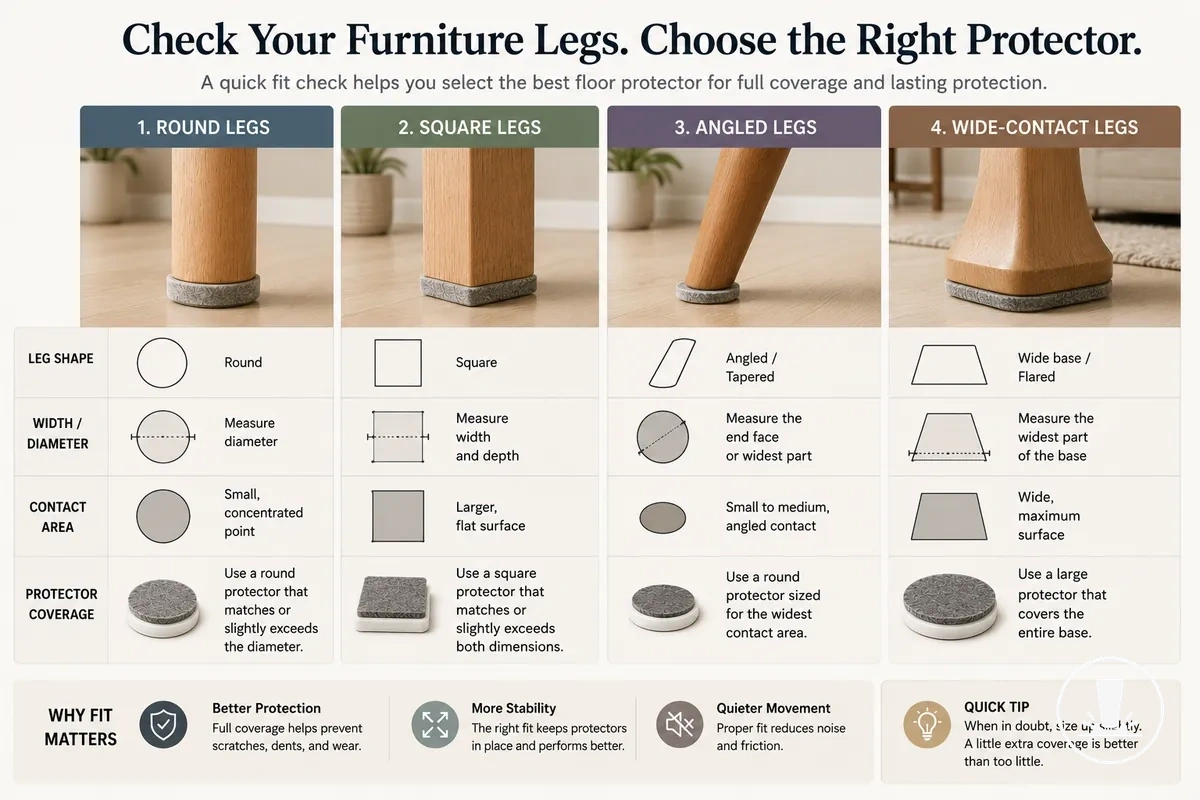
When a furniture leg is round, leg size is usually assessed through diameter, while square or rectangular legs depend more on width and overall contact surface. An angled leg may create uneven floor contact if protector coverage does not follow the contact area correctly. Wide-contact furniture feet can distribute pressure differently than narrow chair legs, which may influence stability and fit security. Accurate leg measurement helps confirm whether shape and size match the intended protector coverage.
Poor fit may lead to detachment, exposed edges, uneven pressure, or floor contact outside the protector surface. These issues can become more noticeable when the contact area, width, diameter, or attachment method does not align with the furniture leg. Before choosing a size, measure furniture legs first to verify the required fit conditions.
Check Furniture Leg Shape, Size, and Contact Area with the following fit-verification checklist before purchase:
- Confirm whether the furniture leg is round, square, rectangular, or an angled leg.
- Measure width or diameter according to the leg shape.
- Check the full contact area that touches the floor.
- Verify that protector coverage matches the contact surface.
- Review attachment compatibility with the furniture leg design and contact conditions.
Round, square, angled, and sled-style legs
Leg geometry changes fit stability because leg form affects contact area, protector fit, and exposure risk. Round legs, square legs, angled legs, tapered legs, and sled-style legs create different floor-contact conditions that may influence how securely a protector stays aligned. The comparison below shows how leg shape can affect fit stability and exposed-edge risk.
Use this comparison to evaluate how leg geometry may influence protector fit:
- Round legs: Round leg diameter defines the contact area, and cap fit may be more stable when the protector shape follows the leg form closely.
- Square legs: Corner coverage can affect protector coverage because limited pad shape coverage may leave an exposed edge.
- Angled legs: A changing contact angle may increase shifting or detachment risk when floor contact does not align with the protector shape.
- Tapered legs: A narrowing leg form may reduce fit stability if the protector does not match the contact area near the floor.
- Sled-style legs: A long contact area may require broader coverage because pressure can be distributed across an extended floor-contact surface.
Pad coverage, thickness, and weight distribution
Pad coverage and thickness affect pressure because contact area changes how furniture weight is distributed across the floor surface. Wider pad coverage can spread pressure across a larger contact area, while thickness may influence clearance, compression, and floor contact behavior. Pad coverage, thickness, and furniture weight should be considered together when evaluating weight distribution.
Use the following criteria to evaluate pressure spread and fit conditions:
- Pad coverage: Larger pad coverage may reduce edge exposure by extending support across more of the contact area, while limited coverage can leave portions of the contact area closer to direct floor contact.
- Thickness: Greater thickness may increase clearance, but compression can vary depending on furniture weight and contact conditions.
- Furniture weight: Higher furniture weight can increase pressure spread demands and compression, which may influence dent risk and stability.
- Weight distribution: Uneven load distribution may contribute to wobble, edge exposure, or inconsistent floor contact, so pad diameter, coverage, and thickness should be checked together.
Compression, dent risk, and wobble depend on how pad coverage, thickness, contact area, and furniture weight interact. Selection suitability may vary when pressure, compression, or floor-contact conditions change, so these factors should be reviewed together.
Choose Attachment Style by Furniture Movement
Attachment style depends on movement frequency because repeated movement can increase the demands placed on holding strength and protector retention. Furniture that moves often may require a different attachment approach than furniture that remains mostly stationary. Common attachment options include adhesive pads, slip-on caps, and glides.
When furniture experiences low movement, attachment style may depend primarily on leg surface condition and stable floor contact. When chairs are dragged, rotated, or repositioned often, repeated movement can increase the likelihood of shifting if the attachment method does not match the use pattern. Frequent movement may place greater emphasis on fit consistency and retention, while low-movement furniture may place more emphasis on stable attachment. These differences make holding strength an important consideration.
Shifting, detachment, and exposed floor contact can occur when attachment style, movement frequency, and leg surface conditions do not align. An attachment method that loosens or moves out of position may leave parts of the furniture leg closer to direct floor contact. Attachment suitability should be checked against both movement conditions and fit requirements.
Choose Attachment Style by Furniture Movement using the comparison below.
| Attachment style | Better movement condition | Fit requirement | Main caution |
|---|---|---|---|
| Adhesive pads | Low movement | Clean leg surface | Shifting may occur if adhesion weakens over time |
| Slip-on caps | Repeated chair movement | Fit tension matched to chair legs | Detachment risk may increase when fit is loose |
| Glides | Regular movement on hard floors | Compatible attachment and floor contact | Floor exposure may occur if the glide shifts |
Self-adhesive pads for simple low-movement use
Self-adhesive pads depend on a clean contact surface and low-movement furniture conditions to maintain adhesive strength. Adhesive hold may vary with leg underside texture, dust buildup, furniture weight, and compression during use, which can increase the risk of shifting or residue. Self-adhesive pads are generally adequate when surface cleanliness and movement level remain favorable.
Check the following conditions before relying on self-adhesive pads:
- Verify that the leg underside provides a clean contact surface with minimal dust or rough texture that could reduce adhesive strength.
- Confirm that low-movement furniture is the intended use condition, because repeated repositioning may increase shifting risk.
- Check that the contact area is adequate for furniture weight and compression, since limited coverage may increase detachment risk or residue potential.
Slip-on caps and glides for chair legs that move often
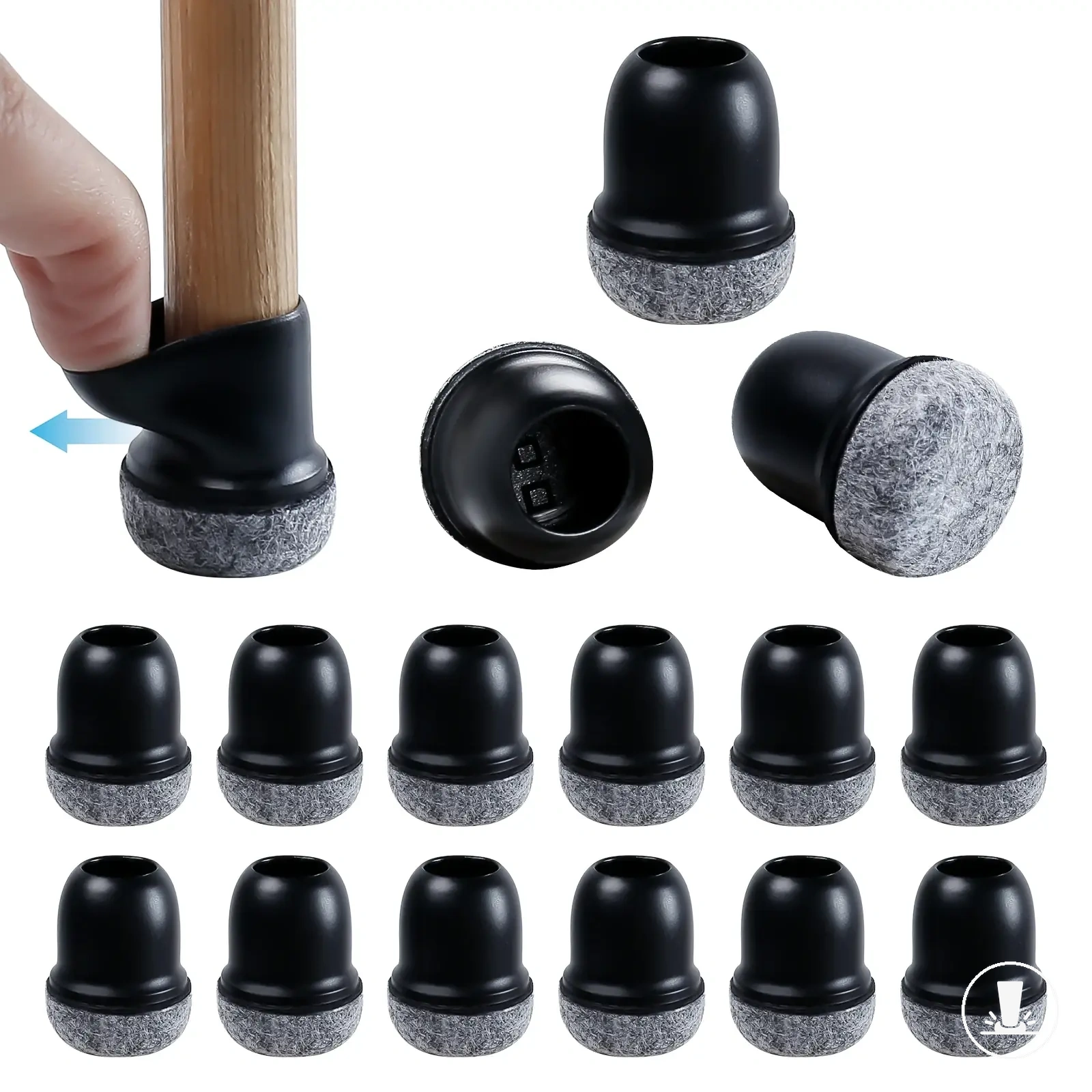
Slip-on caps and glides depend on repeated movement because chair legs that move often require greater fit security to maintain consistent floor contact. Slip-on caps may help retain position when cap tension matches the chair leg shape, while glides may support controlled sliding across a suitable glide surface. Both options are generally more suitable when fit security remains stable during repeated movement.
Consider the following conditions when evaluating slip-on caps and glides:
- Slip-on caps depend on cap tension and chair leg shape because a loose fit may increase protector displacement during repeated movement.
- Glides depend on glide surface characteristics and movement frequency because controlled sliding may help reduce scraping on hard floors.
- Chair legs that move often may require closer attention to fit security because poor fit can increase protector displacement and exposed floor contact.
Selection Checklist for Floor-Safe Furniture Protectors
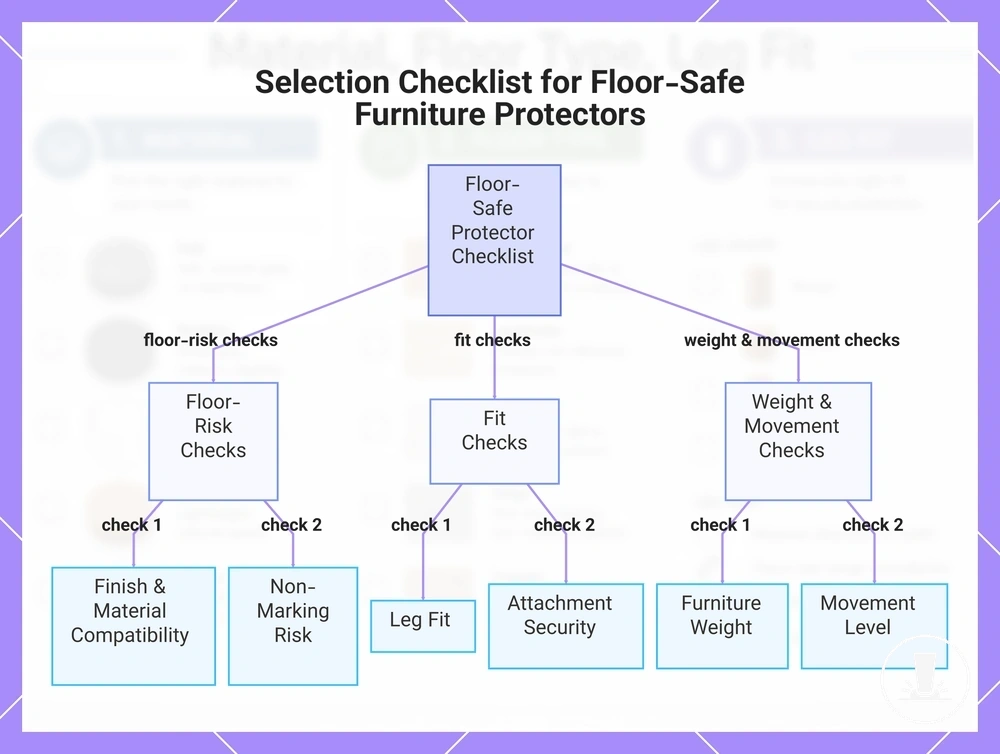
A selection checklist for floor-safe furniture protectors depends on multiple conditions passing together rather than on one feature alone. Floor finish, material, leg fit, attachment security, movement level, furniture weight, and non-marking risk should be evaluated as a combined decision filter. A floor-safe selection depends on how all checks work together.
A caution outcome in one area can affect the overall selection even when other criteria appear suitable. For example, a compatible protector material may still require reconsideration if leg fit or attachment security is uncertain. Likewise, a suitable fit may not reduce floor-risk concerns when non-marking risk remains unclear. Use the checklist below to identify pass and caution signals before making a selection.
- Pass: Floor finish and protector material appear compatible. Caution: Marking risk or finish sensitivity remains uncertain.
- Pass: Leg fit matches the contact area securely. Caution: Loose coverage, gaps, or exposed edges are present.
- Pass: Attachment security matches the expected movement level. Caution: Repeated movement may increase shifting risk.
- Pass: Movement level aligns with the protector type. Caution: Sliding or grip characteristics may not suit use conditions.
- Pass: Furniture weight is supported by suitable pad coverage. Caution: Dent risk, compression, or stability concerns remain.
- Pass: Non-marking risk appears appropriate for the floor surface. Caution: Residue, scuffing, or finish interaction remains unclear.
- Pass: Sizes, shapes, and material types match the required fit range. Caution: Available options may not cover furniture dimensions.
When furniture experiences frequent movement, movement level, furniture weight, and non-marking risk often become more influential selection factors. Heavier furniture may require closer attention to pad coverage and stability, while repeated movement may place greater emphasis on attachment security. After these checks pass, the selection can move toward use-case matching.
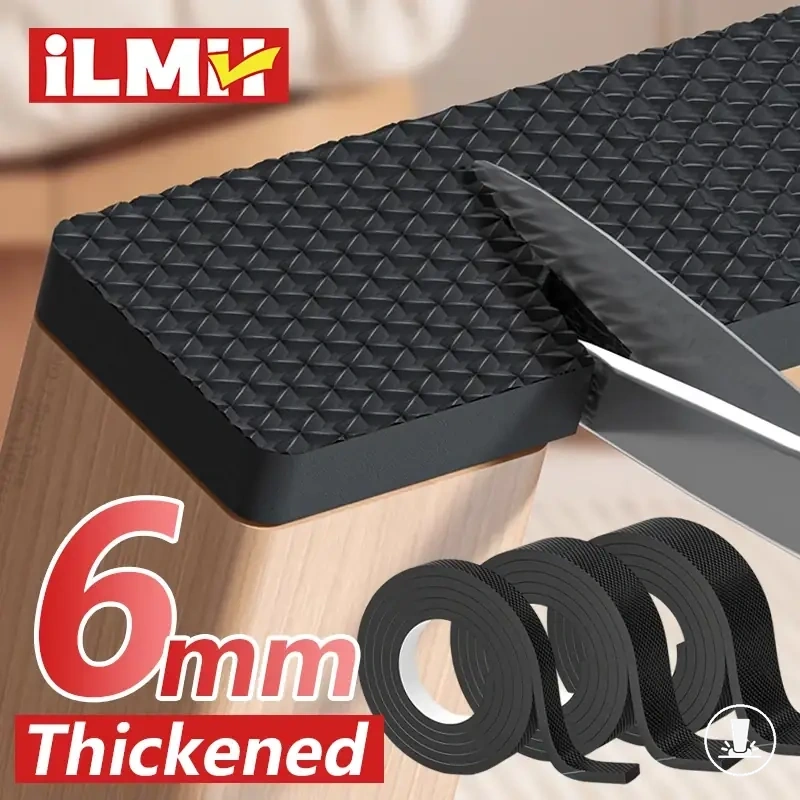
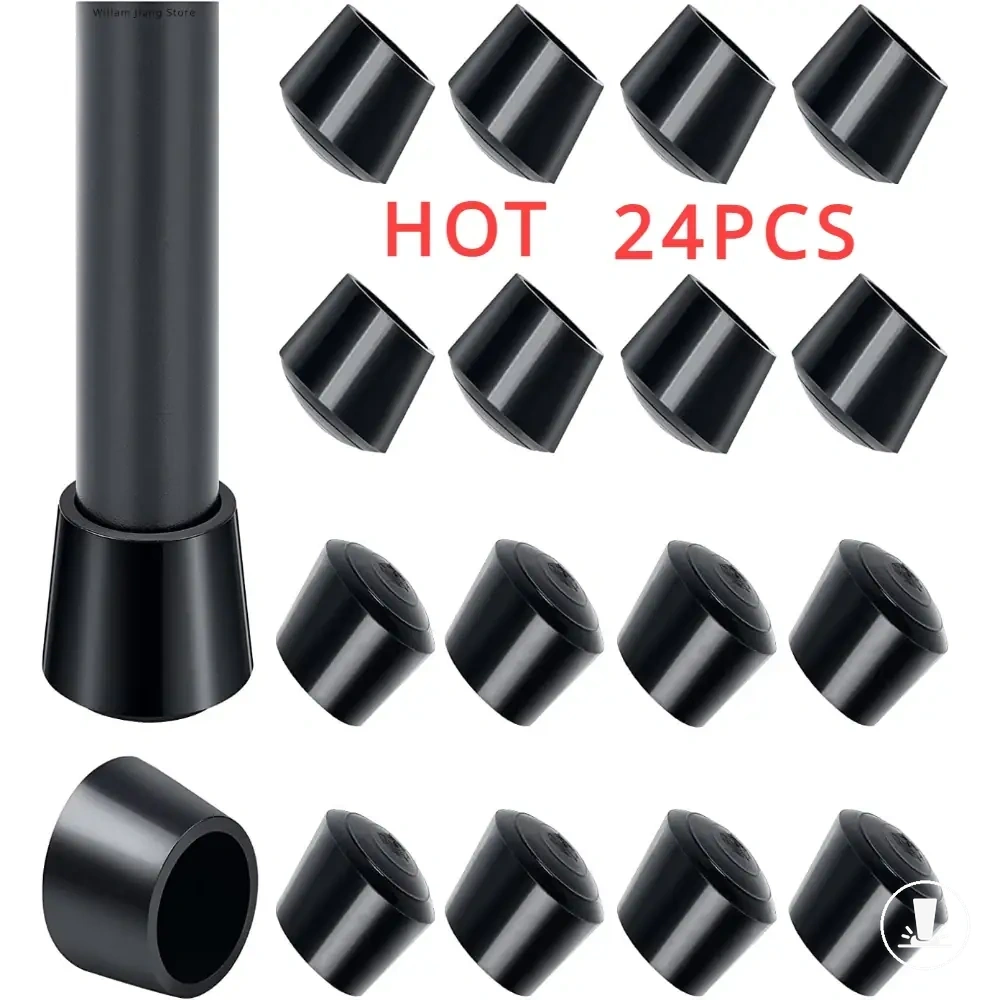
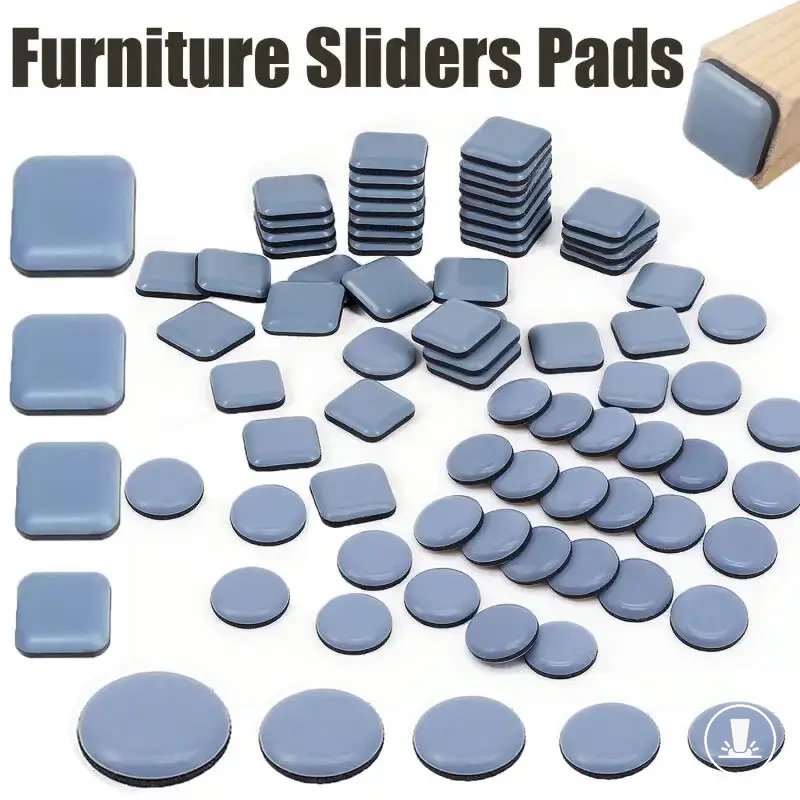
An assortment pack makes sense only after fit and floor-risk checks have passed the decision filter. A furniture protector assortment pack may help when multiple sizes, shapes, or material types are needed within the same fit range. For use-case comparisons after completing the checklist, see best floor protectors by use case.
The products below are useful examples for comparing available options. Before buying, check that the compatibility criteria, key features, and product details match your needs.
This chart shows the main check categories and criteria for selecting floor-safe furniture protectors, based on a combined decision filter of floor finish, fit, weight, and movement conditions.
Floor finish compatibility
Floor finish compatibility depends on the visible coating rather than the floor material alone. A floor finish may respond differently to the same protector contact surface depending on whether the visible coating includes sealed wood, coated tile, a laminate wear layer, or a surface affected by vinyl softness. Use the checklist below to verify finish compatibility and mark risk before selection.
- Check the floor finish for visible coating sensitivity. Caution: Mark risk may vary even when the floor material appears similar.
- Check sealed wood and coated tile surfaces before prolonged contact. Caution: Rubber residue may be more noticeable on certain coated surfaces.
- Check the laminate wear layer for existing wear or coating changes. Caution: Surface marks may be easier to notice when the wear layer condition varies.
- Check areas affected by vinyl softness before extended contact. Caution: Residue or mark risk may depend on the condition of the surface coating.
- Check protectors for felt grit and perform low-visibility testing first. Caution: Felt grit may increase scratch risk on sealed wood or other coated finishes when debris remains trapped.
Scratch, noise, grip, and non-marking requirements
Scratch, noise, grip, and non-marking requirements can conflict because protector texture, friction, cleanliness, and movement behavior may improve one outcome while creating caution for another. A material selected for grip may not provide the same movement characteristics as one selected for noise reduction, and residue risk can influence marking outcomes on certain surfaces. Use the outcome priorities below to determine which requirement should guide the final selection.
- Scratch control: Protector texture and cleanliness can affect scratch risk. Trapped grit may increase contact-related floor-finish wear when debris remains under the protector.
- Noise reduction: Felt surfaces may help reduce noise during chair movement, but movement behavior and surface conditions can still influence scraping sounds.
- Grip: Higher friction may support stationary furniture and reduce sliding. Caution may be needed when regular repositioning is an outcome priority.
- Non-marking risk: Residue risk may vary by material and coated-finish condition. For broader floor damage prevention, marking risk should be evaluated alongside movement behavior and surface-contact conditions.
Fit security before price or pack size
Fit security should outrank price or pack size because a protector must stay aligned, cover the contact area, and match the floor risk before quantity becomes useful. A larger pack may offer limited value when the protector falls outside the required fit range or does not maintain attachment reliability during normal use. This mismatch can create a false value outcome even when more pieces are included.
After fit security has been verified, value can be evaluated through fit range, attachment reliability, and replacement frequency. A protector that matches leg measurement requirements and remains aligned during the expected movement level may provide more practical value than an assortment pack with limited fit compatibility. An assortment pack may be worth considering when multiple leg sizes or fit conditions need to be covered within the same furniture setup.
- Fit: Confirm that leg measurement falls within the stated fit range and that the protector covers the full contact area.
- Attachment: Check attachment reliability against expected movement level because shifting may reduce alignment over time.
- Material match: Review floor risk and replacement frequency before using pack size as a decision factor.
Common Selection Mistakes That Can Damage Floors
When scratches, marks, noise, denting, or protector failure occur, mismatched selection criteria are often the underlying cause rather than protectors as a category. Many floor damage outcomes develop when material, fit, movement conditions, or support requirements do not match the actual furniture setup. This pattern is reflected in common selection mistakes.
When the wrong material is chosen for a floor finish, marking risk may increase under certain contact conditions. Poor sizing can leave an exposed edge that increases floor contact, while a dirty contact surface with felt grit or debris may contribute to scratches. Weak attachment may allow shifting during movement, and heavy furniture pressure may increase denting risk when contact area support is limited. The mistake-and-correction list below connects each selection mistake to a safer correction.
| Mistake | Likely result | Safer correction |
|---|---|---|
| Wrong material | Marks, noise, or increased marking risk on certain floor finishes | Match protector material to floor-finish conditions and expected movement behavior |
| Poor sizing | Exposed edge, detachment, or unintended floor contact | Verify sizing against the contact area and furniture-leg dimensions |
| Dirty contact surface | Scratches from trapped felt grit or debris | Ensure the contact surface is clean before protector installation |
| Weak attachment | Shifting during movement and possible protector failure | Select an attachment method suited to movement conditions and fit requirements |
| Heavy furniture pressure | Denting risk or uneven support | Use coverage and support that suit the contact area and furniture load |
| Wrong movement assumptions | Unexpected sliding, noise, or premature wear | Choose a protector based on actual movement patterns rather than assumed use |
Product examples should only support corrected selection logic rather than replace it. A different protector style or pack configuration may remain unsuitable when the original mismatch has not been corrected. Correcting selection mistakes first provides a more reliable basis for evaluating protector options.
The products below are useful examples for comparing available options. Before buying, check that the compatibility criteria, key features, and product details match your needs.