Furniture floor protector types by contact, movement, grip, and support
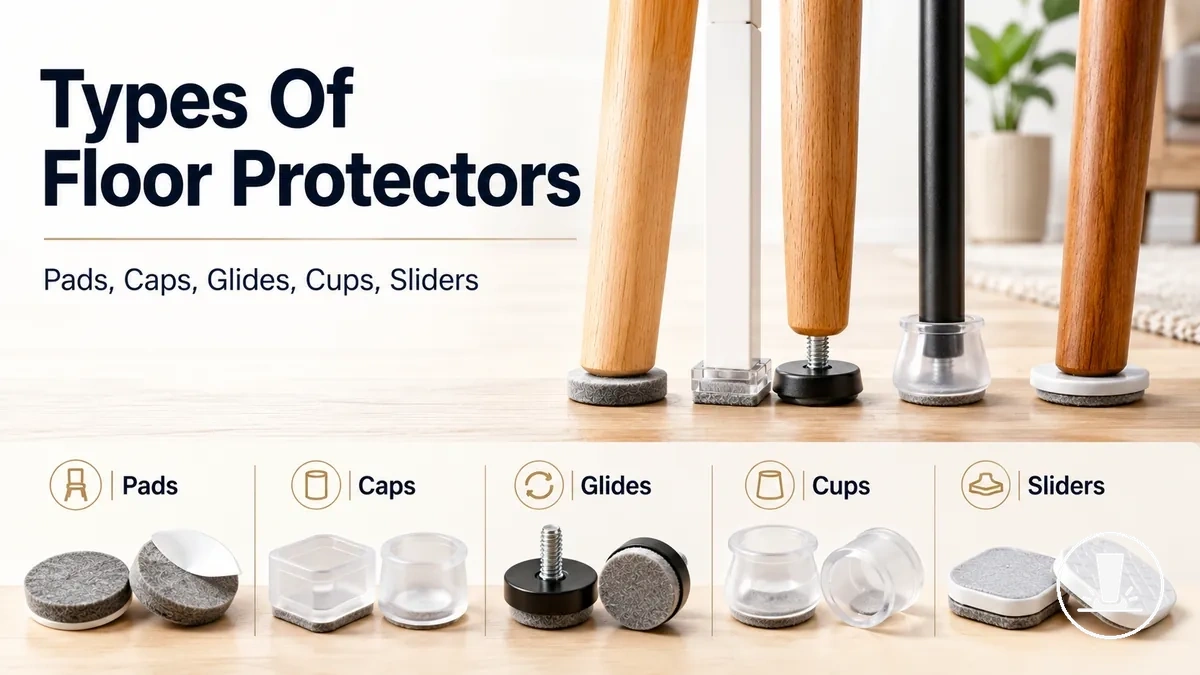
Furniture floor protectors are floor-contact pieces designed to change how furniture interacts with a surface through different contact behaviors and support functions. The main types include pads, caps, glides, cups, sliders, and grippers, each representing a distinct approach to floor contact rather than a material or attachment method. Furniture floor protectors can influence movement, stability, and surface interaction in different ways depending on floor finish, furniture weight, leg shape, and protector condition. Together, these type groups create a decision framework based on contact, movement, grip, and support.
When a chair is moved frequently, a table remains in place for long periods, or a piece of furniture needs more hold than movement, the protector type often becomes the first consideration. Pads, caps, glides, cups, sliders, and grippers are established furniture floor protector types, but their effects may vary according to use conditions and floor characteristics. A protector type explains the role a floor-contact piece is intended to perform, while material and attachment method describe different dimensions of the same product category. Understanding these type differences makes it easier to compare type roles without assuming that any single option is suitable for every situation.
What separates one furniture floor protector type from another
Protector type is defined by how a floor-contact piece interacts with the contact surface and the furniture leg. Different protector types are separated by their contact surface design, movement behavior, grip level, load spread, and intended use condition. These differences influence how a protector option engages with furniture and flooring under changing conditions. Contact behavior is the first separator between one protector type and another.
The direct difference between protector types is the role they are designed to perform at the contact point between furniture and floor. Movement behavior, grip level, and load spread can change how a protector option performs, but outcomes may depend on furniture weight, floor condition, fit, and wear over time. A mismatch between the protector type and use condition can affect the intended result because the contact requirements are different. For broader category context, see the furniture floor protectors hub. Protector type is not the same as material or attachment method.
What separates one furniture floor protector type from another becomes easier to see when contact, movement, grip, and support are viewed together. The image below labels the main classification points and highlights visible differences between floor-contact and leg-contact areas.
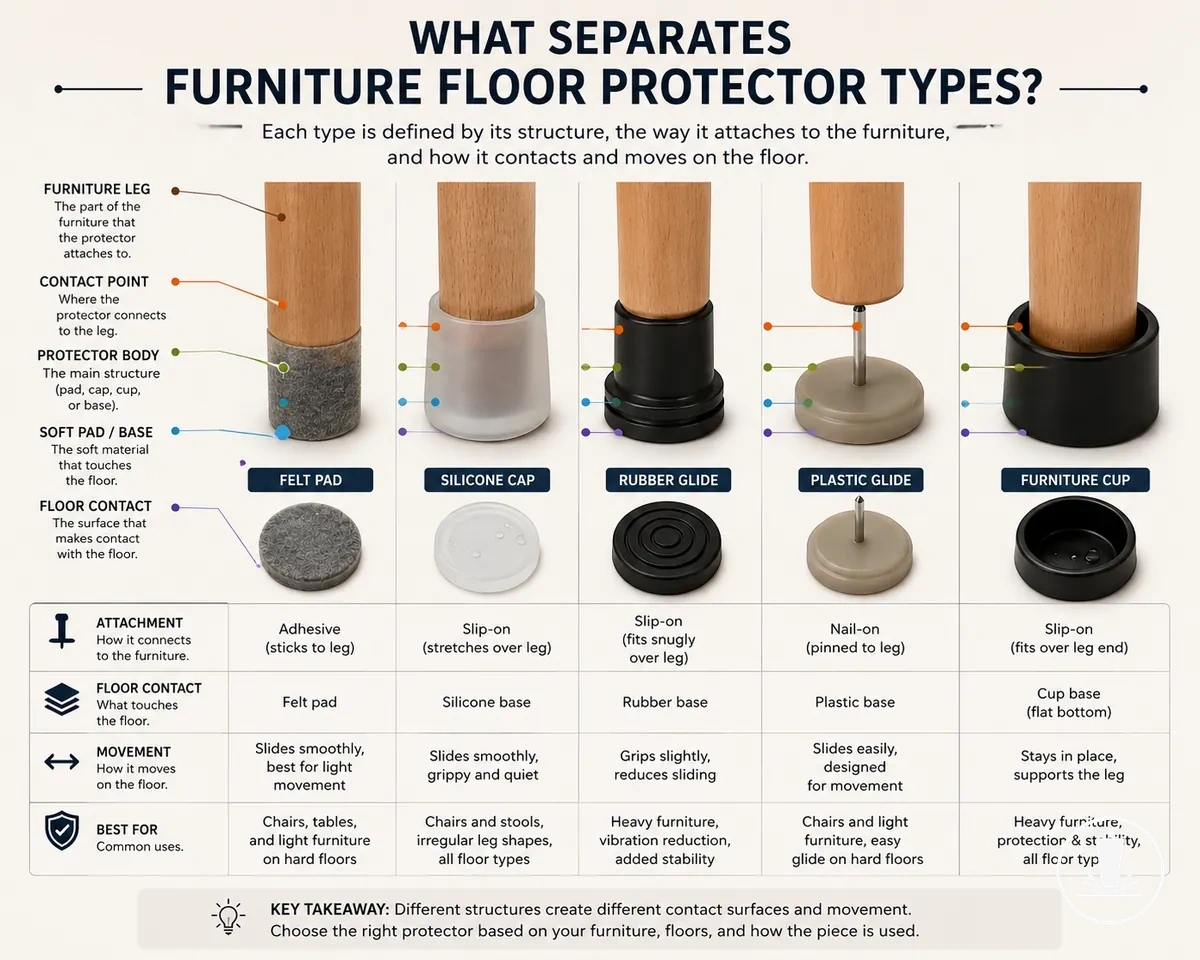
Material remains a related but separate dimension, which is covered in materials used in furniture floor protectors. The comparison block below organizes the main type differences.
| Separator | What changes | Why it matters |
|---|---|---|
| Contact | Contact surface and contact point | Can influence how the protector interacts with furniture and flooring |
| Movement | Movement behavior | May affect how easily furniture shifts under use |
| Grip | Grip level | Can change resistance to movement depending on condition |
| Load spread | Support area beneath the furniture leg | May distribute weight differently across the contact surface |
| Fit | Relationship between protector and furniture leg | Can influence stability and positioning |
| Use condition | Expected environment and furniture behavior | Helps align protector choice with the intended use case |
Main furniture floor protector types and their core roles
Main furniture floor protector types and their core roles are defined by how they influence floor contact, movement, and stability under furniture. Pads, caps, glides, cups, sliders, and grippers are the six common type groups associated with different contact needs and furniture conditions. Each protector type is identified by a primary role rather than by material or attachment details. These six groups form the main inventory of pads, caps, glides, cups, sliders, and grippers.
When furniture needs to move more easily, remain in place, spread weight, or soften contact, different protector types may serve different purposes. Pads are commonly associated with cushioning and floor contact management, while caps cover the furniture leg end and provide a floor-contact base. Glides are linked to controlled movement, cups to stationary support and load spread, sliders to temporary repositioning, and grippers to added stability through friction. The effect of any protector type may depend on fit, floor condition, furniture weight, and wear over time. Each following subsection focuses on role rather than product ranking.
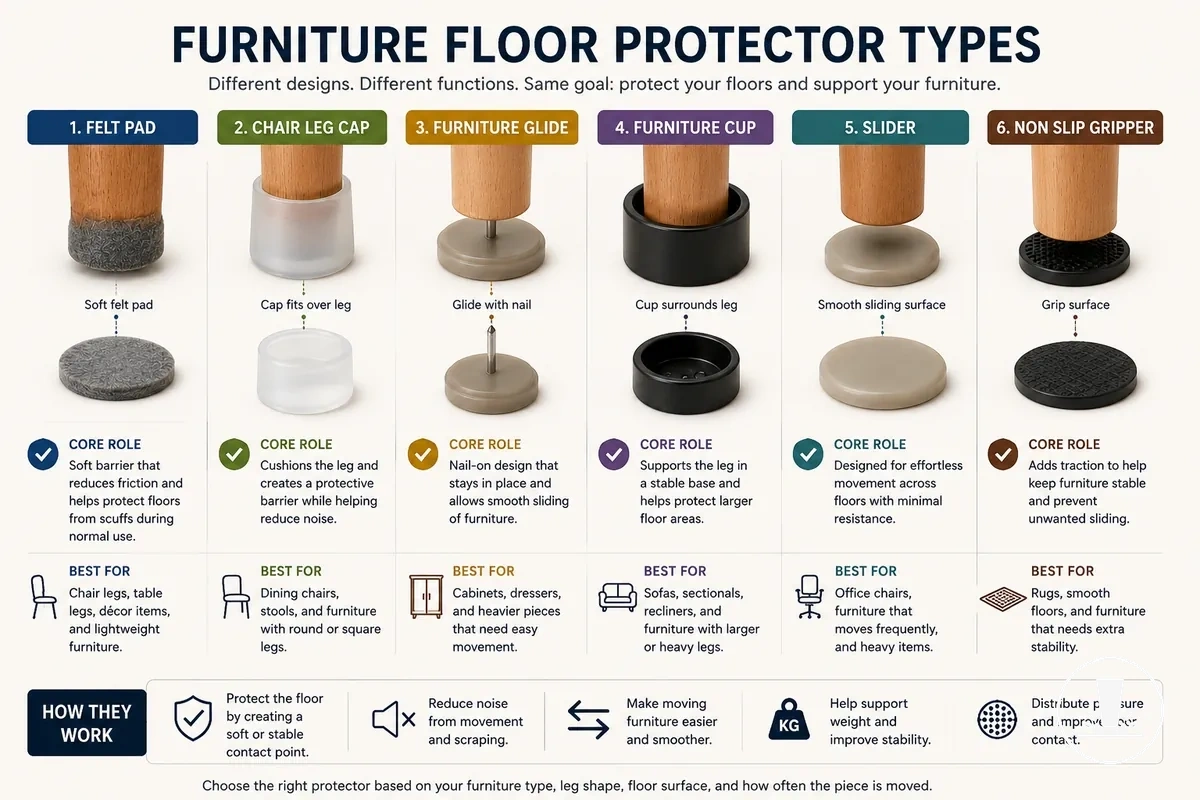
Main furniture floor protector types and their core roles are easier to compare when viewed together. The image below compares the visible form and floor-contact role of each type.
Furniture felt pads for soft sliding contact
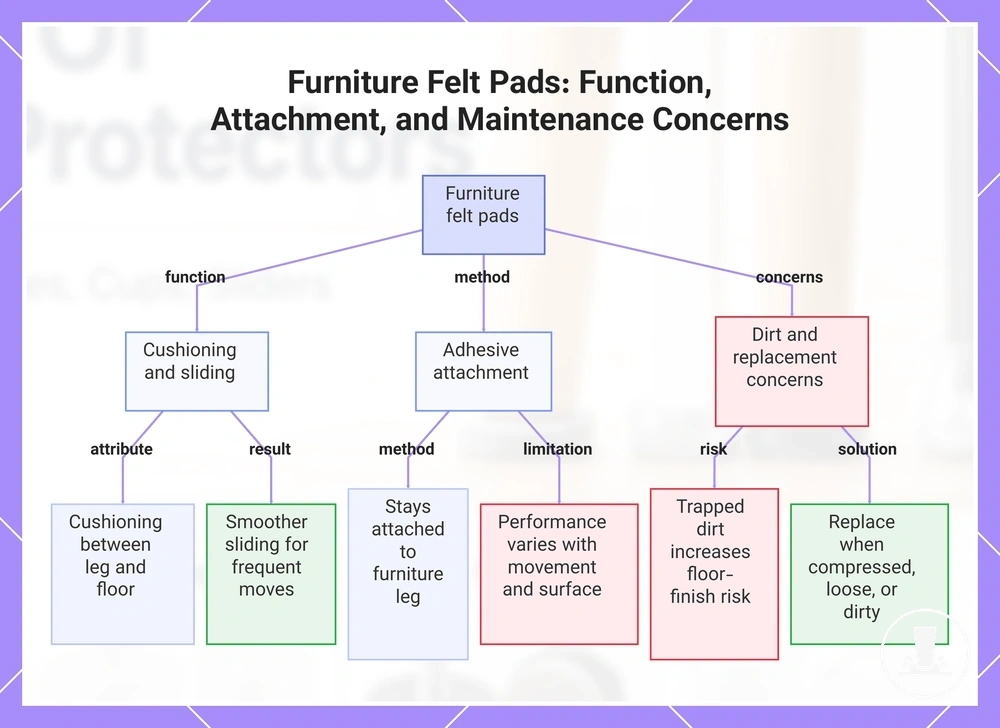
Felt pads are used when soft contact and easier sliding are the main needs at the floor-contact point. Felt pads create a cushioning layer between the furniture leg and the floor, which may help reduce direct surface contact depending on floor finish, dirt, and wear. Many felt pads use an adhesive contact method to stay attached to the furniture leg. The primary felt pad role is to provide cushioning and support smoother sliding.
When furniture is moved frequently, felt pads may support easier movement than harder contact surfaces. Dirt pickup can become a concern because debris trapped in the felt may increase floor-finish risk, and adhesive performance can vary with movement frequency and surface condition. Replacement may be needed when felt pads become compressed, loose, or collect dirt that cleaning no longer removes.
This chart outlines the primary purpose of furniture felt pads, their adhesive attachment method, and key limitations including dirt pickup and replacement needs.
Chair leg caps for covered leg-end protection
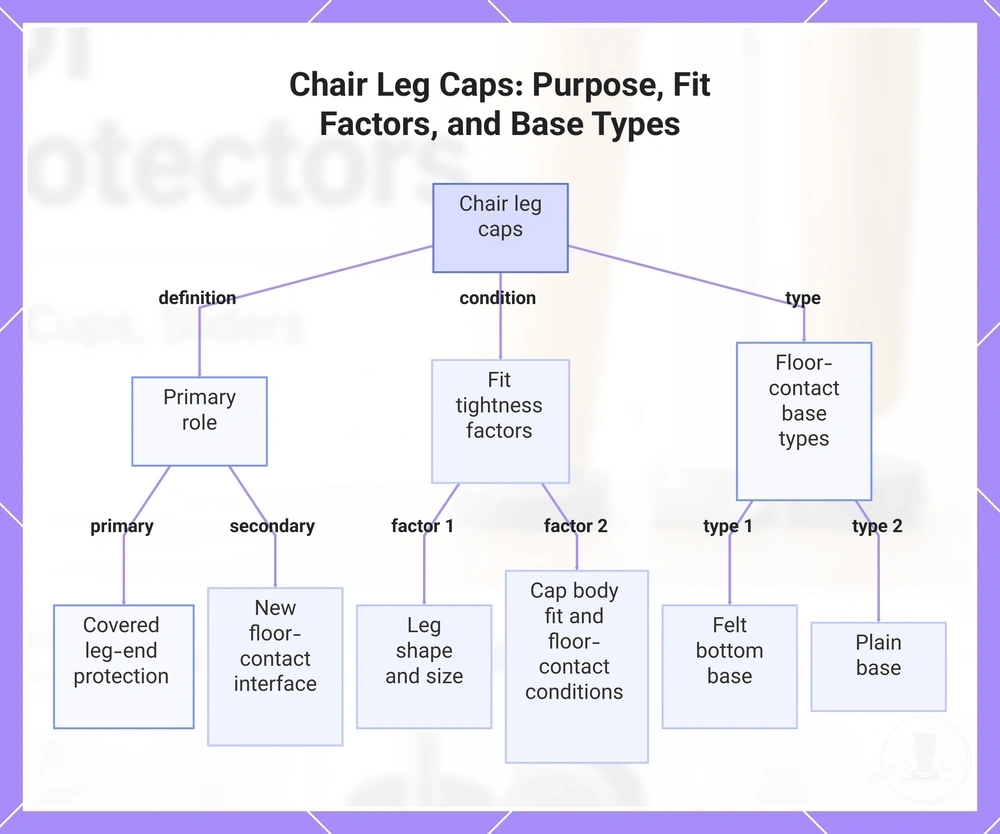
Chair leg caps are protectors that cover the leg end and create a new contact interface between furniture and the floor. The cap body fits over the covered end of the chair leg and provides a floor-contact base beneath it. Chair leg caps are commonly used on round legs and square legs, although fit tightness may vary by leg shape and size. Their primary role is covered leg-end protection.
When furniture legs differ in shape or dimensions, staying-on behavior may depend on cap body fit and floor-contact conditions. A floor-contact base with a felt bottom may influence movement and wear differently from a plain base, depending on use conditions and surface characteristics. For broader fit-related context, see chair leg floor protectors. Fit tightness remains a key factor in how securely chair leg caps stay in place.
This chart shows the definition, fit factors, and floor-contact base types of chair leg caps, explaining their primary role and conditions affecting secure fit.
Furniture glides for controlled movement across floor surfaces
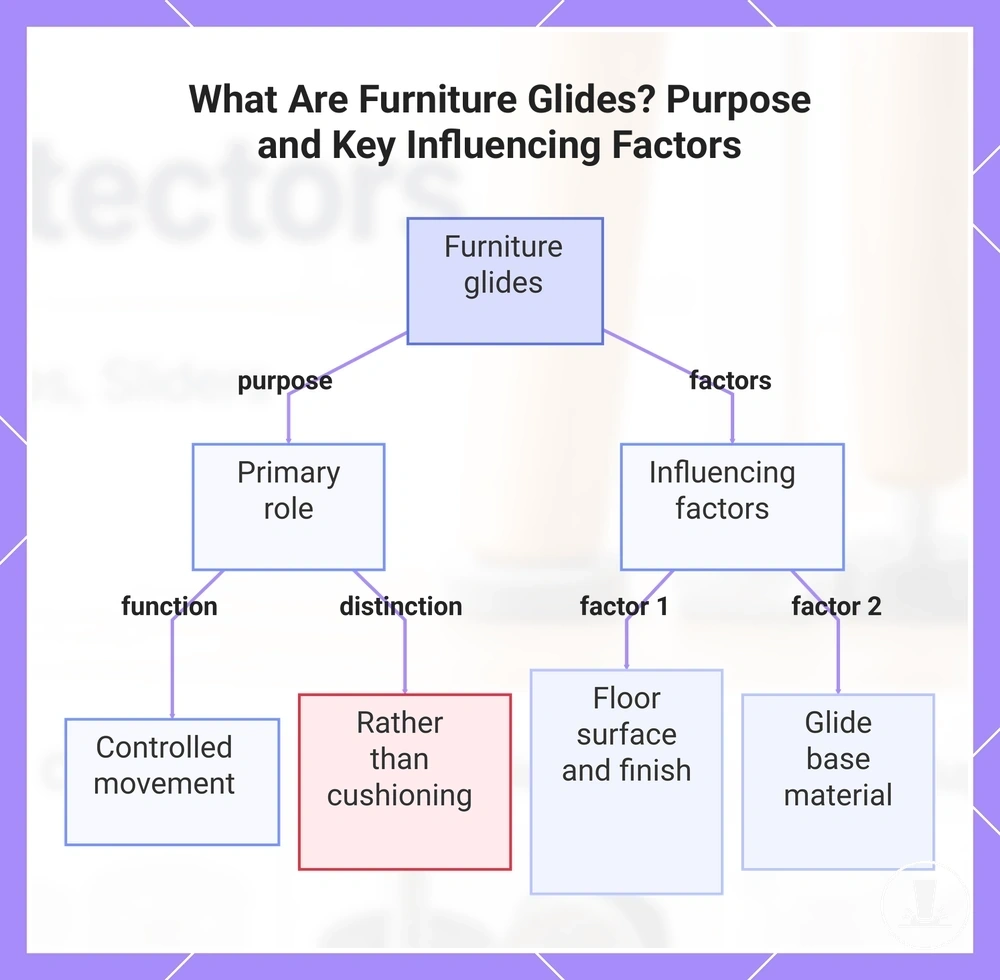
Furniture glides are floor-contact protectors designed for controlled movement rather than simple cushioning. A glide base manages friction between furniture and the floor surface, which may influence furniture movement depending on material, contact conditions, and floor finish. Furniture glides are often used where repeated movement is expected and movement behavior matters more than a cushioning layer. Their primary role is controlled movement.
When furniture is moved regularly, furniture glides may provide a different balance of friction and movement than pads that focus more on cushioning. Glide behavior can vary by floor surface, glide base material, movement frequency, and attachment dependency. For attachment-type context, see adhesive slip-on nail-on and tap-on protectors. Floor sensitivity and movement behavior may depend on both the glide base and attachment dependency.
This chart explains the primary role of furniture glides in controlled movement and the main factors that affect their behavior.
Furniture cups for stationary weight spread
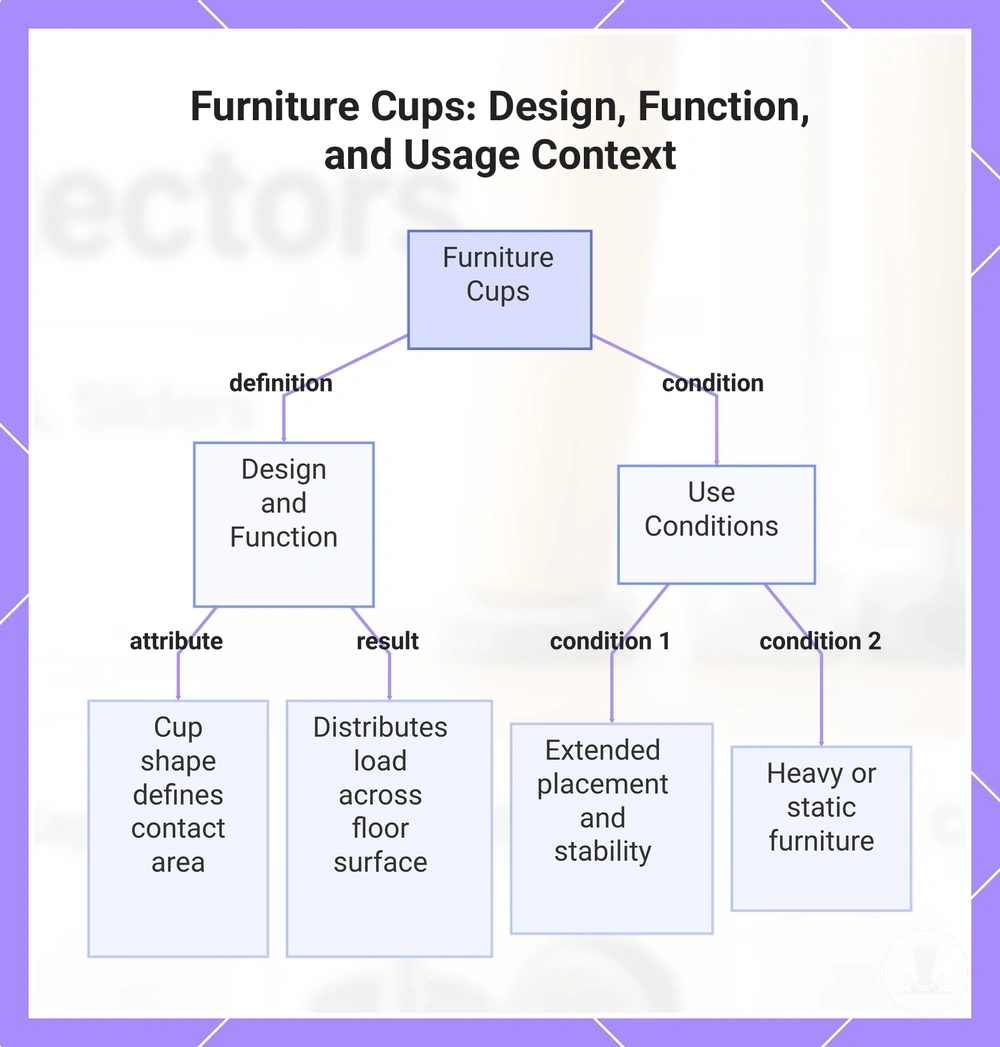
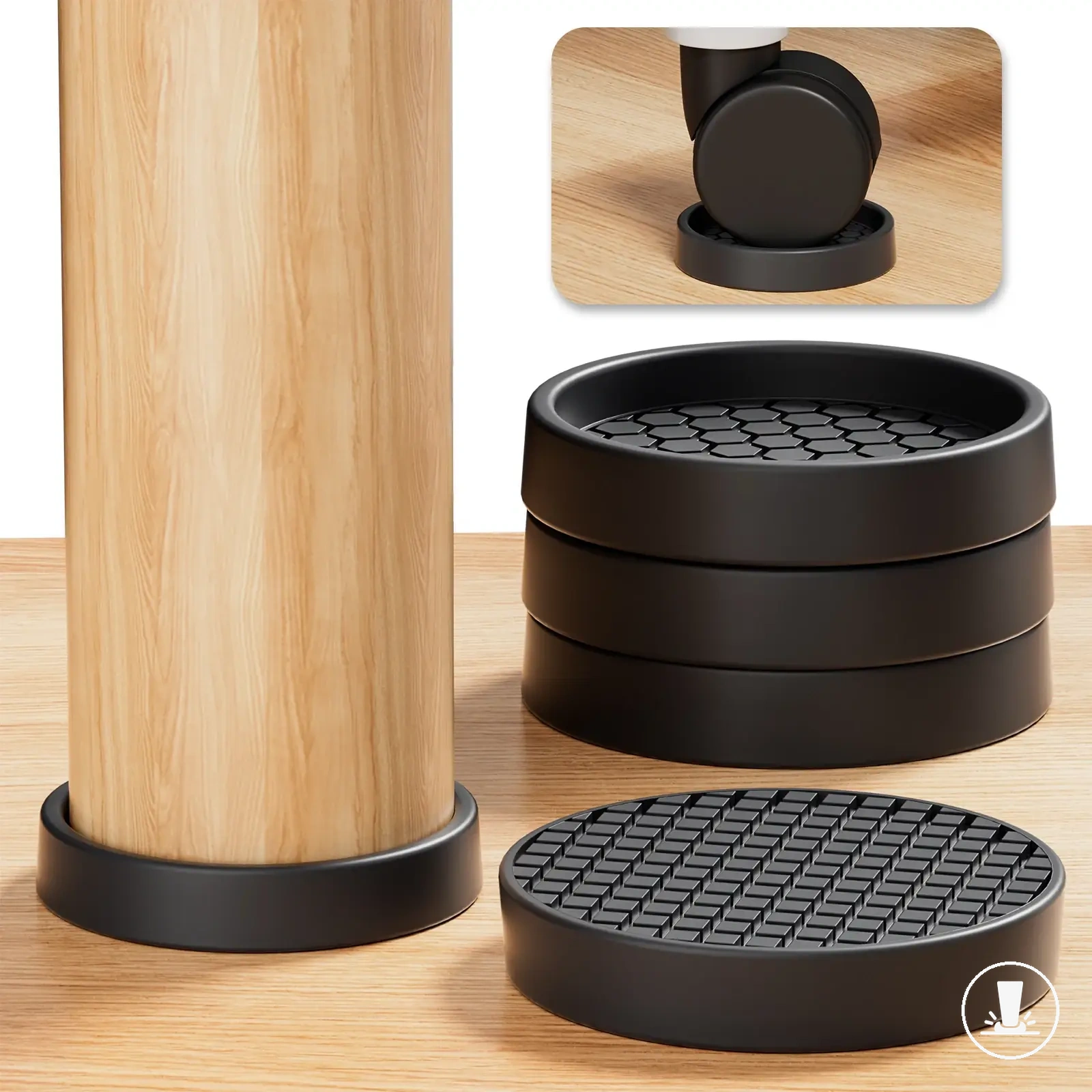
Furniture cups are support protectors designed for stationary support and weight spread beneath furniture feet or legs. Their cup shape creates a defined contact area that can distribute load across a wider portion of the floor surface than a direct contact point. Furniture cups are commonly used where furniture remains in place for extended periods and stability is a consideration. When heavy or static furniture is involved, cup shape, contact area, and floor surface condition may influence indentation risk and stability. Their primary role is stationary support through qualified load spread.
This chart explains what furniture cups are, how their cup shape enables load distribution, and the typical conditions for their use.
Furniture sliders for temporary moving and repositioning
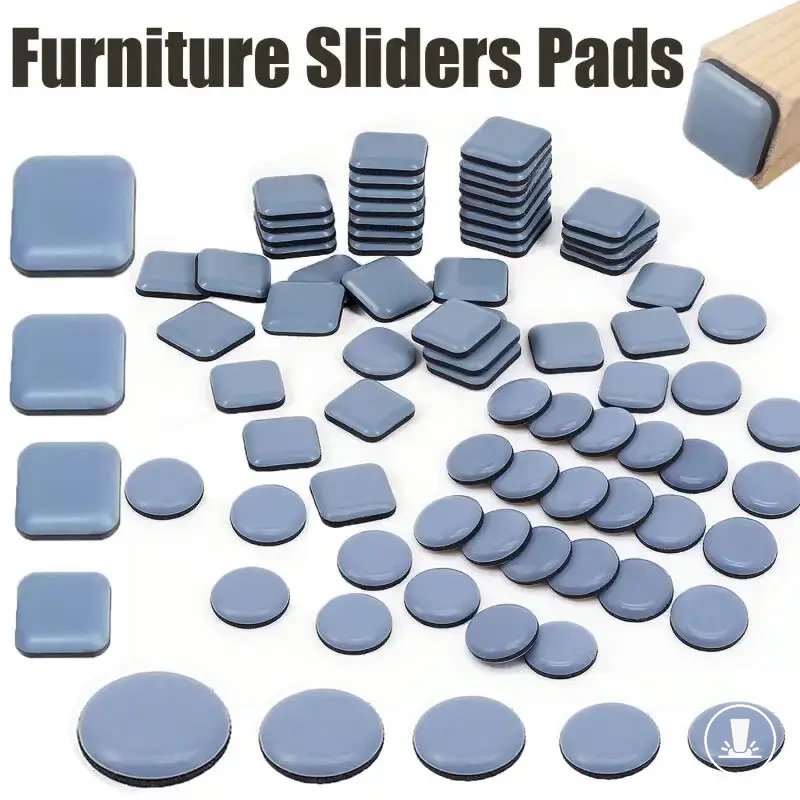
Furniture sliders are protectors designed for temporary movement and repositioning across a floor surface. Their low-friction surface can reduce movement resistance when furniture weight makes shifting difficult. Ease of movement may vary by floor surface condition, slider material, and furniture weight. Their primary role is temporary movement rather than ongoing floor protection.
When furniture needs to be moved for cleaning, rearranging, or access, furniture sliders can help support repositioning under suitable conditions. Use this quick checklist before moving:
- Check furniture weight and whether the slider size suits the contact point.
- Consider the floor surface condition and planned movement path.
- Place sliders beneath stable contact areas before repositioning.
- Move furniture gradually and monitor movement resistance.
- Remove or retain the sliders only if the slider design and floor surface are suitable for continued contact.
- Furniture sliders focus on temporary movement and repositioning.
- Permanent protectors are intended for longer-duration floor contact.
- Both can address floor contact, but they do not serve identical roles.
Non slip furniture grippers for holding furniture in place
Non slip furniture grippers are floor-contact protectors designed to reduce unwanted movement through added grip and friction between furniture and the floor surface. Their primary role is to improve stability under suitable conditions rather than to support movement. The effectiveness of non slip furniture grippers can vary with floor finish, furniture weight, contact area, and weight distribution across the furniture base. Grip strength and hold performance depend on floor surface condition and other contact factors, making movement reduction a qualified rather than absolute outcome.
- Floor finish can influence friction levels and overall grip behavior.
- Furniture weight and weight distribution may affect stability and holding performance.
- Contact area can change how friction is distributed beneath the furniture base.
- Residue or marking risk may depend on gripper material and floor surface condition.
How protector types differ by sliding, grip, cushioning, and load support
Protector types differ by the effect they create at the floor-contact point rather than by product model or brand. Sliding, grip, cushioning, and load support each address different furniture-to-floor interaction needs, and every type involves a trade-off. A glide may improve movement ease through lower friction, while a gripper may increase stability through added friction. These differences make sliding, grip, cushioning, and load support the primary comparison criteria.
When movement ease is the priority, a sliding-focused protector may be more suitable than a stability-focused one. When stability, cushioning, or weight spread matters more than movement, a different contact behavior may be preferable. The image below shows how protector types differ by sliding, grip, cushioning, and load support before the table organizes trade-offs and mismatch risk.
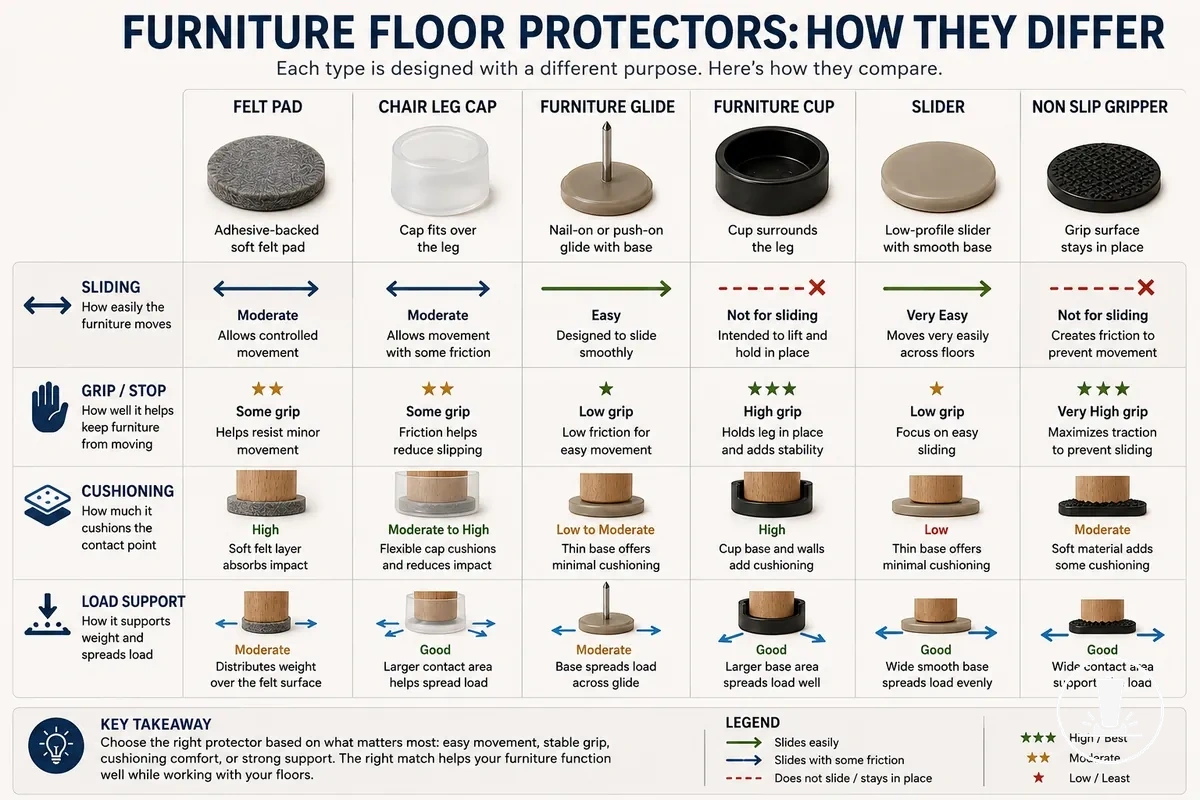
| Protector type | Strongest effect | Trade-off | Better use condition |
|---|---|---|---|
| Pads | Cushioning and soft contact | May provide less movement ease than glides | When contact-surface cushioning is the main need |
| Caps | Controlled contact behavior | Performance depends on fit and contact-base design | When leg-end coverage and managed floor contact are needed |
| Glides | Sliding and movement ease | May provide less hold than grippers | When furniture moves regularly across a floor surface |
| Cups | Load support and weight spread | Movement is not the primary contact behavior | When furniture remains stationary and contact area matters |
| Sliders | Temporary repositioning | May not suit ongoing floor contact | When temporary movement is the primary goal |
| Grippers | Grip and stability | Reduced movement can make repositioning more difficult | When unwanted movement needs to be reduced |
Which protector type fits common furniture and floor situations
Protector type selection depends on furniture movement, furniture weight, floor condition, contact shape, and the desired outcome. A protector type that suits frequent chair movement may not offer the same suitability for stationary heavy furniture, while a type that improves grip may be less suitable when movement ease is the priority. Leg or foot shape can influence fit because contact shape affects how the protector meets the furniture base. Fit and suitability depend on conditions rather than one universal best type.
When chairs move frequently, movement frequency often becomes the primary selection factor. When a furniture setup includes heavier items, furniture weight, load level, and contact area may influence the protector type decision more than movement. For example, a dining chair that moves daily may require a different match than a stationary cabinet. The table below organizes common situations by condition, suitability, and caution.
| Situation | Main condition | Better type direction | Caution |
|---|---|---|---|
| Moved chairs | Frequent furniture movement | Glides or pads may support sliding control | Suitability depends on floor condition and contact shape |
| Stationary heavy furniture | Higher furniture weight and load level | Cups may support load spread across a larger contact area | Mismatch risk may increase when contact area is limited |
| Hard floors | Visible floor finish and direct contact | Pads, caps, or glides may suit different desired outcomes | Grip and movement behavior can vary by floor condition |
| Carpeted floors | Soft surface interaction | Type direction depends on movement and stability needs | Fit may vary with carpet texture and furniture setup |
| Mixed-use rooms | Changing use situations | Selection may depend on balancing grip, movement, and contact shape | No single protector type suits every condition |
Frequently moved chairs and tables
Frequently moved chairs and tables depend on protector behavior that balances repeated movement, sliding control, cushioning, and grip risk. Protectors that support controlled sliding may be more suitable when dining chairs move often, while higher-grip options can increase resistance during repositioning. Cushioning can help soften floor contact, but wear and noise reduction may vary with floor finish, dirt buildup, adhesive condition, fit, and contact surface characteristics. Replacement frequency depends on movement frequency and floor-contact conditions.
- Repeated movement can increase friction and wear at the contact surface.
- Sliding control may be more suitable than high grip when chairs move regularly.
- Cushioning can help soften contact between chair legs, tables, and the floor surface.
- Grip risk may increase when moved furniture is repositioned often.
- Replacement frequency may vary with dirt accumulation, adhesive condition, fit, and use patterns.
Stationary sofas, dressers, and heavy furniture
Stationary sofas, dressers, and heavy furniture depend on protector behavior that supports load spread across an appropriate contact area while maintaining stability under low movement frequency. A larger contact area may help distribute weight more broadly, while indentation risk can vary with floor material, foot width, furniture weight, and duration of use. Protector choice for static furniture should prioritize stability and contact-area support before movement-related considerations. Suitability depends on weight and contact area, and broader situation-specific guidance is available in heavy furniture floor protectors.
Hard floors, carpeted floors, and mixed floor use
Hard floors, carpeted floors, and mixed floor use depend on how a protector interacts with the floor surface, because friction, softness, finish sensitivity, debris risk, and protector behavior can change under different conditions. The same protector type may move differently on hard surfaces, respond differently on carpet, or involve trade-offs in mixed rooms where flooring changes between areas. Grip, movement, and floor contact outcomes often depend on floor finish, surface softness, debris accumulation, and protector material. Floor surface changes protector behavior.
| Floor situation | Behavior change | Selection caution |
|---|---|---|
| Hard floors | Friction and finish sensitivity may influence grip and movement. | Debris risk and floor condition can affect contact behavior. |
| Carpeted floors | Softness may change movement response and load distribution. | Protector behavior can vary with carpet condition and density. |
| Mixed floor use | The same protector may behave differently across floor surfaces. | Movement and grip may require a condition-based trade-off. |
Common type confusions that change the right choice
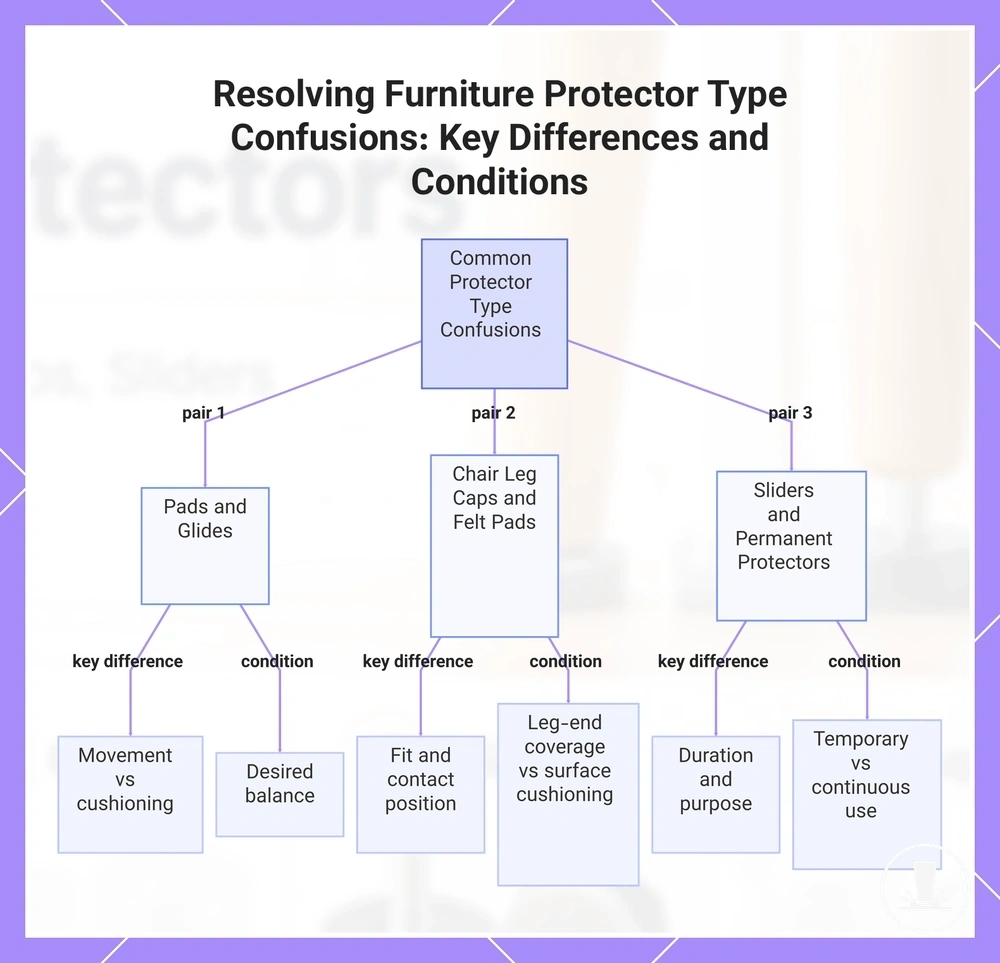
Type confusion depends on recognizing that similar protector names can describe different contact behavior and use cases. Many protector types share a floor-contact purpose, yet a shared attribute can hide a key difference that changes the protector choice. Movement, cushioning, fit, and duration are often the attributes that separate similar-looking options. Overlooking those distinctions can make type confusion a decision risk.
Pads and glides share the attribute of reducing direct furniture-to-floor contact, but their key difference is movement versus cushioning. Pads are associated with cushioning at the contact point, while glides are associated with controlled movement. The likely outcome may differ depending on whether cushioning or movement is the more important condition. The condition that changes the choice is the desired balance between movement and cushioning.
Chair leg caps and felt pads share the attribute of protecting a furniture contact area, but the key difference is fit and contact position. Chair leg caps cover the leg end, while felt pads are typically applied at the contact surface. Their likely outcome may vary depending on furniture shape and attachment approach. The condition that changes the choice is whether leg-end coverage or surface-level cushioning is needed.
Sliders and permanent floor protectors share the attribute of reducing direct floor contact, but the key difference is duration and purpose. Sliders are intended for temporary movement, while permanent floor protectors are intended for ongoing floor contact. Attachment criteria may also influence the decision, as discussed in adhesive slip-on nail-on and tap-on protectors. The condition that changes the choice is whether the goal is temporary repositioning or continuous use.
When similar protector types appear interchangeable, comparing the shared attribute, key difference, and condition can reduce confusion before selection. A comparison pair may seem alike until movement needs, fit requirements, contact position, or duration become the deciding factor. This distinction often appears when evaluating broader chair leg floor protectors scenarios alongside movement-focused choices. The most practical decision is to match the protector type to the condition that changes the likely outcome.
The products below are useful examples for comparing available options. Before buying, check that the compatibility criteria, key features, and product details match your needs.
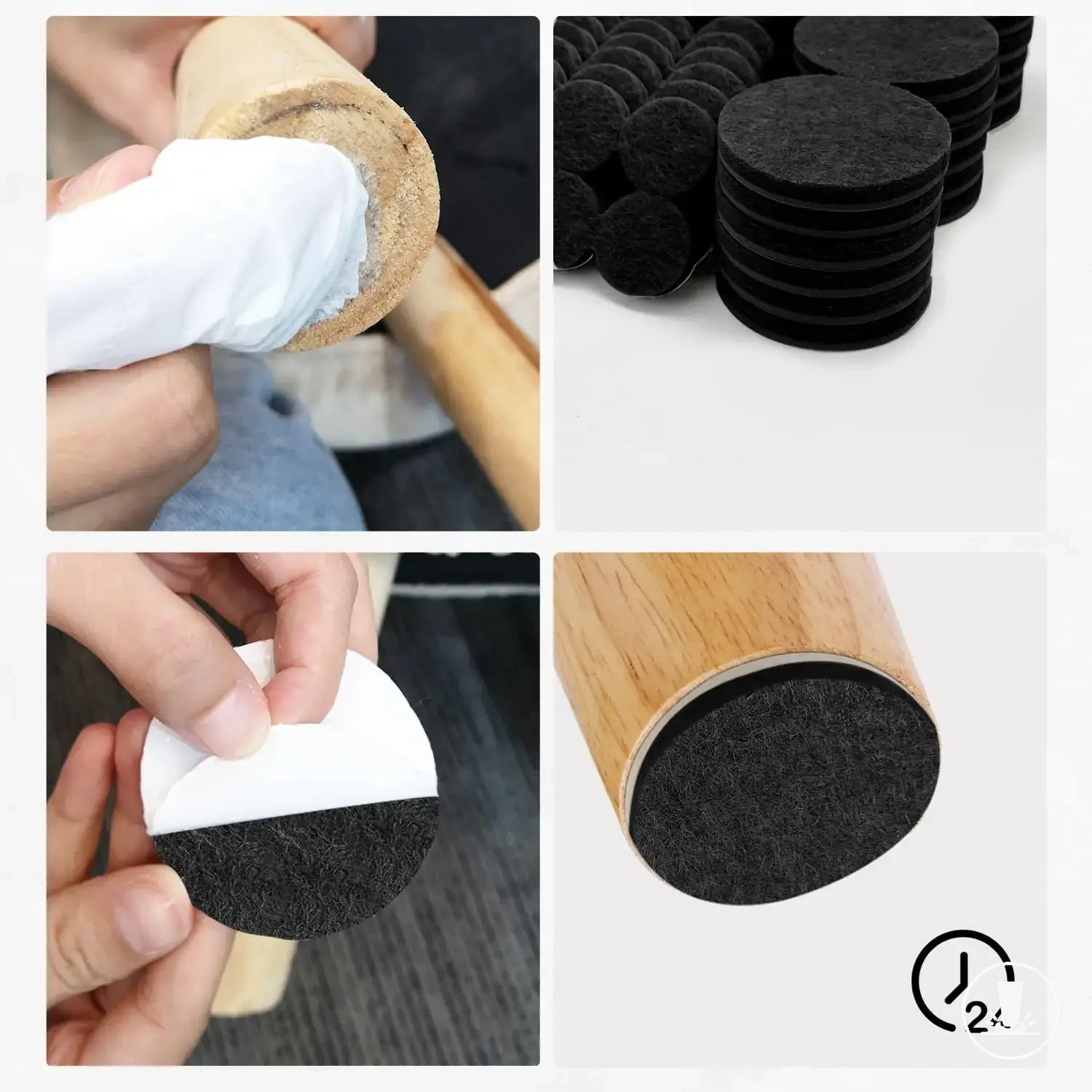
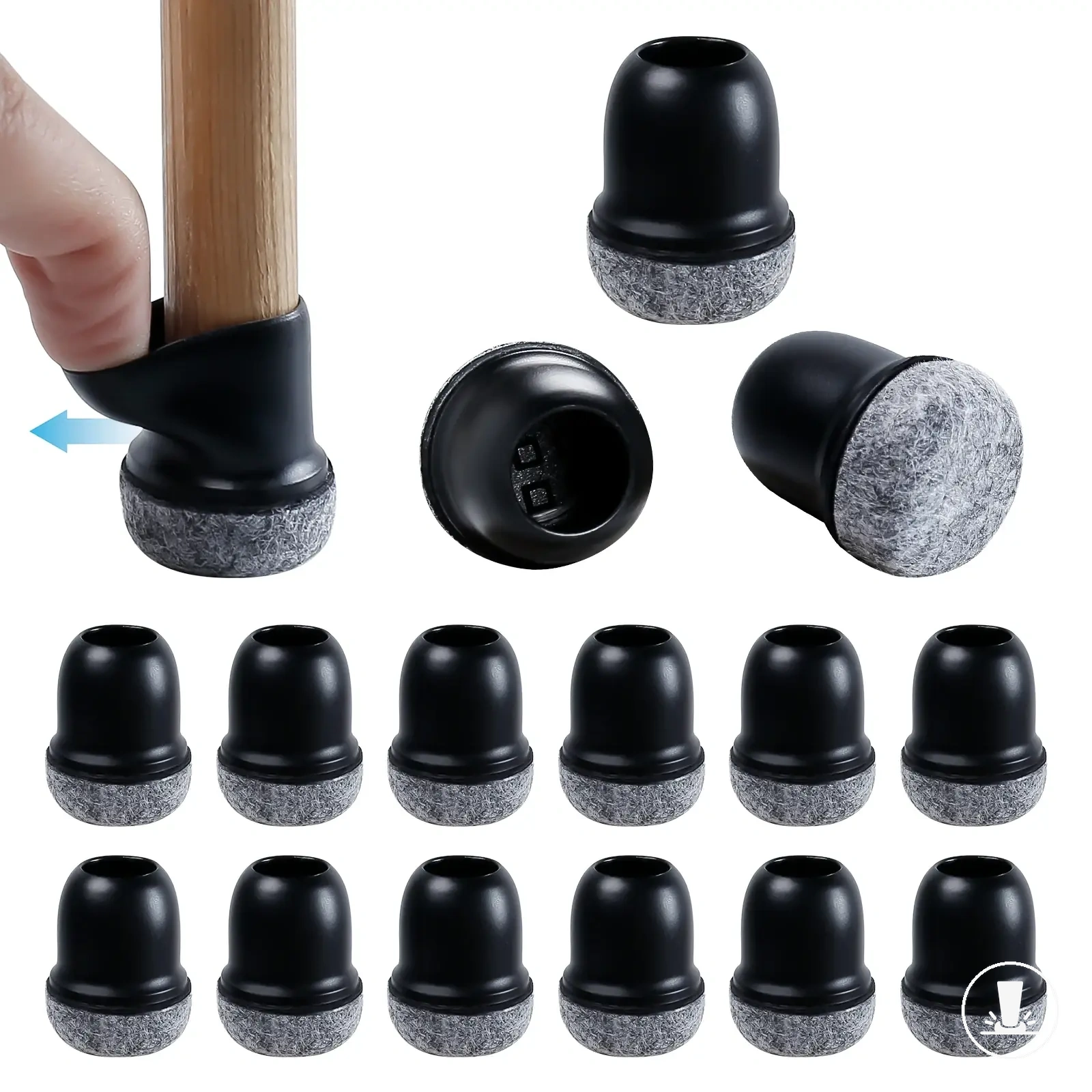
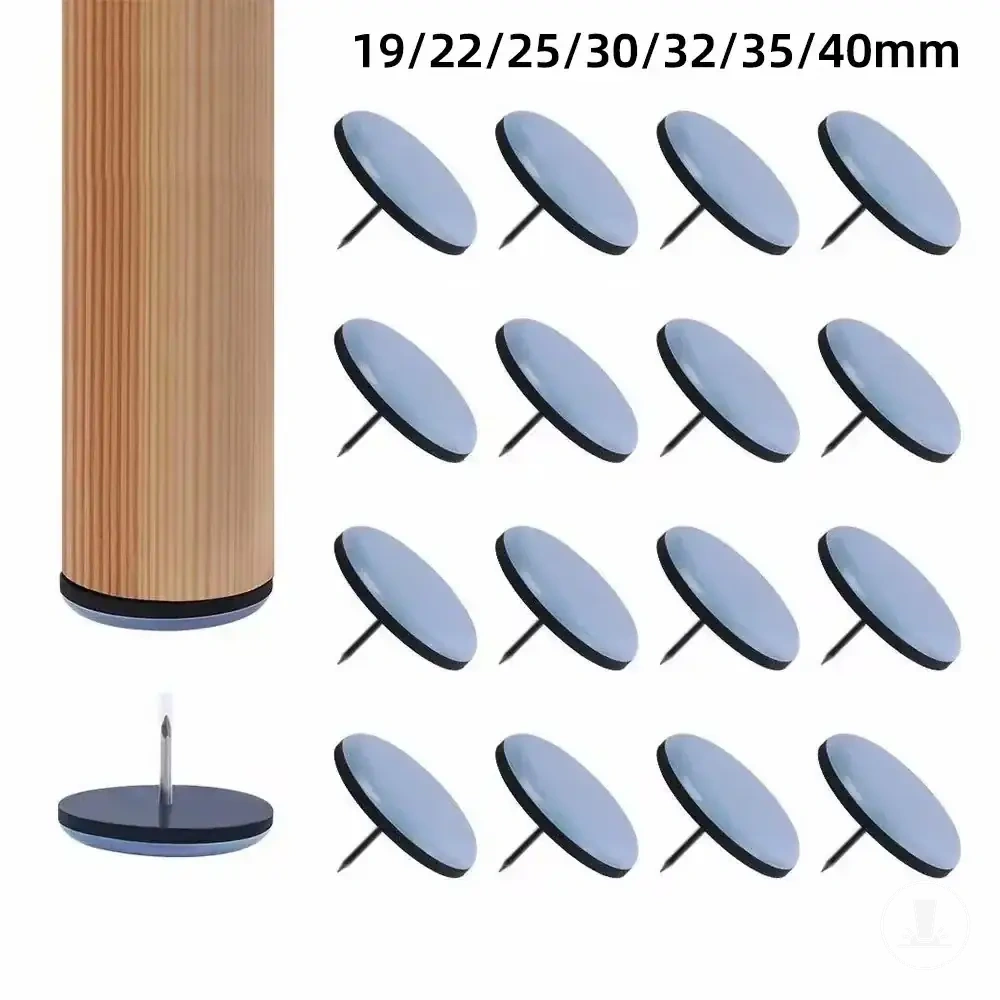
This chart compares three common protector type confusions, showing the key difference and deciding condition for each pair to help choose the right protector.
Furniture pads vs furniture glides
Furniture pads and furniture glides differ mainly in contact behavior and movement control. Furniture pads typically emphasize cushioning at the contact surface, while furniture glides focus on managing friction to support sliding ease. Sliding ease, floor sensitivity, and overall behavior may vary with floor finish, attachment dependency, fit, and use condition. The core distinction between furniture pads and furniture glides is movement versus cushioning.
| Pads | Glides |
|---|---|
| Cushioning is the main effect. | Movement control is the main effect. |
| Movement may involve higher friction. | Movement may involve lower friction and greater sliding ease. |
| Contact behavior focuses on cushioning at the contact surface. | Contact behavior focuses on controlled movement across the floor surface. |
| Wear may depend on attachment dependency and use condition. | Floor sensitivity may depend on attachment dependency and floor condition. |
| Often chosen when cushioning is the priority. | Often chosen when movement control is the priority. |
Chair leg caps vs felt pads
Chair leg caps and felt pads differ mainly by coverage, fit, and contact position. Chair leg caps provide leg-end coverage through fitted contact around the chair leg, while felt pads use adhesive contact at the floor-contact area. Staying-on risk, movement behavior, and replacement timing may vary with leg shape, movement, and wear conditions. The core distinction is coverage versus contact position.
| Chair leg caps | Felt pads |
|---|---|
| Provide leg-end coverage. | Protect the contact position beneath the chair leg. |
| Use fitted contact around the leg. | Use adhesive contact at the floor-contact base. |
| Fit dependency may vary with leg shape and size. | Adhesive contact may vary with movement and wear. |
| The floor-contact base is part of the cap structure. | The floor-contact base is created by the pad. |
| Replacement may be needed when fit changes or staying-on risk increases. | Replacement may be needed when wear increases or adhesive contact weakens. |
Furniture sliders vs permanent floor protectors
Furniture sliders and permanent floor protectors differ primarily by duration and purpose. Furniture sliders are intended for temporary movement across a floor surface, while permanent floor protectors are intended for continuous contact beneath furniture. Both interact with furniture weight and the floor surface, but they serve different roles. The key distinction is temporary movement versus continuous contact.
When moving furniture is the main job, furniture sliders may be part of the decision because they are designed for temporary movement rather than ongoing protection. Permanent floor protectors are typically considered when furniture weight remains in one position and continuous contact with the floor surface is expected. Whether a slider remains in place depends on product design, floor surface, furniture weight, and use conditions. The final decision often centers on removal for temporary movers or retention for ongoing protectors.
| Sliders | Permanent protectors |
|---|---|
| Temporary duration | Continuous duration |
| Purpose is temporary movement | Purpose is ongoing floor contact |
| Used during furniture repositioning | Used during regular furniture use |
| Risk and suitability may vary with floor surface and furniture weight | Risk and suitability may vary with floor surface and furniture weight |
| Often involve removal after the moving task | Often involve retention during continued use |