Furniture Floor Protector Attachment Methods Compared
Furniture floor protectors differ mainly by attachment method because attachment methods can influence fit, holding strength, floor contact, and replacement effort. furniture floor protectors are floor-contact accessories designed to sit between a furniture leg and the floor surface under suitable conditions. The same furniture floor protector function can behave differently depending on how it attaches to the furniture leg. This comparison focuses on adhesive pads, slip-on caps, nail-on glides, and tap-on glides as the main attachment methods.
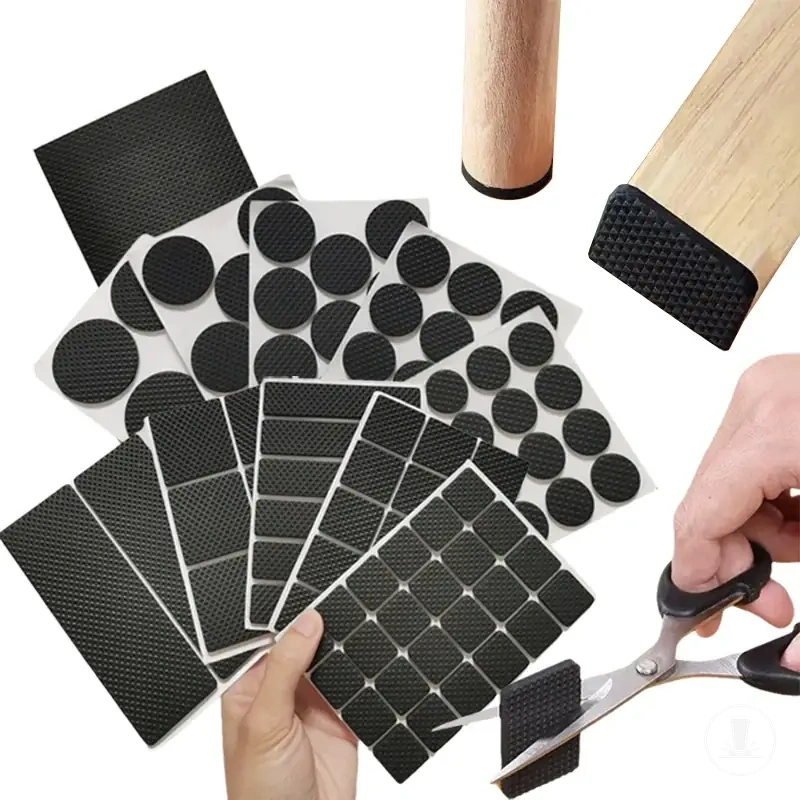
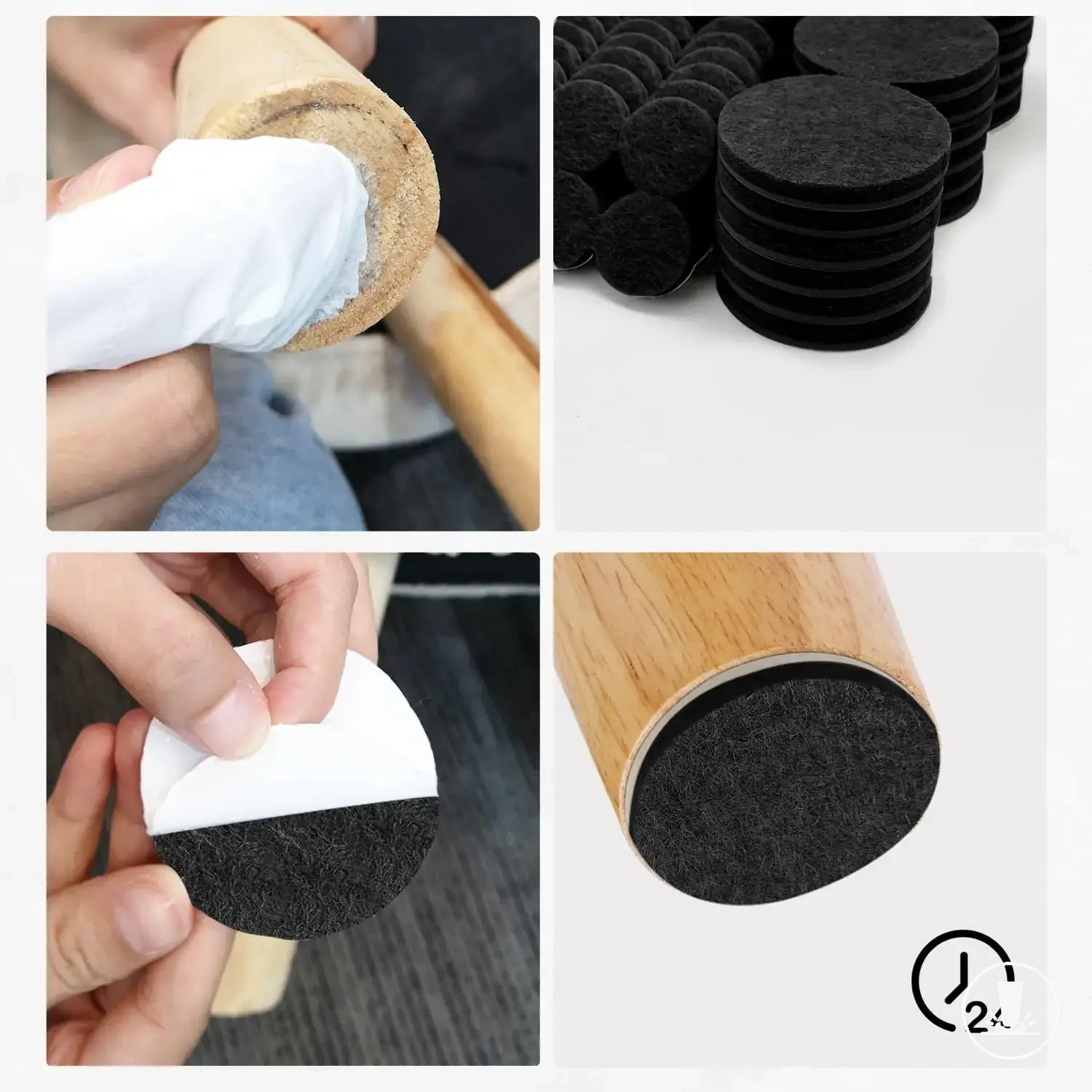
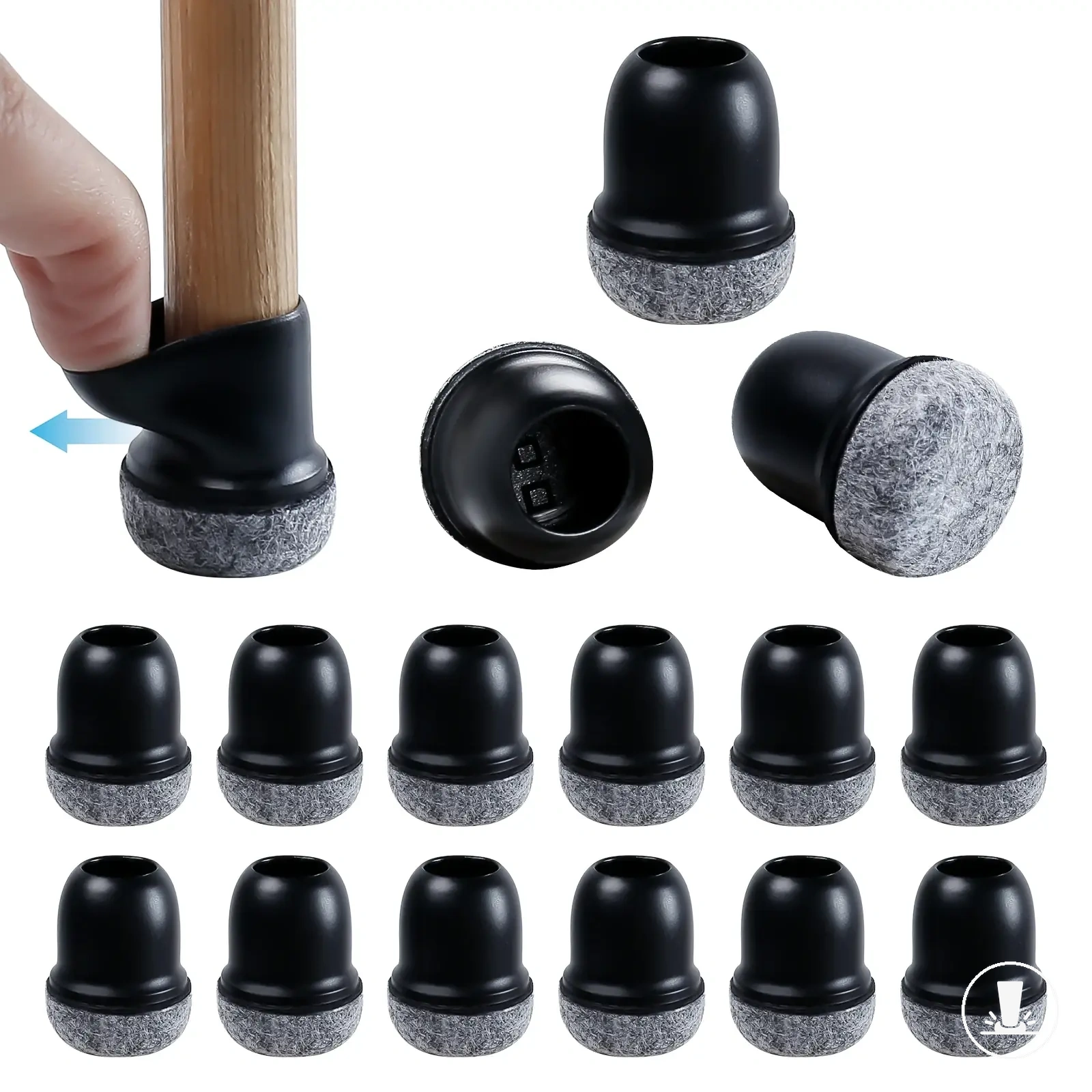
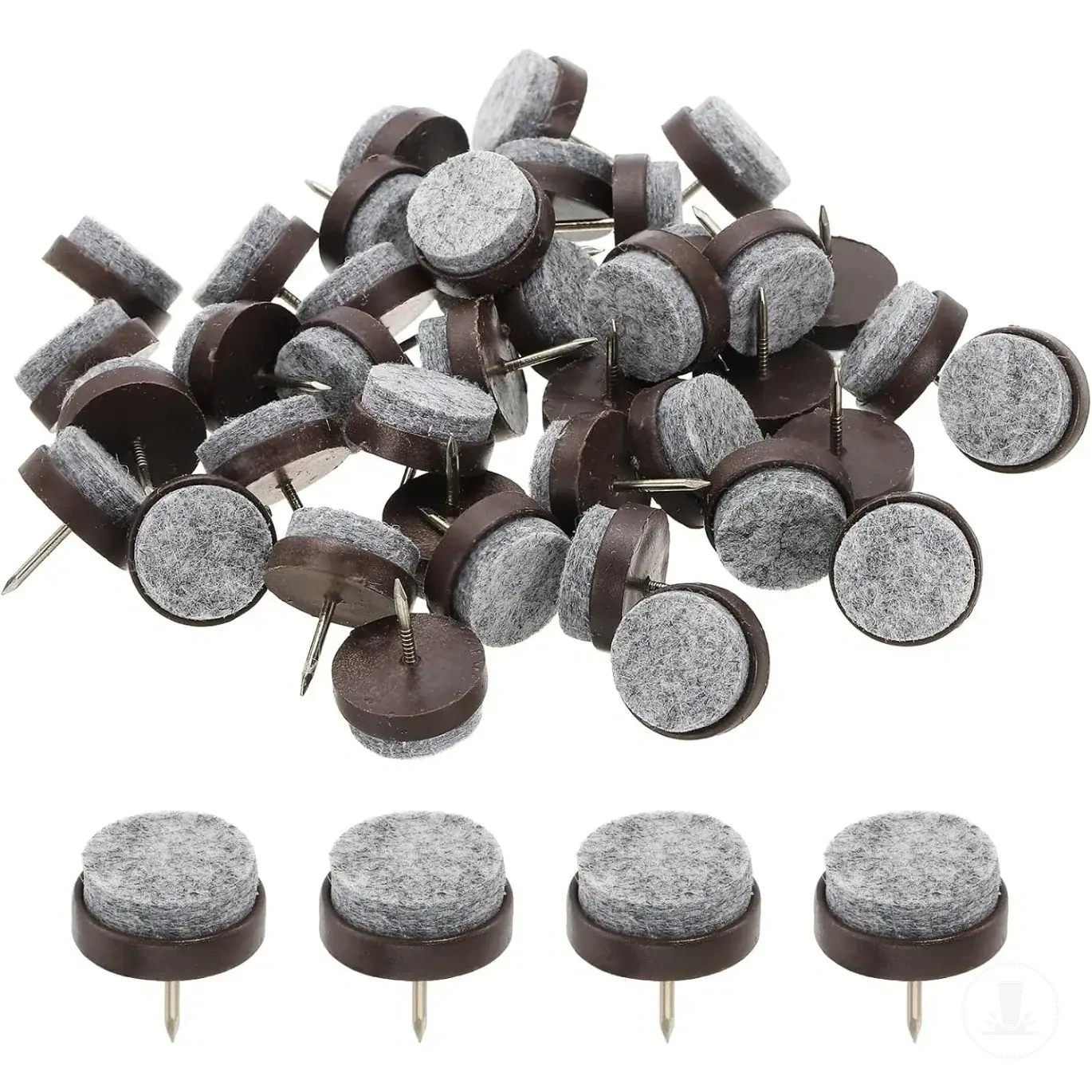
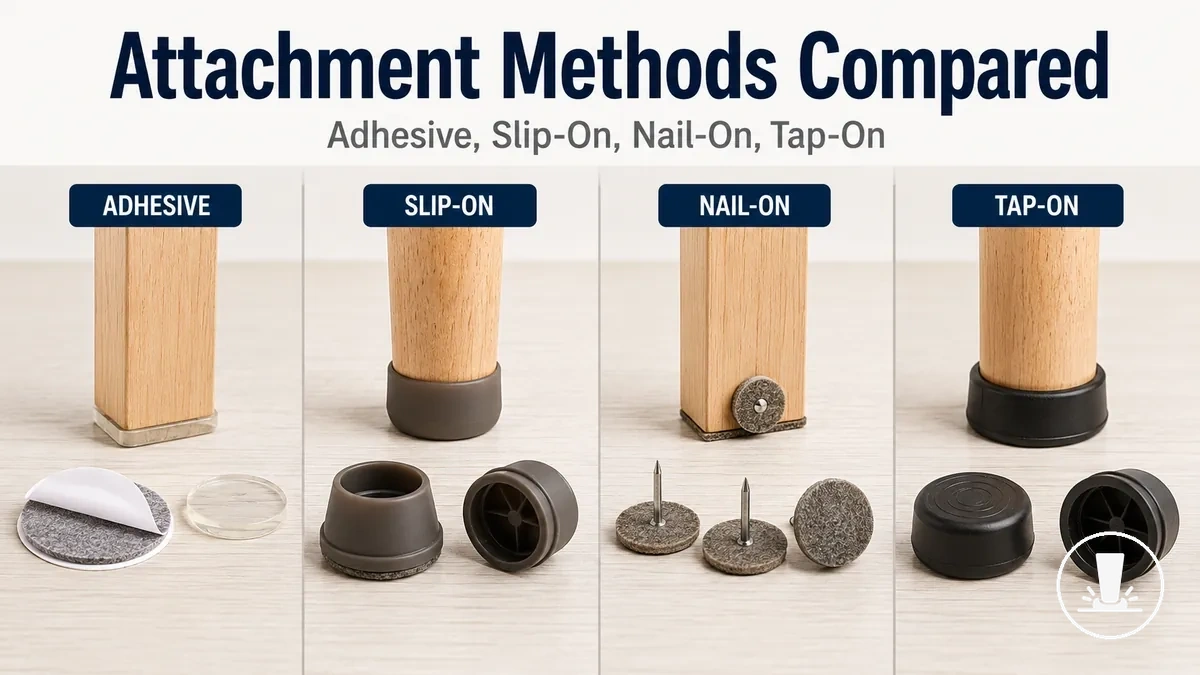
Furniture Floor Protector Attachment Methods Compared: The image for this page highlights how each method attaches to the furniture and contacts the floor, helping clarify the differences before evaluating method-specific tradeoffs and compatibility considerations.
Attachment method refers to the way a furniture floor protector is secured to a furniture leg or furniture foot. The attachment method can affect holding strength, movement behavior, floor contact stability, and replacement effort. Attachment method is different from material because adhesive pads, felt pads, caps, and glides are often discussed together even though they describe different attributes. Material, floor type, and leg sizing remain separate considerations from attachment method.
When furniture is moved frequently or used across different floor surfaces, attachment-method differences may become more noticeable. One method may suit a situation better because of its fit, holding strength, or replacement effort, while another may involve a different tradeoff depending on the furniture leg and usage conditions. The following comparison focuses on method-level differences rather than providing a full guide to product types, sizing, or troubleshooting.
What Attachment Method Changes in Furniture Floor Protectors
Attachment method is the way a furniture floor protector connects to a furniture leg and maintains contact with the floor. As an attribute of a furniture floor protector, it affects how the protector is secured rather than what the contact surface is made from. Attachment method changes how the protector is held in place.
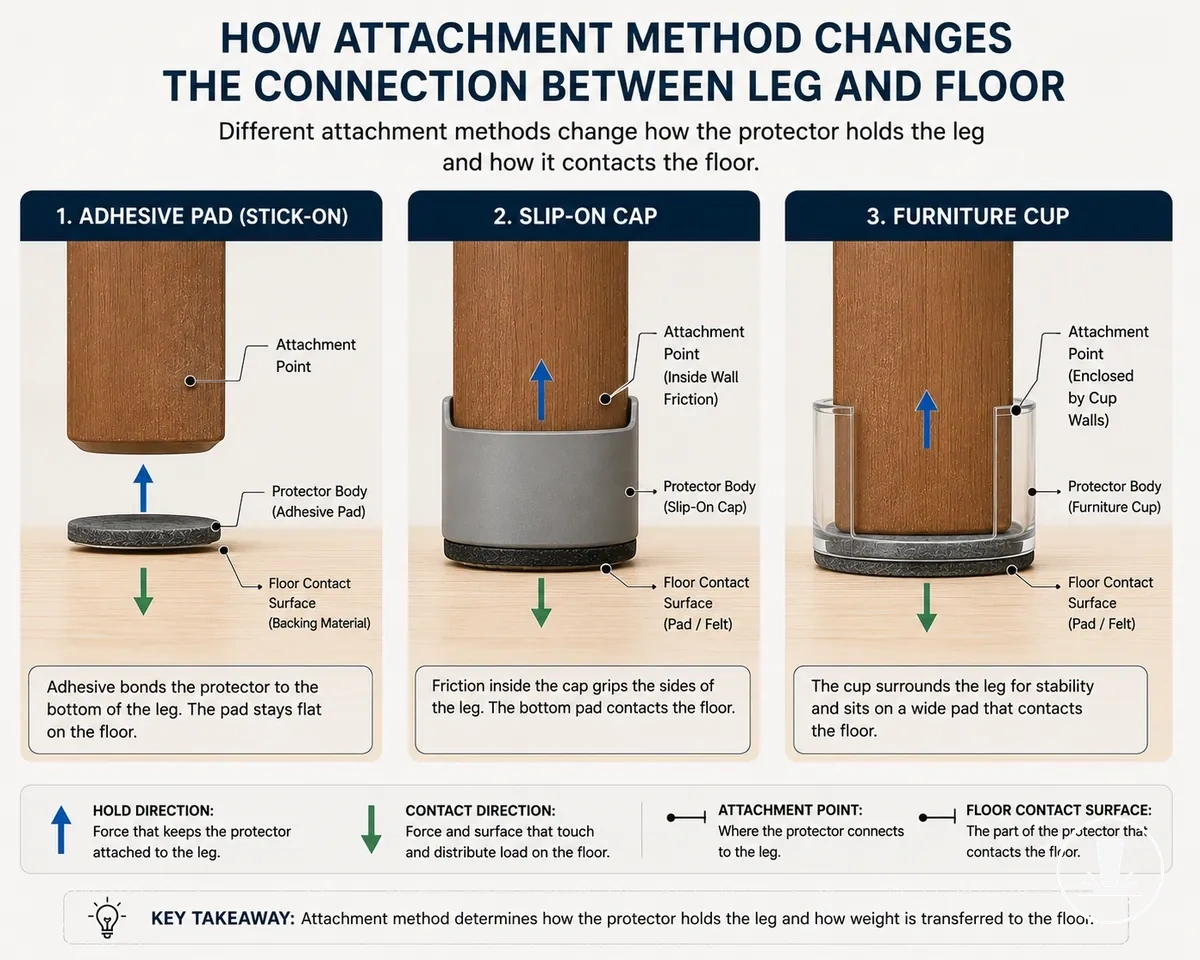
What Attachment Method Changes in Furniture Floor Protectors is mainly the behavior between the furniture leg and the floor contact point. Different attachment methods can influence contact stability, floor movement, noise behavior, removability, and replacement difficulty because they connect to the furniture leg in different ways. Adhesive, slip-on, nail-on, and tap-on methods use different holding approaches, which may change how the protector behaves during use. These differences may affect stability, removability, movement behavior, and replacement burden.
What Attachment Method Changes in Furniture Floor Protectors: The diagram labels the attachment point and the floor-contact point to separate attachment effects from adjacent criteria.
| Attribute | What attachment changes | What still depends on context |
|---|---|---|
| Hold | How the protector stays connected to the furniture leg | Leg shape, surface condition, and usage patterns |
| Removability | How easily the protector may be removed or replaced | Protector design and furniture condition |
| Floor contact | How consistently the protector maintains contact during movement | Floor surface, load, and contact material |
| Noise behavior | How movement may influence sound through the connection point | Contact material, floor type, and movement frequency |
| Replacement | The effort involved when changing a worn protector | Protector construction and attachment condition |
When the same felt, rubber, or plastic contact surface is used with different attachment methods, the furniture floor protector may behave differently because the holding method changes how the protector stays aligned during movement. Material and leg size still matter, but they are not the main subject here. Broader category differences are covered in types of furniture floor protectors, where type-level distinctions extend beyond attachment-method differences.
Adhesive, Slip-On, Nail-On, and Tap-On Methods Compared
Adhesive, slip-on, nail-on, and tap-on methods should be judged by fit, hold, floor safety, installation effort, and replacement needs. Each attachment mechanism secures a furniture floor protector differently, which can influence suitability depending on furniture movement, leg shape, and floor conditions. These evaluation criteria help reveal the tradeoff behind each attachment method.
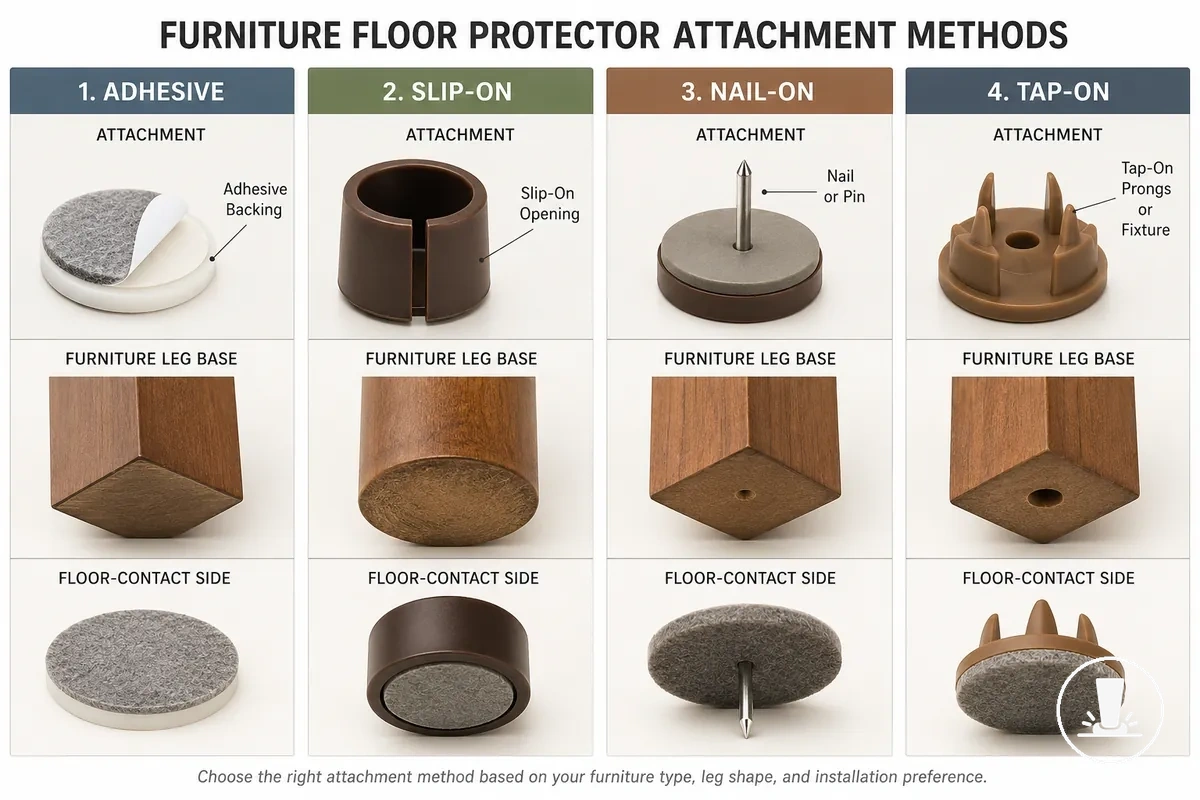
Adhesive, Slip-On, Nail-On, and Tap-On Methods Compared: The image shows visible attachment differences before the criteria table, highlighting how each method connects to the furniture leg and presents its floor-contact side.
When a removable method is easier to attach or replace, hold may depend more on surface condition, fit, or movement patterns. When a fixed method increases attachment security, removal can become less reversible and replacement may require more effort. The table below compares each method through mechanism, suitable condition, tradeoff, and replacement needs without ranking any method universally.
| Method | How it attaches | Best fit conditions | Main tradeoff | Replacement difficulty |
|---|---|---|---|---|
| Adhesive | Uses a stick-on attachment mechanism bonded to the furniture foot | Clean surfaces with a relatively flat foot area | Convenient replacement may come with reduced hold under heavier movement | Usually lower |
| Slip-on | Uses a cap-style attachment mechanism based on fit and tension | Furniture legs with a compatible shape and size | Performance may vary with leg shape and chair movement | Usually lower |
| Nail-on | Uses a nail-in attachment mechanism fixed into a wooden base | Furniture with a suitable wooden attachment point | Greater fixation may reduce reversibility and can leave removal marks | Usually higher |
| Tap-on | Uses tap-in prongs or a fixed glide attachment mechanism | Furniture designed for a fixed attachment point | More secure attachment may reduce ease of replacement | Usually higher |
Convenience, hold, and reversibility usually involve a tradeoff. A removable method can simplify replacement needs, while a more fixed method may provide stronger attachment when the furniture and floor context are suitable.
Adhesive Pads and Self-Adhesive Felt Protectors
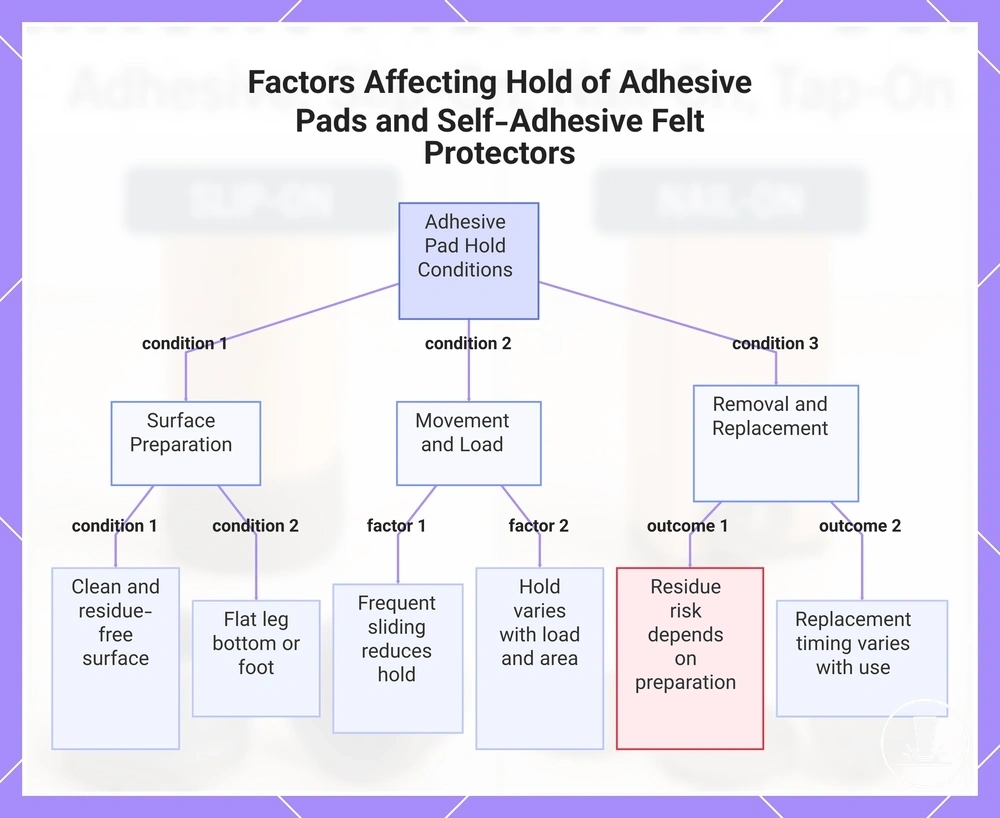
Adhesive pads and self-adhesive felt protectors depend on backing strength, surface preparation, and furniture movement. These stick-on pads are often more suitable on a clean surface with a flat leg bottom or furniture foot because the adhesive backing can make more complete contact. Hold, residue risk, and replacement frequency usually depend on clean surface conditions and movement patterns.
Adhesive Pads and Self-Adhesive Felt Protectors: The conditions below identify factors that can affect hold and removability.
- Surface cleanliness: Adhesive pads may achieve a more consistent hold when the contact area is clean and free from dust, moisture, or existing residue.
- Flat contact area: A flat leg bottom or furniture foot can support better contact between the adhesive backing and the furniture surface than an uneven contact area.
- Movement frequency: Frequent sliding or repeated furniture movement may reduce hold over time and increase replacement frequency.
- Furniture weight: Hold can vary with load, contact area, and movement conditions, so suitability depends on the furniture and surface context.
- Removal and replacement: Self-adhesive felt protectors are generally removable, but residue risk and replacement timing may vary with adhesive backing, surface preparation, and duration of use.
This chart shows the main conditions that influence the hold, residue risk, and replacement frequency of adhesive pads and self-adhesive felt protectors.
Slip-On Caps and Chair Leg Covers
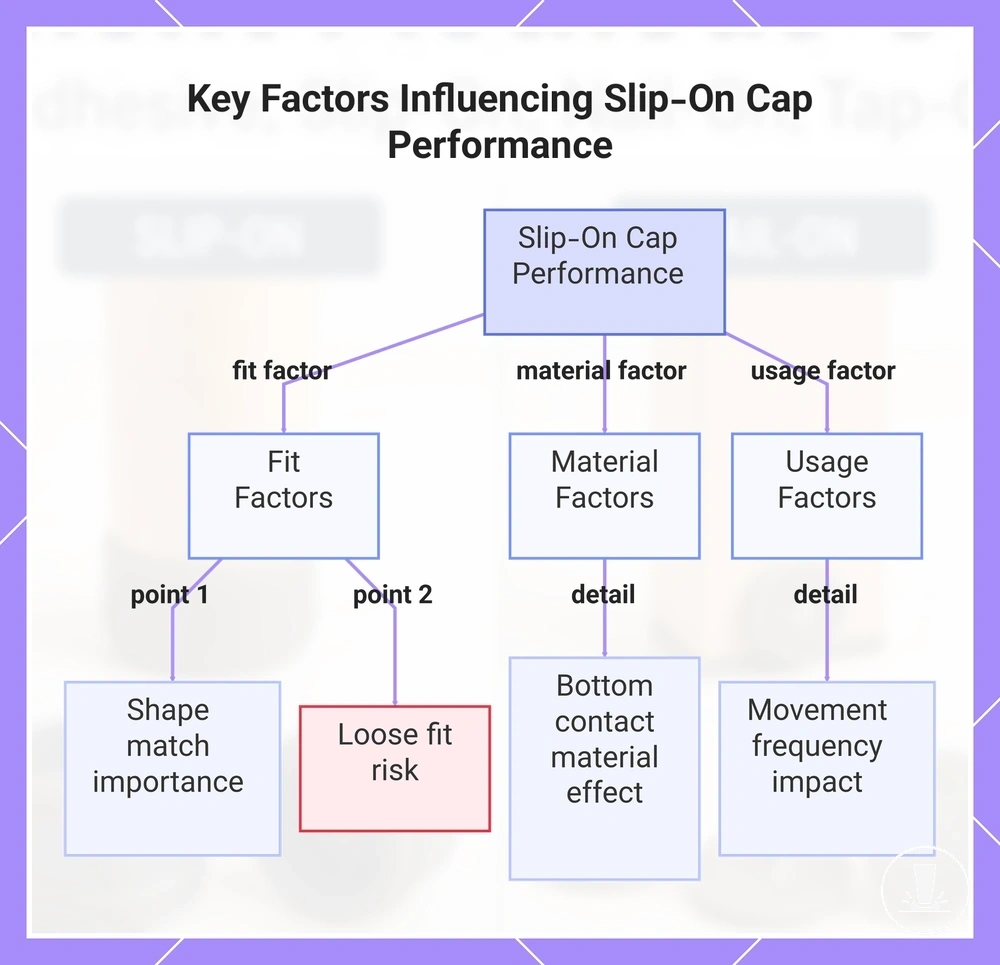
Slip-on caps and chair leg covers depend on tension fit, leg coverage, and shape match. These cap-style protectors attach by fitting over the furniture leg, and grip often depends on how closely the cover matches the leg profile. Slip-on performance is usually influenced by measured fit, material stretch, and movement conditions.
Slip-On Caps and Chair Leg Covers: The conditions below highlight factors that can affect grip, noise control, and fall-off risk.
- Leg shape: Shape match matters because a slip-on cap that fits one leg profile may not provide the same grip on a different shape.
- Leg profile: Chair leg covers often perform more consistently when the cap dimensions and leg profile are closely matched.
- Stretch and tension: Tension fit can help keep cap-style protectors in place, while a loose fit may increase fall-off risk during furniture movement.
- Bottom contact material: Grip and noise control can vary with the bottom contact material, so chair leg caps may behave differently on the same floor surface.
- Movement frequency: Repeated chair movement can affect retention over time, particularly when shape match or tension fit is less secure.
This chart shows the main conditions that affect grip, noise control, and fall-off risk for slip-on caps and chair leg covers.
Nail-On Glides and Nail-On Felt Pads
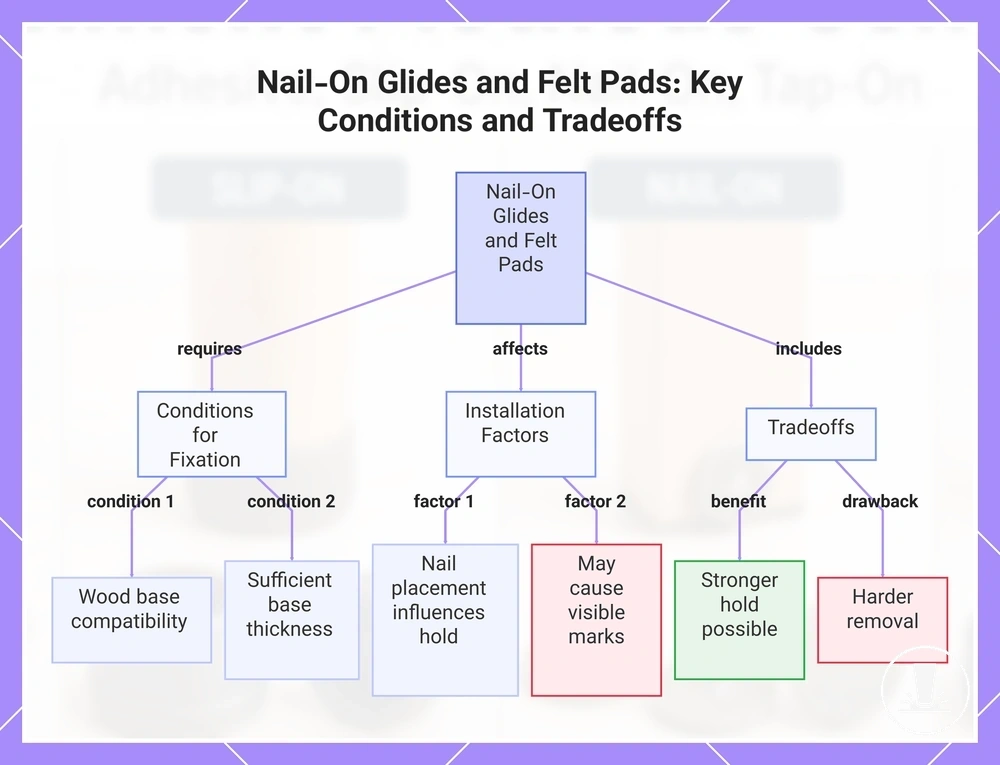
Nail-on glides and nail-on felt pads depend on nail or pin fixation and a compatible wooden base. These fixed pads are designed for furniture legs that can support the attachment point, and they may provide stronger hold when the base material and construction are suitable. Compatibility with the furniture base, leg material, and base thickness remains an important condition.
Nail-on glides and nail-on felt pads can offer stronger hold when nail or pin fixation is supported by a suitable wooden base, but harder removal is often part of the tradeoff. Installation marks may occur around the fixation area, and suitability can vary by leg material and base thickness. Nail-on fixation may be less suitable when the furniture base is thin, non-wooden, or unable to support secure attachment.
Nail-On Glides and Nail-On Felt Pads: The conditions below identify factors that can affect fixation suitability.
- Wood compatibility: Nail or pin fixation is typically intended for a compatible wooden base rather than every furniture leg type.
- Base thickness: Suitability can depend on whether the furniture base provides enough material to support the fixed attachment.
- Nail placement: Placement conditions may influence hold and the likelihood of visible installation marks.
- Removal considerations: Harder removal and possible installation marks can be part of the tradeoff when replacing nail-in glides or nailed felt pads.
This chart outlines the key conditions that affect fixation suitability, installation factors, and the tradeoffs of using nail-on glides and felt pads.
Tap-On Glides and Tap-In Felt Pads
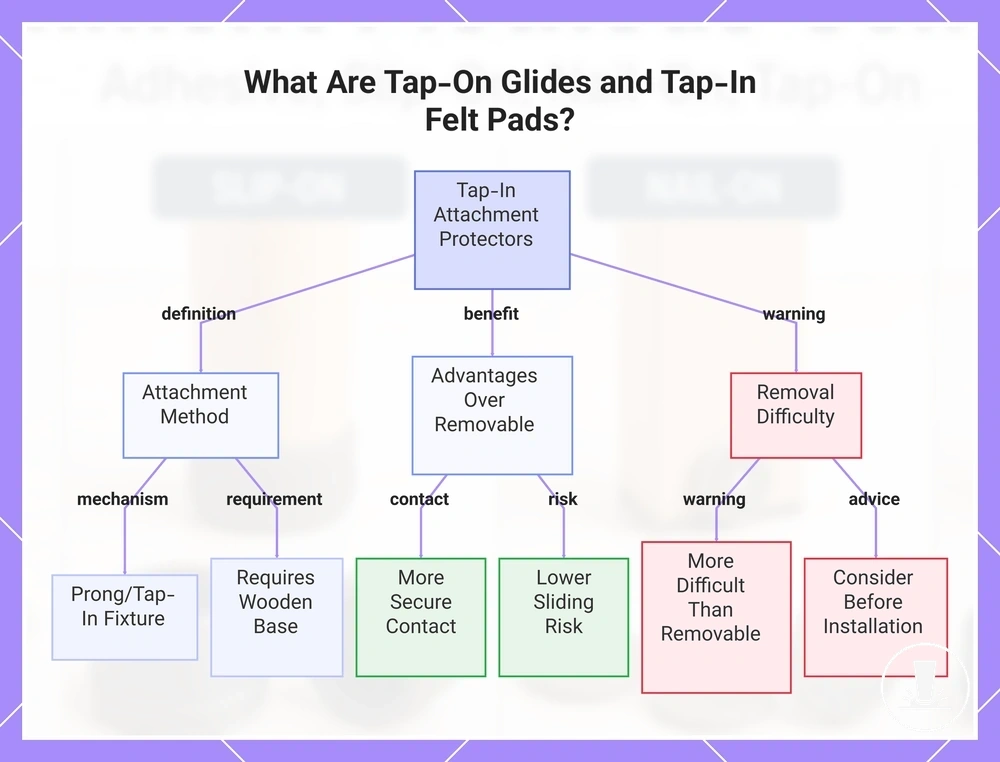
Tap-on glides and tap-in felt pads are fixed attachment protectors that use a prong, pin, or tap-in fixture secured into a compatible wooden base. When the furniture base supports this attachment method, these protectors may provide more secure contact and a lower sliding-off risk than removable options. The prong or tap-in fixture is the defining attachment feature.
Tap-on glides and tap-in felt pads share the fixed-attachment concept used by nail-on options, but the tap-in fixture creates a distinct fixation style that can influence permanence and reversal difficulty. When used with a compatible wooden base, the attachment may offer stable hold during furniture movement, although results still depend on the base condition and floor-contact setup. Because the connection is more fixed, removal can be more difficult than with removable protectors, and reversal difficulty should be considered before installation.
This chart explains the attachment method, advantages, and removal difficulty of tap-on glides and tap-in felt pads compared to removable options.
Holding Strength and Why Some Protectors Stay On Better
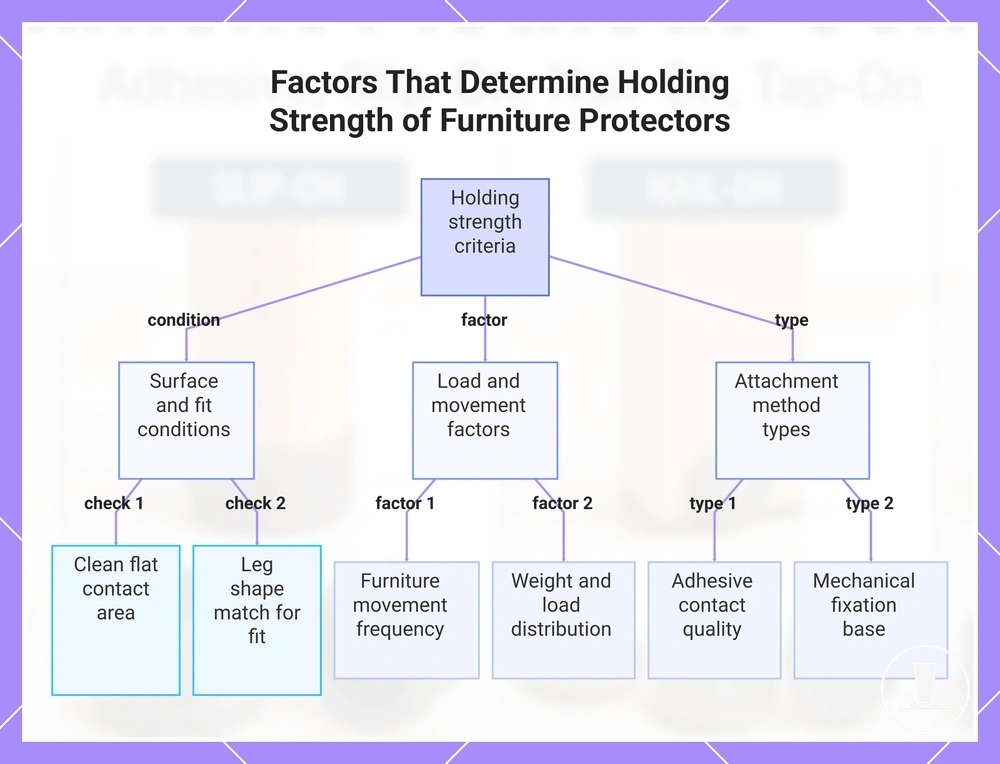
Holding strength depends on attachment method, surface preparation, leg fit, furniture movement, and load rather than one label alone. Staying-on performance can vary even when protectors appear similar because different conditions affect how well they stay on. Holding Strength and Why Some Protectors Stay On Better is a criteria issue that involves attachment method, preparation, fit, movement, and load.
Holding Strength and Why Some Protectors Stay On Better: The checklist below verifies the conditions that can affect stay-on performance.
- Clean surface for adhesive backing contact
- Flat contact area for consistent attachment
- Leg shape and shape match for secure fit
- Furniture movement frequency during use
- Furniture weight and load distribution
- Mechanical fixation through a compatible base
- Replacement need when hold decreases over time
When staying-on performance is inconsistent, evaluating the criteria can help identify which attachment approach is more suitable. The same attachment method may produce different results because surface preparation, clean surface quality, leg fit, and furniture movement vary across furniture types. Adhesive-dependent hold often relies more on contact quality, while fit-or-fixation-dependent hold relies more on shape match or mechanical fixation. Mechanical fixation may be a safer choice than adhesive convenience when attachment security depends on a compatible base rather than adhesive contact alone.
Holding strength should be evaluated as a criteria-based attribute rather than a single-cause problem. Load, movement frequency, shape match, attachment method, and failure risk can all influence whether a protector continues to stay on over time. For deeper troubleshooting of falling-off conditions and corrective actions, see protectors that do not stay on.
This chart shows the key criteria that influence how well furniture protectors stay on, including surface and fit conditions, load and movement factors, and the type of attachment method.
Floor Surface, Furniture Weight, and Leg Compatibility
Attachment choice depends on floor surface, furniture weight, and leg compatibility rather than the attachment method alone. The same furniture protector can perform differently on hard floors, carpet, heavy furniture, and different leg bases because floor contact, load, and fit conditions change. Compatibility is a combined condition involving floor surface, load, leg material, leg shape, and movement pattern.
When a protector is used on hardwood, tile, laminate, vinyl, or carpet, the floor surface can influence how the attachment method behaves during movement. Furniture weight may affect compression and hold characteristics, while movement pattern can change how often the protector experiences drag or shifting forces. Wooden legs and metal legs may support different attachment choices depending on the attachment style. Round legs and square legs can also affect suitability because leg shape influences fit condition.
Floor Surface, Furniture Weight, and Leg Compatibility: The image below labels the visible compatibility factors that can affect attachment choice.
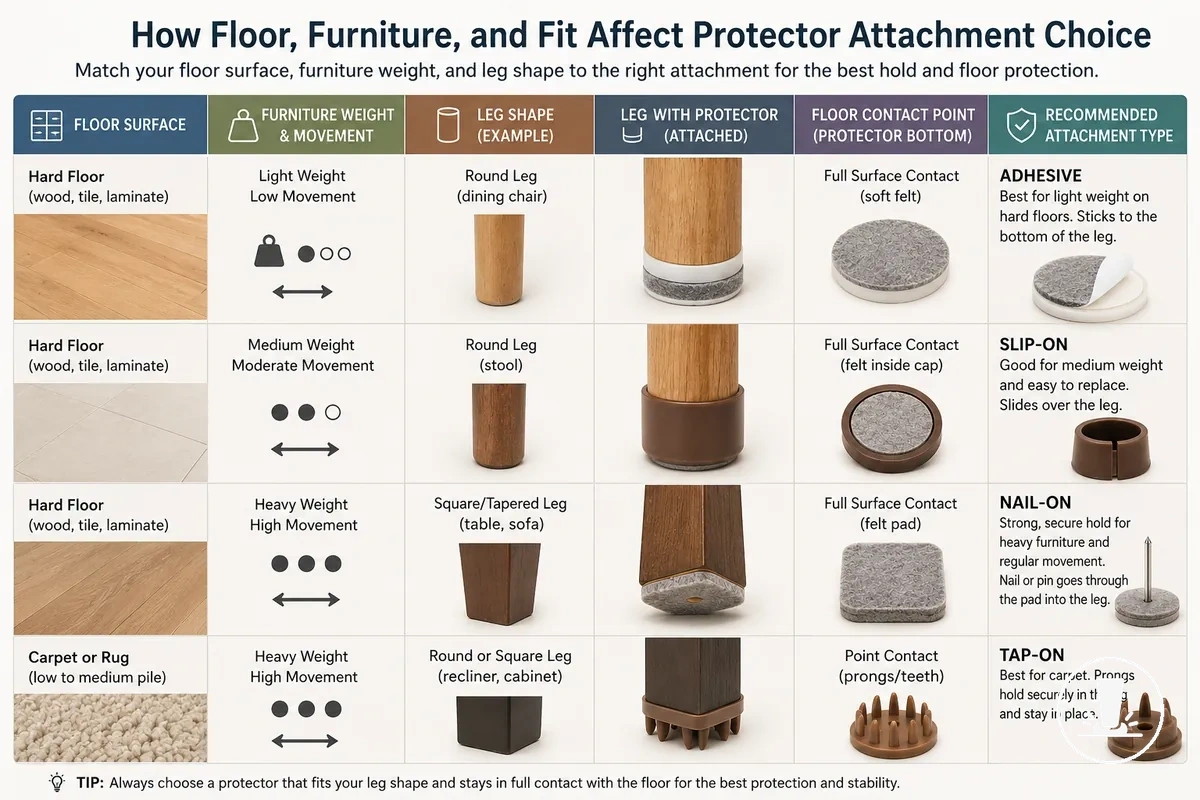
The table organizes the main compatibility factors that influence attachment choice. For additional fit-related evaluation, see chair leg protector fit. Attachment suitability depends on multiple conditions, so universal matching claims should be avoided.
| Compatibility factor | Condition to check | Attachment impact | Decision caution |
|---|---|---|---|
| Floor surface | Hard floors, carpet, and floor-contact conditions | May influence slide behavior, contact material performance, and scratch risk | One attachment choice may not behave the same across every floor type |
| Furniture weight | Load and pressure on the protector | Can affect hold, compression, and staying position | Higher load may change attachment performance |
| Leg material | Wooden legs or metal legs | May influence whether adhesive, slip-on, or fixed methods are suitable | Attachment choice depends on leg material compatibility |
| Leg shape | Round legs, square legs, and fit condition | Can affect attachment security and alignment | Shape match may influence suitability |
| Movement pattern | Frequency of sliding, dragging, or repositioning | May affect hold and long-term attachment performance | More movement can increase attachment demands |
Hard Floors, Carpet, and Surface Contact
Surface contact depends on floor condition and can influence the attachment decision through sliding, dragging, noise, and scratch risk. Hard floors and carpet create different floor-contact conditions, so the same protector may behave differently across surfaces. Surface contact links floor behavior to attachment choice.
| Floor condition | Contact behavior | Attachment implication |
|---|---|---|
| Hard smooth floors | Felt, rubber, plastic, cap, or glide contact materials may influence sliding, noise, and scratch risk | Attachment choice may depend on the balance between movement and floor contact |
| Textured hard floors | Surface texture can change dragging, contact consistency, and movement behavior | Attachment performance may vary with floor-contact conditions |
| Carpeted floors | Carpet can increase dragging and affect how a glide or cap moves across the surface | Attachment choice may depend on movement pattern and contact behavior rather than floor type alone |
Wood, Metal, Round, and Square Furniture Legs
Furniture leg condition depends on leg material and leg shape because both can affect attachment fit and failure risk. Wood legs, metal legs, round legs, and square legs may support different attachment approaches depending on how the protector grips, sticks, nails in, or taps in. Material and shape are the local variables that influence attachment fit.
A flat bottom may provide a more consistent contact area for an adhesive pad, while a curved base can make contact conditions less predictable. Hollow metal may limit attachment methods that depend on a compatible base, while wood legs may support nail-on, tap-on, adhesive, or slip-on options when the furniture leg construction is suitable. Square edges can affect cap fit and contact alignment, while a round profile may change how tension-based protectors respond to movement. These furniture leg conditions can influence attachment fit and failure risk.
Fit Checklist:
- Leg material: Check whether the furniture leg uses wood or metal because leg material can affect attachment options.
- Leg shape: Check whether the furniture leg has round legs or square legs because leg shape can influence attachment fit.
- Flatness: Check whether the flat bottom or leg bottom provides stable contact because contact area can affect hold.
- Hollow or solid base: Check whether hollow metal or a solid base changes attachment suitability.
- Movement frequency: Check how often the furniture moves because movement can influence failure risk.
- Measured fit: Check whether the protector matches the chair leg profile because closer fit may improve retention.
Before choosing a size-dependent protector, it can help to measure furniture legs so attachment fit is evaluated through leg shape and profile rather than assumptions.
Installation Effort, Permanence, and Replacement Tradeoffs
Installation effort depends on how much reversibility, permanence, and future maintenance are acceptable for the furniture and usage context. Easier attachment methods often change removal difficulty, maintenance burden, and replacement concerns. Installation effort, permanence, and replacement tradeoffs should be considered together because each attachment method balances effort, permanence, and replacement differently.
| Method | Setup effort | Permanence | Removal or replacement concern |
|---|---|---|---|
| Adhesive | Usually lower due to peel-and-stick attachment | Typically more reversible | Residue risk may depend on surface condition and time in use |
| Slip-on | Usually lower due to stretch-on attachment | Generally removable | Replacement ease may depend on fit and movement conditions |
| Nail-on | Requires fixed attachment | Usually more permanent | Removal difficulty and furniture mark risk may increase during replacement |
| Tap-on | Requires fixed attachment | Usually more permanent | Removal difficulty may depend on furniture construction and attachment condition |
When frequent protector replacement is expected, peel-and-stick and stretch-on methods may offer greater reversibility than nail-on or tap-on options. Peel-and-stick methods can support replacement ease but may involve residue risk when surface conditions vary. Stretch-on methods depend more on fit and movement, while nail-on and tap-on methods rely on fixed attachment and may involve greater removal difficulty.
For renters, reversibility may be a higher priority than permanence when replacement tradeoffs are evaluated. Delicate furniture may require additional attention to furniture mark risk before choosing a fixed attachment method. High-movement chairs can increase maintenance burden and replacement frequency because attachment conditions may change more often during use.
Best Attachment Method by Furniture Use Case
The best attachment method depends on the furniture use case, furniture movement, leg type, floor surface, and willingness to use permanent fixation. An attachment method that suits one situation may be less suitable in another because movement, compatibility, and replacement needs can vary. The best attachment method is a conditional choice.
A decision table can help compare use-case fit without relying on product ranking or universal recommendations. The deciding attributes are furniture movement, leg type, floor surface, permanence preferences, and compatibility conditions.
| Use case | Main condition | Better-fitting attachment | Limitation to check |
|---|---|---|---|
| Light furniture | Lower movement and simpler replacement needs | Adhesive | Residue risk may depend on surface condition |
| Frequently moved chairs | Regular movement and repeated floor contact | Slip-on | Hold may depend on leg shape and fit |
| Wooden legs needing fixed hold | Compatible wooden base and preference for permanent fixation | Nail-on or tap-on | Removal difficulty may increase during replacement |
| Delicate or rented furniture | Higher priority on reversibility | Adhesive or slip-on | Attachment performance may depend on fit or surface condition |
| Carpet or drag-prone surfaces | Frequent dragging or higher movement resistance | Slip-on, nail-on, or tap-on | Attachment suitability depends on furniture construction |
| Uncertain fit | Compatibility has not been confirmed | Safer alternative: adhesive | Measurement and compatibility should still be checked |
The strongest pattern is that removable methods often suit situations where reversibility and replacement ease matter, while fixed methods may be more suitable when a compatible base supports permanent fixation. Furniture movement and leg type usually influence whether a slip-on, nail-on, or tap-on attachment is a practical choice.
When fit, floor surface, or permanence preferences are unclear, a safer alternative is often a removable attachment method. Adhesive options may allow easier compatibility evaluation, while slip-on options can be considered when leg shape and measurement are known. Fixed methods are usually easier to justify when compatibility conditions have already been confirmed.
A furniture use case should guide the recommended attachment rather than a universal ranking. The practical choice depends on furniture movement, floor surface, leg type, replacement expectations, and comfort with permanent fixation. No attachment method is best for every home, so a conditional choice is usually the most reliable approach.
Here are product examples that may make comparison easier. Before buying, always review the compatibility criteria, essential features, and product details.