
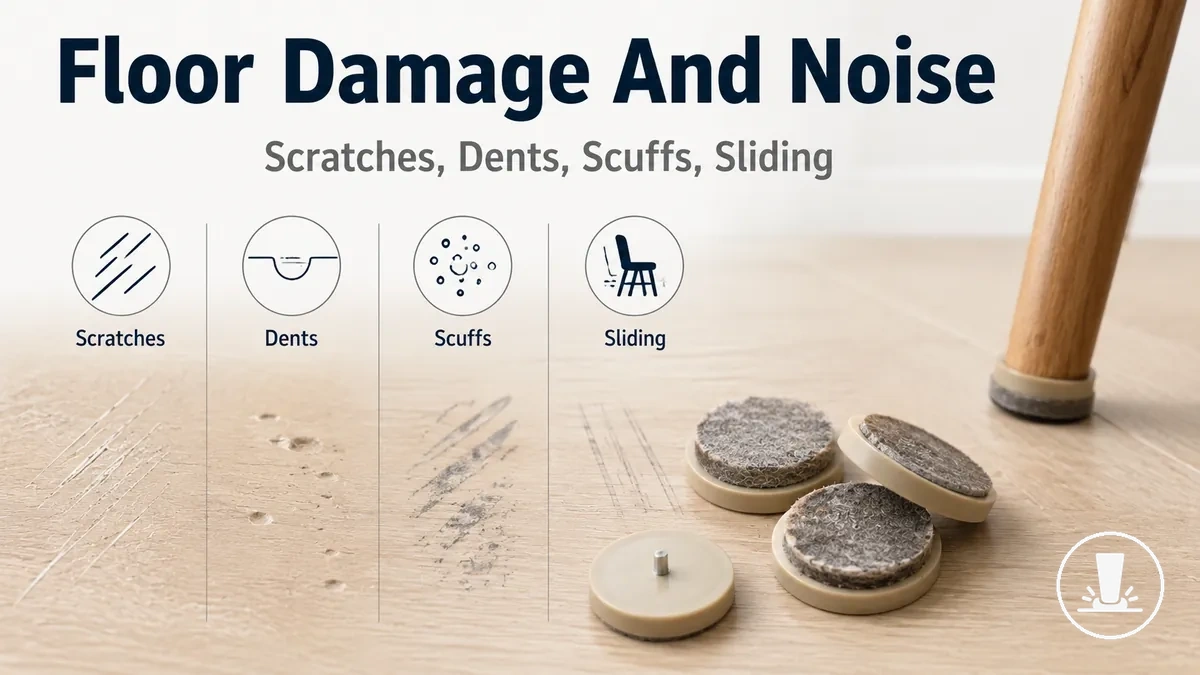
Furniture floor protectors for safer floor contact and movement control
Furniture floor protectors are contact-layer accessories that sit between furniture and the floor to help manage how weight, movement, and friction interact with a surface. Their role is to create a more controlled floor contact point through material choice, fit, grip, and load spread. Furniture floor protectors can be used under chairs, tables, and other furnishings where repeated movement or sustained weight may affect a floor finish. They are decision-support tools for reducing risk, but outcomes can vary by floor finish, furniture weight, movement frequency, and protector condition, so prevention is better understood as risk reduction rather than certainty.
Problems such as scratches, dents, scuffs, noise, and unwanted sliding often develop when furniture movement or concentrated weight creates stress at a small contact area. A properly matched protector can help create softer contact, improve load spread, or adjust friction so movement is more controlled. The effect depends on factors such as protector material, leg shape, fit, contact area, and how often furniture is moved across the surface. Different conditions may require different priorities, whether the concern is scraping noise from chair movement, stability from added grip, or reduced pressure from better load spread. These risks generally fall into visible surface damage, pressure-related floor impact, and movement-related control concerns.
Furniture floor protectors can often help create safer floor contact and movement control when they match the furniture and floor conditions involved. They do not serve the same function in every situation because floor finish, fit, friction, stability, and furniture weight influence the result. Understanding what protectors can and cannot reduce provides the foundation for evaluating floor-contact risks more accurately.
What furniture floor protectors can and cannot prevent
Furniture floor protectors can reduce the likelihood of scratches, dents, scuffs, noise, and sliding by changing how furniture interacts with a floor surface. They cannot guarantee that these issues will never occur because outcomes depend on contact pressure, movement frequency, floor finish, and protector fit. A remaining risk may still exist when conditions place more stress on the floor-contact area.
furniture floor protectors are accessories designed to create a more controlled contact point between furniture and a floor surface. Their protective function is based on limiting friction, improving grip, or spreading load rather than eliminating all wear. The outcome depends on realistic conditions such as furniture weight, floor finish, movement frequency, and protector fit. The table below outlines the boundary between expected reduction and remaining risk.
A common misconception is that prevention means complete protection. In practice, reduction and delayed wear are often more realistic outcomes than total prevention. Furniture floor protectors may help lower risk, but reduction is not the same as repair.
Protection depends on contact pressure, movement frequency, floor finish, and protector fit. These factors influence whether a protector mainly reduces risk, delays wear, or leaves a remaining possibility of floor-contact impact.
| Can reduce | Depends on | Cannot guarantee |
|---|---|---|
| Scratches | Floor finish, protector fit, movement frequency | No scratches under all conditions |
| Dents | Contact pressure, furniture weight, load spread | No dents from every load condition |
| Scuffs | Floor finish, friction, movement pattern | No scuffs over time |
| Noise | Surface type, protector material, protector fit | Silent movement in every situation |
| Sliding | Grip, floor finish, furniture use | Complete prevention of sliding |
Floor damage risks that protectors reduce
Floor damage often develops when furniture movement or concentrated weight creates repeated stress at a contact point. Furniture floor protectors are intended to reduce that stress by changing how a furniture leg interacts with the surface below. The amount of risk reduction can vary with contact pressure, movement patterns, floor finish, and protector material. These risks generally fall into scratch, dent, and surface-mark categories.
Floor damage risks that protectors reduce become easier to evaluate when movement damage and pressure damage are viewed separately. The image below labels the main visible risk patterns, including scratches, dents, and scuffs, so the different causes can be understood at a glance.
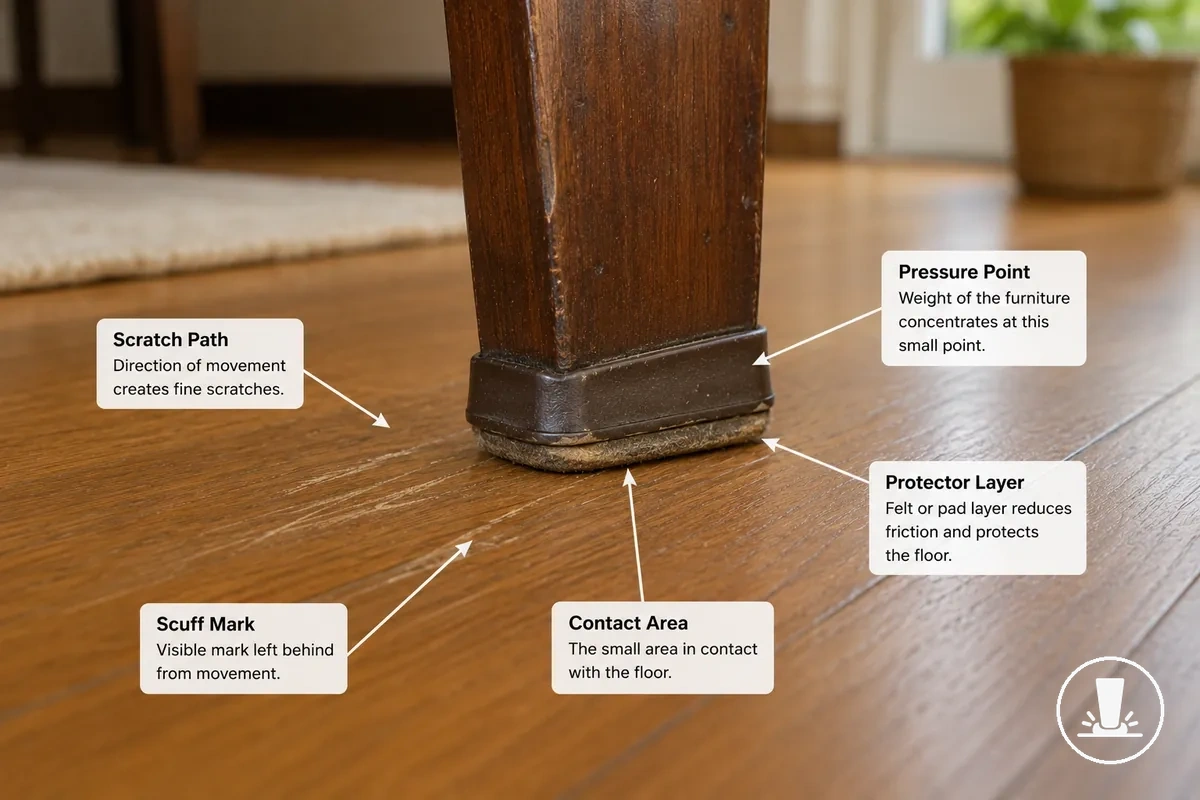
Movement damage is commonly associated with dragging, shifting, or repeated abrasion across a floor surface. Scratches, scuffs, nicks, and other marks may occur when friction develops between a furniture leg and the floor finish. Protector material can help change that contact condition, but outcomes still depend on movement frequency, finish sensitivity, and protector condition. Movement-related risks are primarily linked to abrasion rather than furniture weight.
Pressure damage is more closely associated with furniture weight, contact pressure, and contact area. Narrow feet can concentrate pressure into a smaller point, which may increase the likelihood of dents on certain surfaces. A protector that increases contact area may help lower pressure concentration, although results depend on floor hardness, furniture weight, and surface condition. Pressure damage and movement damage can occur together, but they arise from different causes.
A protector that helps reduce scratches through smoother movement may not influence dent risk in the same way when pressure remains concentrated. Likewise, a protector material that limits scuffs may still leave a remaining risk of marks when movement is frequent or the floor finish is sensitive. The table below summarizes the main risk patterns and the conditions that influence risk reduction.
| Risk type | Main cause | Protector attribute | Qualified outcome |
|---|---|---|---|
| Scratches | Movement and abrasion | Smoother contact surface | May reduce surface wear when dragging is limited |
| Dents | Furniture weight and contact pressure | Greater contact area | May lower pressure concentration under certain conditions |
| Scuffs | Repeated friction and finish sensitivity | Suitable protector material | Can help reduce visible marks depending on floor finish |
| Nicks | Sharp or concentrated contact points | Protective contact layer | May reduce localized marking when fit remains stable |
| Contact marks | Surface interaction over time | Controlled contact area | Can lower remaining risk, though outcomes depend on conditions |
Scratches from dragging, scraping, and repeated chair movement
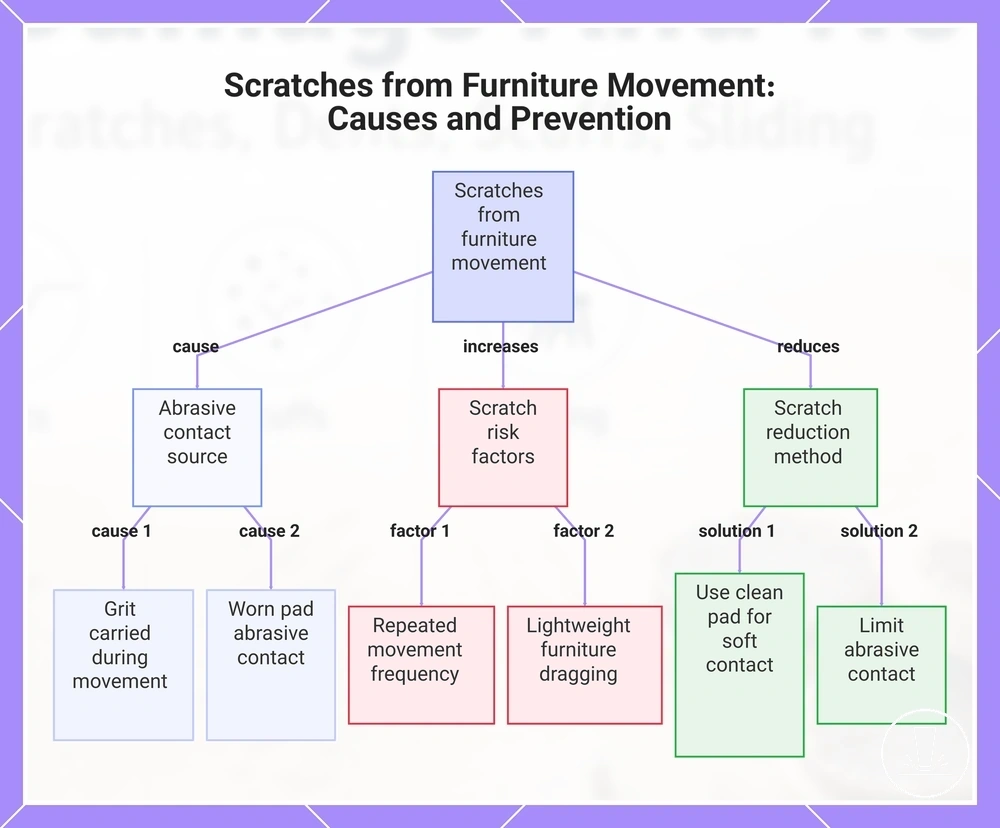
Scratch risk increases when dragging, scraping, or repeated chair movement creates abrasive contact at the floor surface. A chair leg or furniture base can carry grit across the floor during movement, which may increase abrasion and visible scratching. Scratch reduction depends on limiting abrasive contact and maintaining a cleaner contact condition.
Repeated movement situations often create more opportunities for surface wear. A clean pad can help create soft contact and reduced abrasion, while a worn pad or trapped grit may increase scratch risk during sliding or scraping. For example, a chair leg with a clean pad may maintain softer contact, whereas a worn pad containing grit can create a more abrasive contact condition during movement.
- Chair leg — repeated chair movement — higher scratch risk when grit is present
- Stool base — sliding movement — increased scraping marks when contact becomes abrasive
- Table leg — frequent repositioning — greater scratch likelihood when a worn pad is used
- Lightweight furniture — repeated dragging — higher abrasion risk under abrasive contact conditions
This chart explains the main causes of scratches from furniture movement, the risk factors that increase scratch likelihood, and the key methods to reduce scratching.
Dents from furniture weight and narrow contact points
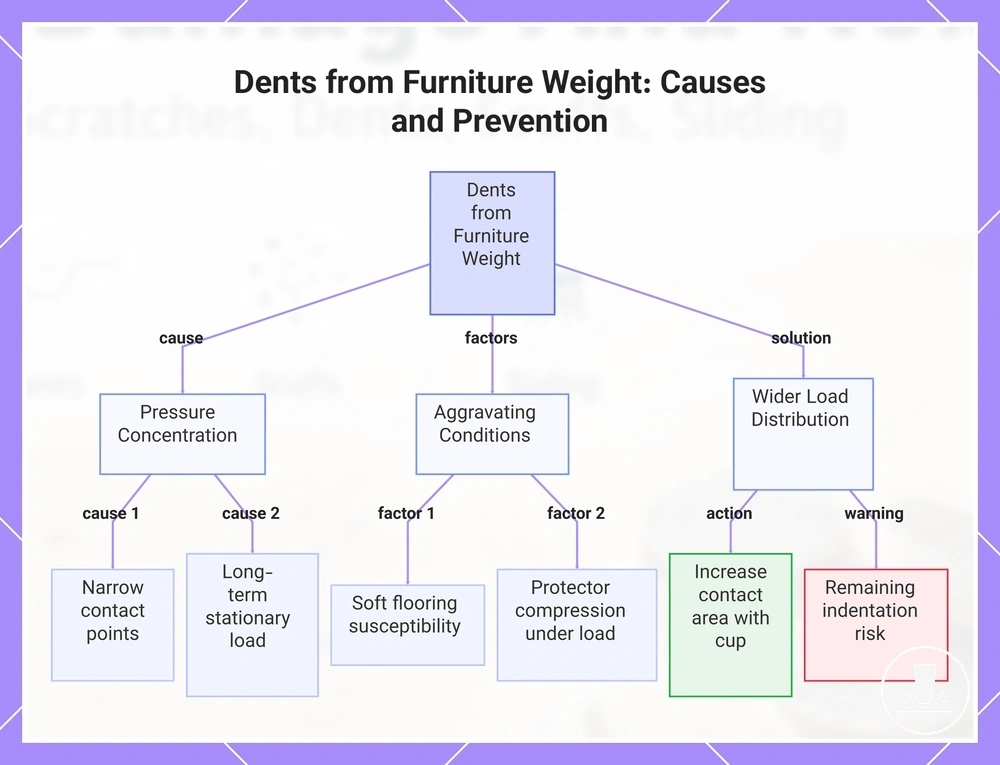
Dents are usually caused by concentrated furniture weight rather than surface rubbing alone. Furniture weight focused through narrow contact points can increase indentation risk, especially when contact area remains small. Dent risk rises when pressure becomes concentrated at a limited point of contact.
Pressure-related dents often occur when heavy loads are supported by narrow feet for extended periods. Increasing contact area may help improve load spread and reduce pressure concentration, although remaining indentation risk depends on soft flooring, stationary pressure, and floor condition. In cases involving narrow feet, wider load distribution often matters more than softness when improving load spread.
Before evaluating dent risk, consider the conditions that influence pressure distribution:
- Furniture weight and overall load
- Width of feet or narrow contact points
- Soft flooring susceptibility to indentation
- Duration of stationary pressure
- Protector compression under load
Long-term stationary pressure can create dents even when movement is minimal. As a clarification, heavy furniture floor protection often focuses on improving contact area and load spread rather than relying on soft surfaces alone. A furniture cup may help distribute weight across a larger area, but heavy furniture can still leave pressure marks or indentation under certain conditions.
This chart shows the main causes, aggravating factors, and prevention approach for dents caused by furniture weight.
Scuffs, nicks, and surface contact marks
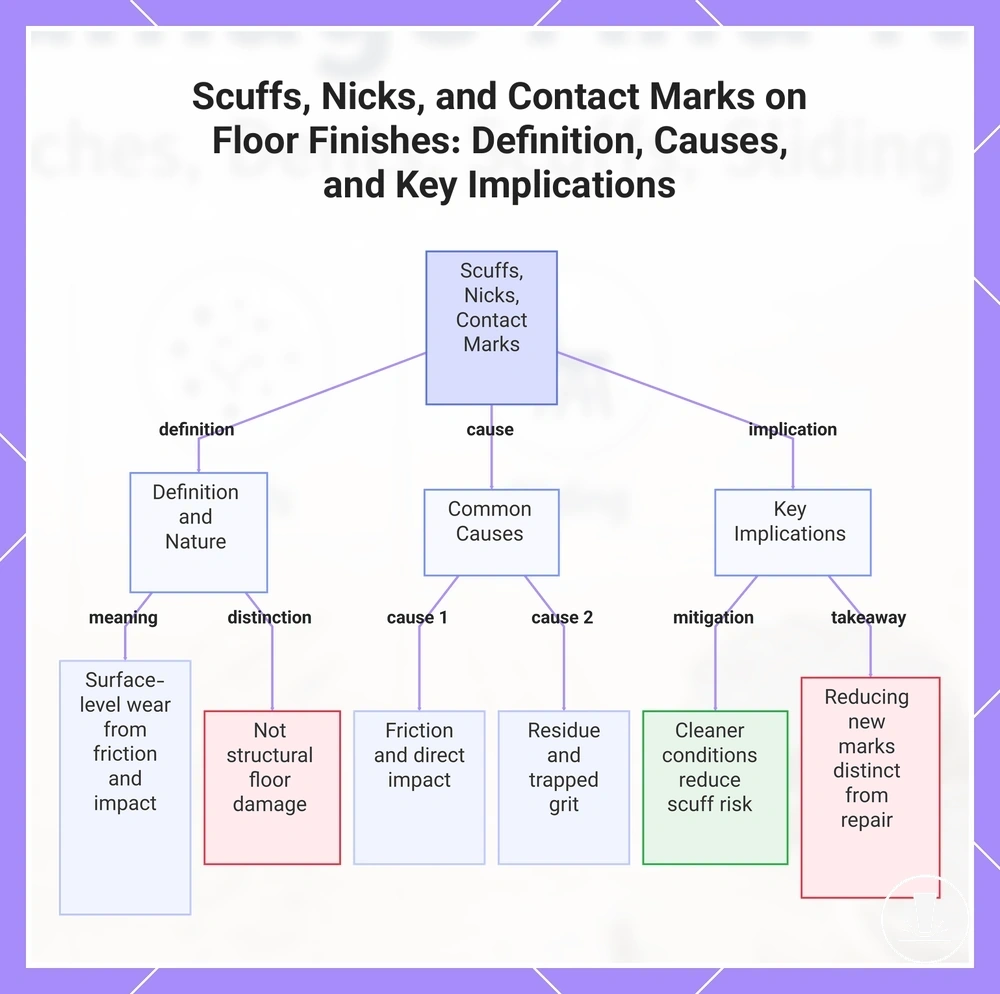
Scuffs, nicks, and contact marks are surface-level outcomes that can occur when friction, impact, residue, or trapped grit interacts with a floor finish. These marks often appear as rub marks, minor marks, or localized surface wear rather than structural floor damage. Surface marks are generally distinct from deeper damage.
Mark risk often increases when contact material carries residue or trapped grit across a floor finish. Cleaner contact conditions may help reduce friction-related scuffs and contact marks, while impact or abrasive particles can increase visible marking. Reducing new surface marks is not the same as repairing existing finish damage, especially when residue or trapped grit remains at the contact point.
- Residue between contact material and floor finish may increase contact mark risk
- Trapped grit can create friction that contributes to scuffs and surface wear
- Repeated rubbing may leave rub marks on sensitive floor finishes
- Minor impact at a contact point can contribute to small nicks
- Dirty contact conditions may increase the likelihood of visible surface marks
This chart explains what scuffs, nicks, and contact marks are on floor finishes, their common causes, and important implications for maintenance.
Noise and sliding risks from furniture movement
Noise and sliding risks often develop when furniture movement creates repeated contact with a floor surface. Scraping sounds can occur when hard contact transfers vibration during chair movement, while uncontrolled sliding may increase stability concerns. Different contact conditions influence these outcomes in different ways. Noise and sliding are related to movement, but they are not the same risk.
Cushioning can help reduce noise by softening hard contact between furniture and the floor. During chair movement, sound reduction or sound dampening may occur when contact materials absorb part of the vibration that would otherwise create scraping sounds. The outcome can vary with floor finish, movement frequency, and contact condition. Noise reduction is mainly associated with cushioning rather than grip.
Grip and friction are more closely connected to sliding control and stability. A non-slip contact condition may help reduce unwanted sliding when furniture is pushed or shifted, although the outcome depends on the floor surface and contact material. Higher friction can improve stability in many cases, while lower friction may allow easier movement. Sliding control is primarily influenced by grip rather than cushioning.
Noise reduction and sliding control depend on different contact attributes. The comparison below highlights why a protector designed for easy glide may not provide the same non-slip behavior.
| Noise-first need | Sliding-first need |
|---|---|
| Contact attribute: cushioning | Contact attribute: grip and friction |
| Likely material behavior: sound dampening and smoother contact | Likely material behavior: increased stability and movement control |
| Trade-off: may allow easier glide during chair movement | Trade-off: may reduce glide compared with sliders, chair pads, or furniture grippers designed for movement control |
Glide and grip serve different purposes. A surface that supports easy movement may not provide the same sliding resistance as furniture grippers, while a higher-friction contact condition may reduce movement but also change how furniture glides across the floor.
Scraping noise from chairs and movable furniture
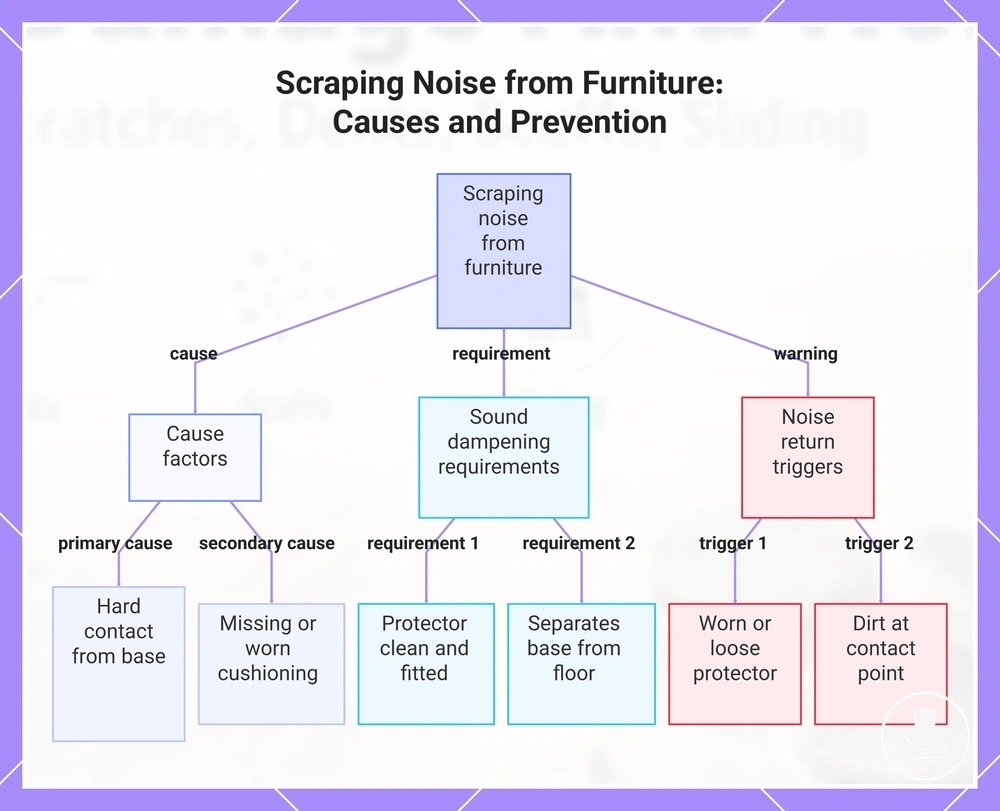
Scraping noise from chairs and movable furniture usually happens when hard contact or rough contact moves across a floor surface. A chair leg, stool base, or frequently shifted table can create noise when movement frequency keeps the contact point active. A soft layer may help reduce chair noise, but hard contact remains the main cause when cushioning is missing or worn.
Dining chairs often create scraping noise during repeated pull-out movement, while office chairs, stools, and movable furniture may create similar sound when floor pads lose their contact quality. Sound dampening depends on the protector staying clean, fitted, and able to separate the furniture base from the floor. A worn protector, loose floor pad, or dirt trapped at the contact point can allow scraping noise to return during movement.
This chart shows the main causes of scraping noise from furniture, the requirements for effective sound dampening, and the triggers that allow noise to return.
Sliding furniture that needs grip instead of glide
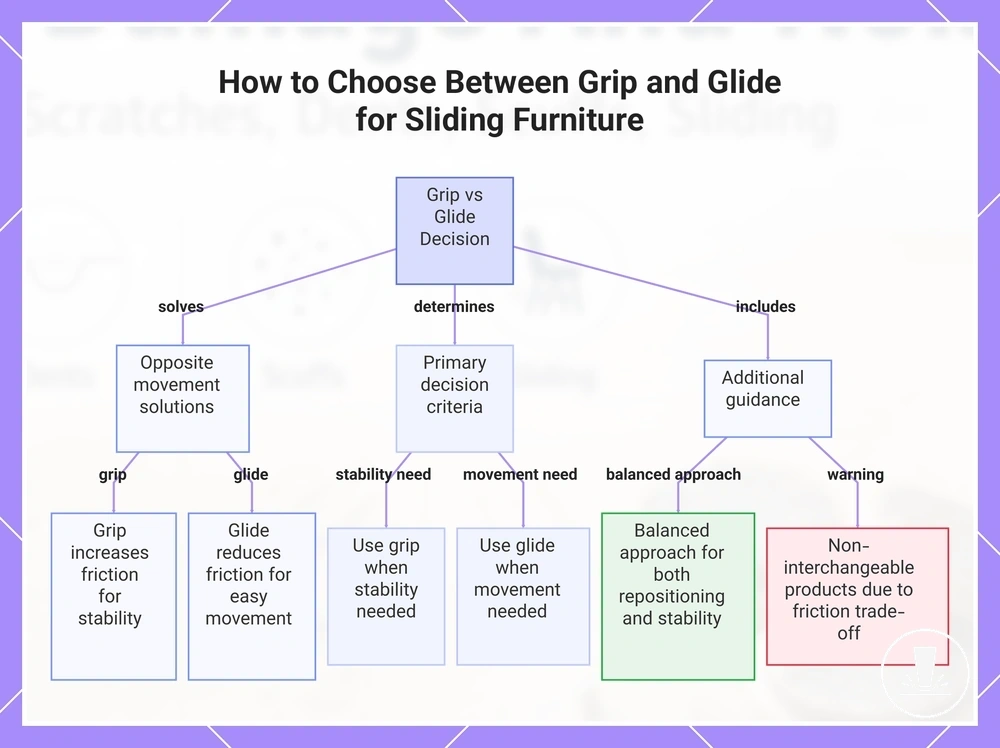
Sliding furniture needs grip when unwanted movement is the main problem. Grip increases friction to support stability, while glide reduces friction to make movement easier. Grip and glide solve opposite movement problems.
When sliding furniture shifts too easily, non-slip grippers may help increase friction and improve stability. When furniture must move regularly, sliders or glides may be a better match for the desired movement level. The safer choice depends on the furniture use-case, surface friction, and intended movement level.
- Use grip when furniture should remain stable during normal use.
- Use glide when furniture is expected to move easily and often.
- Use a balanced approach when both repositioning and stability matter.
A dining chair may benefit from controlled glide for repeated movement, while a side table may need more grip to reduce unwanted sliding. Non-slip grippers, furniture grippers, and sliders are not interchangeable because each creates a different friction and movement trade-off. Some furniture should move easily, while other furniture should remain stable.
This chart outlines the key factors for deciding whether to use grip or glide for furniture movement, including the opposite solutions, primary decision criteria, and additional guidance.
Protector attributes that change safety outcomes
Protector attributes that change safety outcomes depend on how a furniture leg contacts the floor and how that contact behaves during use. Different safety outcomes may result from changes in contact softness, load spread, compression resistance, friction, adhesion, and fit. These attributes influence scratch, dent, noise, and sliding risks through different mechanisms rather than a single protector feature. The key evaluation criteria are contact softness, load spread, compression resistance, friction, adhesion, and fit.
Protector attributes that change safety outcomes can be compared visually by examining contact softness, load spread, grip, and fit. The image below highlights visible features that may influence floor-contact behavior under different conditions.
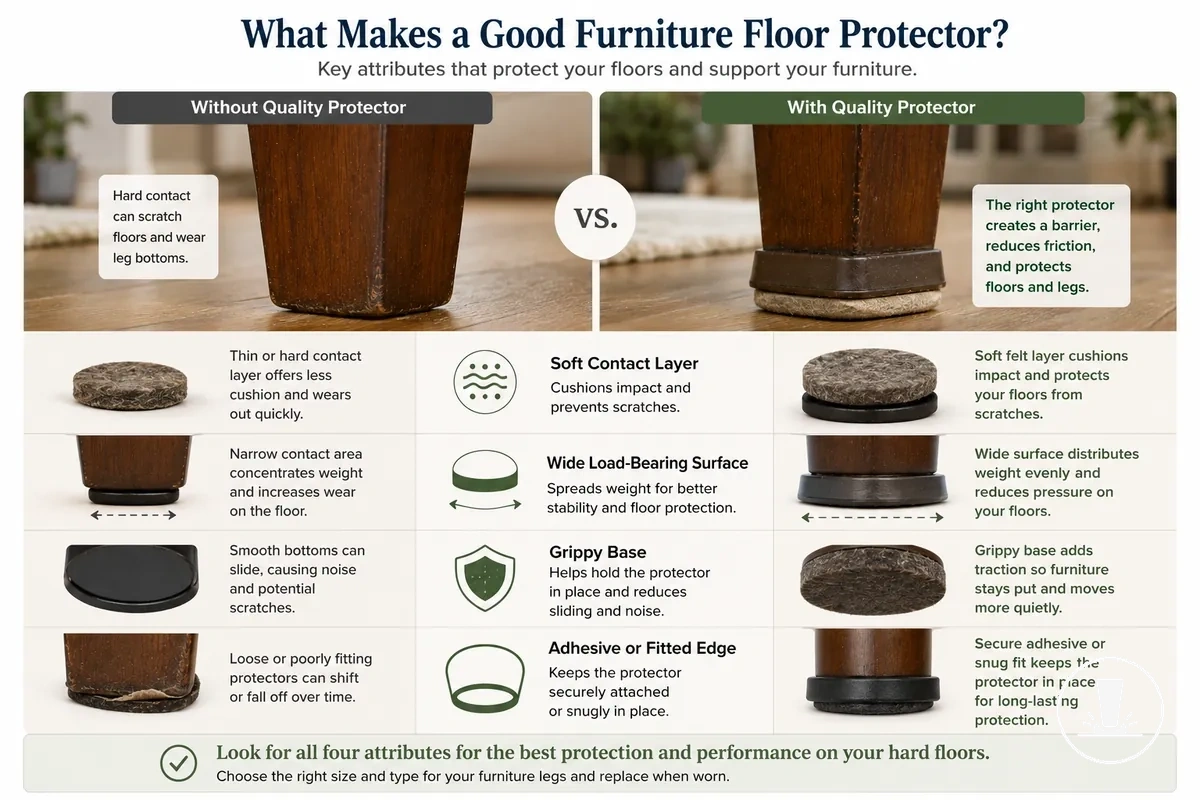
Contact softness and cushioning influence how a protector material interacts with the floor during movement. Greater contact softness may help reduce abrasion and noise when movement occurs, while the safety outcome can vary with floor condition, protector material, and movement frequency. Cushioning mainly affects contact behavior rather than pressure distribution.
Load spread and compression resistance influence how weight is distributed beneath a furniture leg. Wider load spread may help reduce pressure concentration, while compression resistance can help a protector maintain its contact shape under load. The effect on dents or pressure-related marks depends on furniture weight, floor condition, and how much the protector compresses during use.
Friction, adhesion, and fit influence stability and protector movement. Higher friction may help reduce sliding, while adhesion and fit can help limit protector shift during repeated movement. As a simple comparison, felt and rubber protector differences are often discussed in terms of how friction and movement behavior change under different floor-contact conditions.
Use the criteria below to evaluate which attribute aligns with the primary risk priority.
| Protector attribute | Value or condition | Risk affected | Decision signal |
|---|---|---|---|
| Contact softness | Softer contact layer | Scratches and noise | Priority is reducing abrasive contact |
| Load spread | Wider contact area | Dents and pressure concentration | Furniture weight is concentrated on a small area |
| Compression resistance | Maintains shape under load | Pressure-related floor impact | Furniture remains stationary for long periods |
| Friction | Higher or lower grip level | Sliding and stability | Desired movement level is the main concern |
| Adhesion | More secure hold | Protector shift | Movement may cause protectors to loosen |
| Fit | Closer match to furniture leg | Movement consistency | Protector position needs to remain stable |
Soft contact layers for scratch and noise reduction
Soft contact layers can help reduce abrasive contact between a furniture leg and the floor surface. A soft contact layer such as felt, a cushioned pad, or a soft-bottom cap may create gentler surface contact during movement. Scratch and noise reduction are more likely when the layer remains clean, properly fitted, and able to limit abrasion.
During repeated chair movement or furniture repositioning, a furniture felt pad or cushioned pad may help dampen movement noise by adding cushioning between the furniture leg and the floor. The same soft layer can help reduce scratches when abrasive contact is limited, but performance depends on fit, surface condition, material condition, and movement patterns. Dirt buildup or compression over time may reduce protection by increasing abrasion or reducing the effectiveness of the cushioning layer.
Wide load-bearing surfaces for dent prevention
A wide contact surface can help reduce pressure concentration by spreading furniture weight across a larger area. Wider load spread may lower the risk of dents when compared with narrow legs that focus pressure on a smaller contact point. The relationship between furniture weight, contact width, and pressure is central to pressure distribution.
When heavy furniture rests on narrow legs, pressure may become concentrated and increase the likelihood of dents, especially where compression occurs more easily. Furniture cups, a broad base, or a load-bearing pad can help improve weight distribution by increasing contact area, while surface condition and protector compression still influence the outcome. Dent risk may be reduced through wider load spread, but soft floors, long-term stationary furniture, and very heavy items can still experience pressure-related marking under certain conditions.
Grip, adhesion, and fit stability under movement
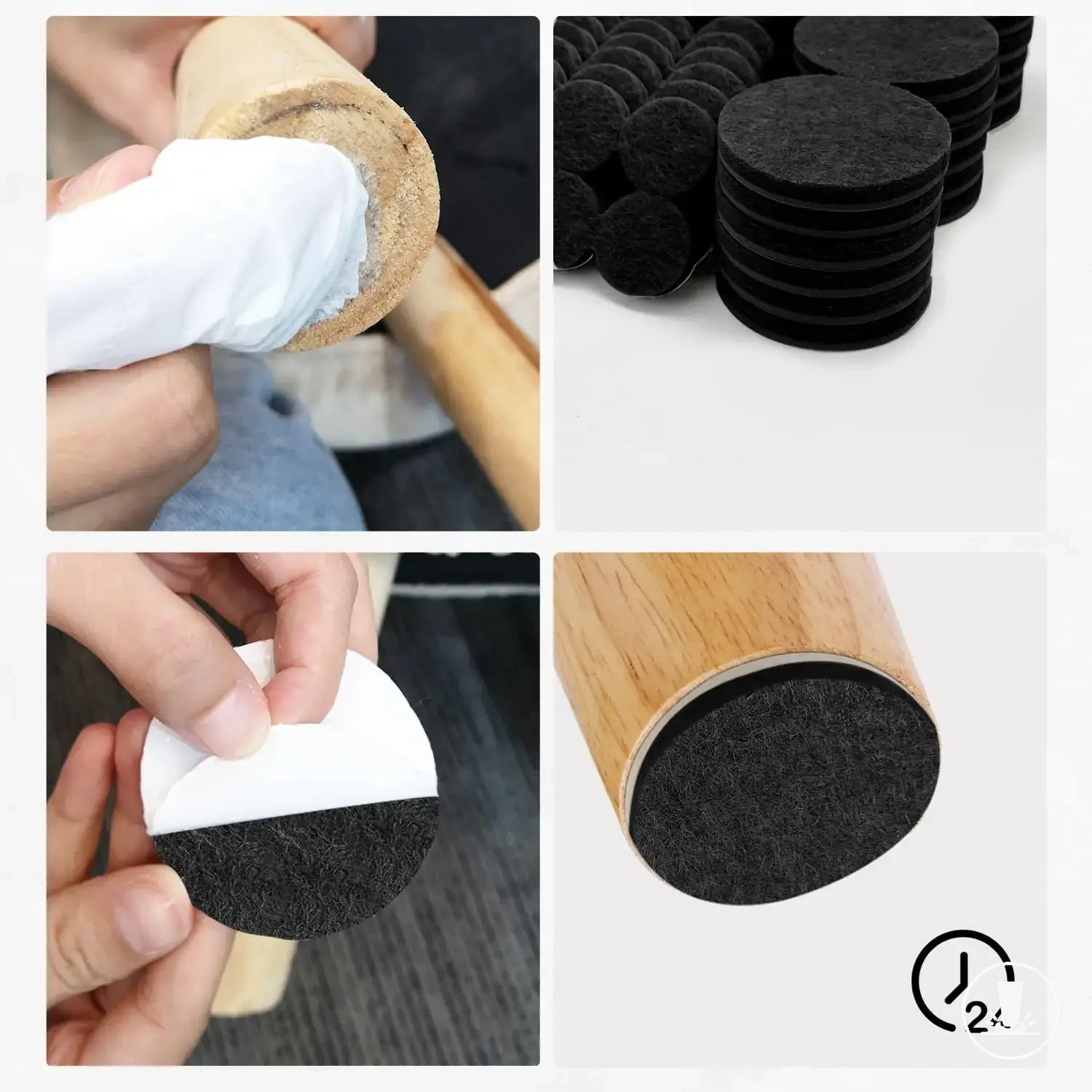
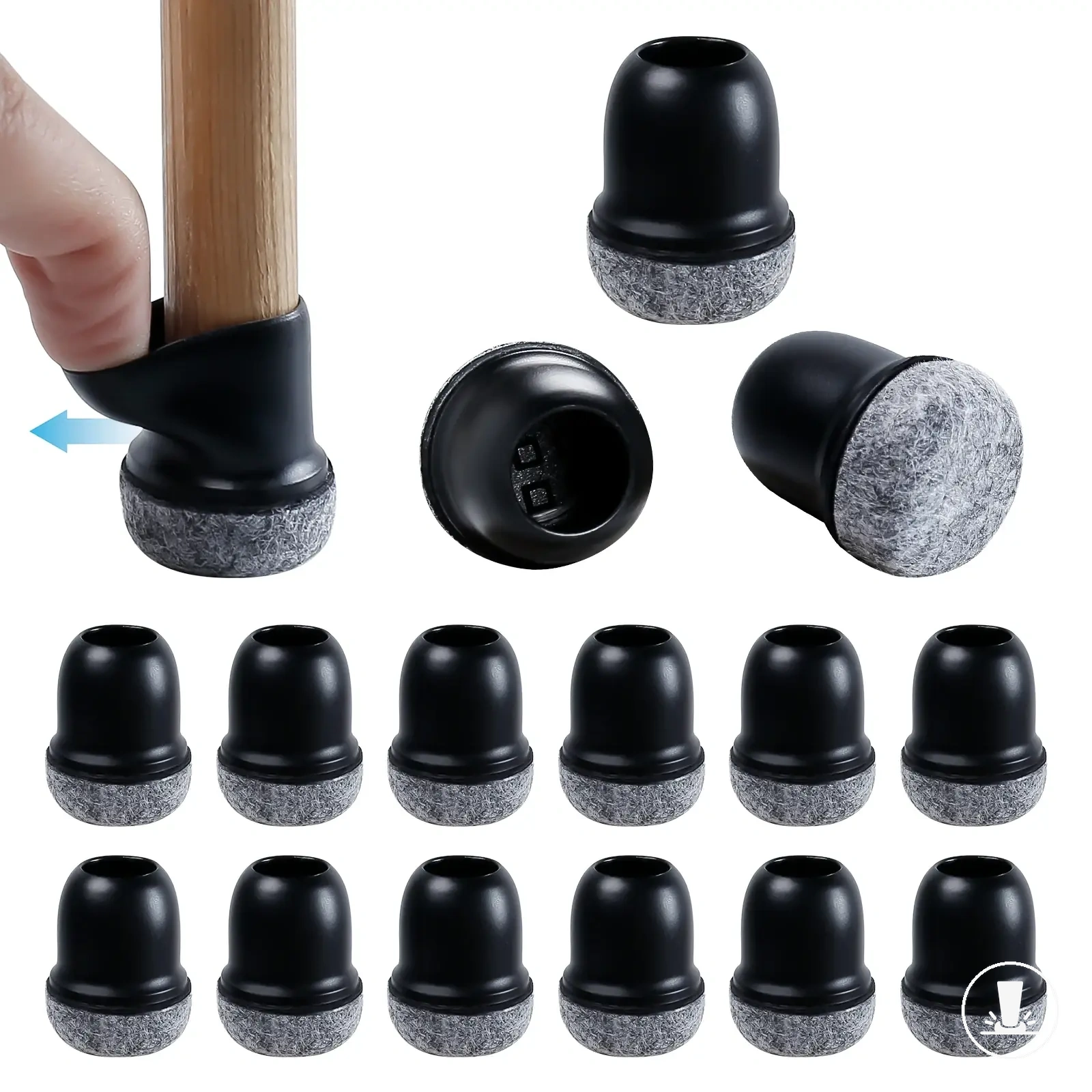
Grip, adhesion, and fit stability depend on whether a protector can maintain its position during repeated movement. Grip is influenced by bottom friction, adhesion depends on the hold of an adhesive pad, and fit stability depends on cap fit and leg shape. These compatibility conditions can help reduce slipping, peeling, or shifting when movement stability is maintained.
When repeated movement creates movement stress, protectors may become less effective if adhesion weakens or fit stability decreases. A fitted cap that matches the leg shape and a non-slip base with suitable bottom friction may help maintain position during use. Compatibility depends on movement conditions, furniture condition, and whether the fit or adhesive condition remains stable.
Use the checklist below to evaluate movement-related compatibility:
- Adhesion remains secure without visible peeling
- Cap fit matches the furniture leg shape
- Bottom friction supports the desired level of grip
- Repeated movement does not cause noticeable shifting
- Dirt does not interfere with hold or contact stability
If a protector shifts out of place during repeated movement, the exposed contact point may create new scratch or noise risk. This condition can occur when grip, adhesion, or fit stability no longer matches the movement demands placed on the protector.
Floor and furniture conditions that change protector choice
Protector compatibility depends on the conditions the protector must handle rather than on a single product attribute. The same protector criterion may produce different outcomes depending on floor surface, furniture weight, movement frequency, and leg design. A protector choice that suits one condition may involve a trade-off under another condition. Compatibility is shaped by floor surface, floor finish, furniture weight, movement frequency, and leg design.
Floor and furniture conditions that change protector choice become easier to compare when the main variables are viewed together. The image below labels the conditions that alter protector priority, including floor surface, furniture weight, movement demands, and contact width.
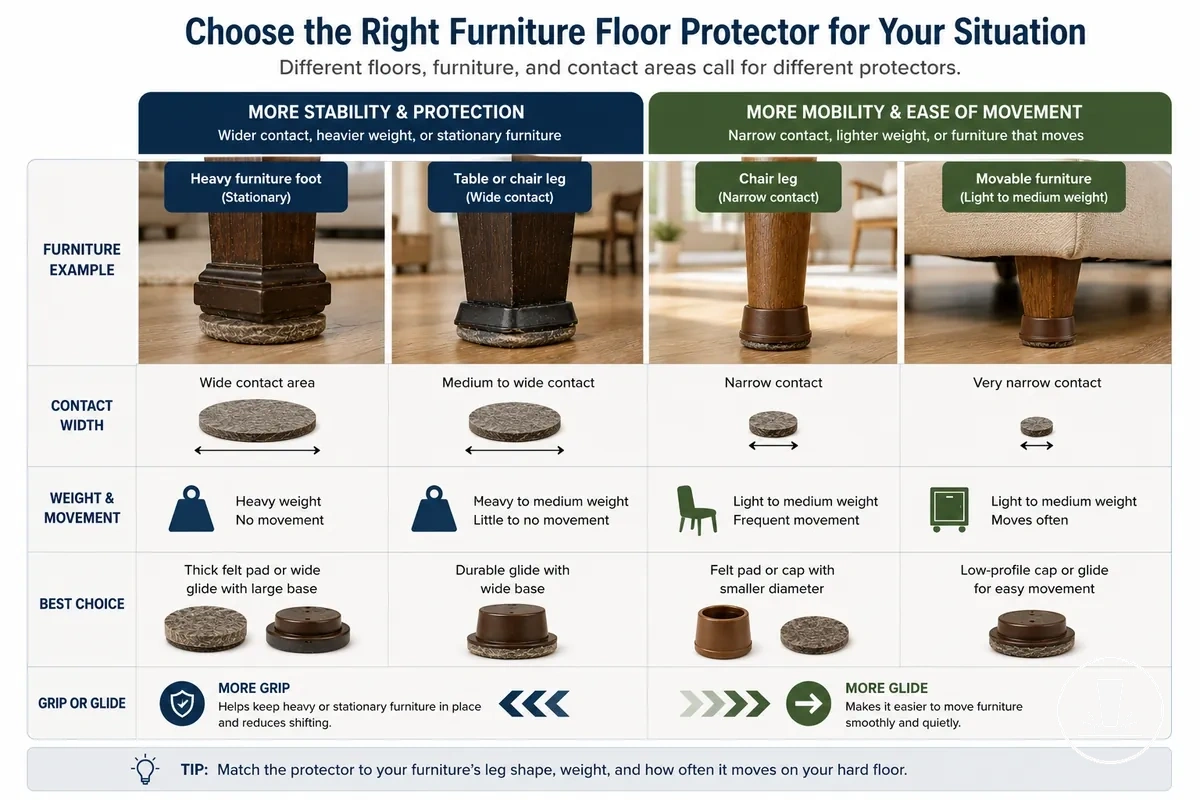
Floor finish and surface hardness can change how a protector behaves during use. Hardwood and tile may respond differently to friction, contact material, or movement patterns, so the protector criterion often depends on mark risk, surface condition, and the desired balance between grip and glide. Material choice should be evaluated against the floor finish rather than assumed suitable for every floor type.
Furniture weight and movement frequency can change which attribute becomes the priority. Heavy furniture may place more emphasis on load spread and contact area when dent risk is a concern, while movable chairs may place more emphasis on movement control, noise reduction, or controlled glide. The appropriate trade-off depends on how often the furniture moves and how much pressure reaches the floor surface.
Leg design also affects compatibility because fit influences stability during use. Narrow furniture legs, wider feet, and different leg shapes may require different fit conditions to keep protectors positioned correctly. Floor compatibility should not be confused with universal product suitability because protector choice still depends on fit, furniture condition, and movement requirements.
The same protector attribute can behave differently when floor and furniture conditions change. Use the matrix below to compare the condition, risk signal, protector priority, and decision boundary.
| Condition | Risk signal | Protector priority | Boundary note |
|---|---|---|---|
| Hard floors such as hardwood or tile | Mark risk during movement | Contact protection and controlled friction | Outcome depends on floor finish and movement condition |
| Heavy furniture | Dent risk from concentrated pressure | Load spread and contact area | Pressure effects vary by surface condition |
| Movable chairs | Frequent movement and noise | Balanced grip and glide | Movement frequency influences the trade-off |
| Narrow legs | Limited contact width | Stable fit and wider contact support | Fit depends on leg design |
| Slippery surfaces | Reduced movement control | Grip and bottom friction | Higher grip may reduce glide |
Hard floors that show scratches, scuffs, and noise faster
Hard floors often reveal scratches, scuffs, and scraping noise more quickly because surface marks and contact sounds remain more visible during furniture movement. A hard floor surface may show abrasion or rubbing marks sooner when movement creates repeated contact. Protector priority often increases when hard floors have greater visible wear sensitivity.
When a chair moves across wood, tile, or laminate, contact conditions can make scratches, scuffs, or scraping noise easier to notice than on softer surfaces. Movement frequency, trapped grit, or hard contact may increase visible wear, which is why protector choice often depends on the floor finish and movement pattern. For readers comparing broader hardwood floor protection options, material choice may still depend on the floor finish or coating because coatings can change compatibility conditions.
Heavy furniture that needs weight spread before softness
Heavy furniture compatibility often depends on load spread before softness becomes useful. When furniture weight is concentrated on a narrow contact point, pressure concentration may increase dent risk even if a soft pad is present. Protector priority usually starts with weight distribution and contact area to support load spread before softness.
When a heavy item rests on a soft but narrow pad, the pad may compress under load and provide less effective weight distribution. A wider load-bearing surface, such as large furniture pads or furniture cups, may help reduce pressure concentration when foot width is limited, although the outcome still depends on floor condition and compression risk.
- Check furniture weight and overall load.
- Check foot width and contact area.
- Check floor softness and dent sensitivity.
- Check how long the furniture remains in one place.
- Check whether compression reduces load spread over time.
Chairs and frequently moved furniture that need durable contact control
Chairs and frequently moved furniture depend on attachment stability and wear resistance when repeated movement is part of normal use. Protectors that maintain grip and contact control during sliding, lifting, and repositioning may help reduce scratches and noise over time. Protector priority often increases with repeated movement.
When dining chairs, stools, or other movable furniture are shifted frequently, repeated movement can increase wear and the chance of protector shift. Attachment stability may help maintain consistent grip and reduce scratch risk, while wear resistance can support more consistent contact control. A loose protector may become a source of scratches or noise if repeated movement changes the contact condition, creating loose-protector risk.
- Dining chairs often need greater wear resistance because movement is frequent.
- Stools may benefit from attachment stability when repositioned repeatedly.
- Desks that are moved periodically can place additional wear on protector contact points.
- Small tables that shift during use may require consistent grip under repeated movement.
Choosing protectors by primary floor risk
Protector selection depends on the primary floor risk rather than on secondary benefits. Scratches, dents, noise, and sliding often require different protector criteria because each risk comes from a different floor-contact condition. A protector that performs well for one risk may involve a trade-off for another. Choose the primary floor risk first.
A scratch-first selection priority usually points toward soft contact and controlled abrasion. Furniture pads may help when surface marks are the main concern, especially when contact points remain clean and abrasive particles are limited. The protector criterion is reducing abrasive contact rather than increasing grip or load spread.
A dent-first selection priority usually points toward load spread and contact width. When furniture weight creates pressure concentration, wider contact support may become more important than softness alone. The protector criterion is managing pressure distribution through load spread under the relevant floor condition.
A noise-first selection priority often favors cushioning and soft contact because scraping sounds are linked to floor-contact behavior. A sliding-first priority usually favors grip and friction when unwanted movement is the main concern. These priorities can compete because greater grip may reduce glide, while greater glide may reduce movement control.
Mixed-risk situations depend on which outcome creates the greater concern. When scratches and dents compete, soft contact and load spread should be evaluated together; when noise and sliding compete, cushioning, grip, and glide should be balanced by condition. Readers who want to choose protectors by floor risk can use the decision signals below because scratch, dent, noise, and sliding risks require different attributes.
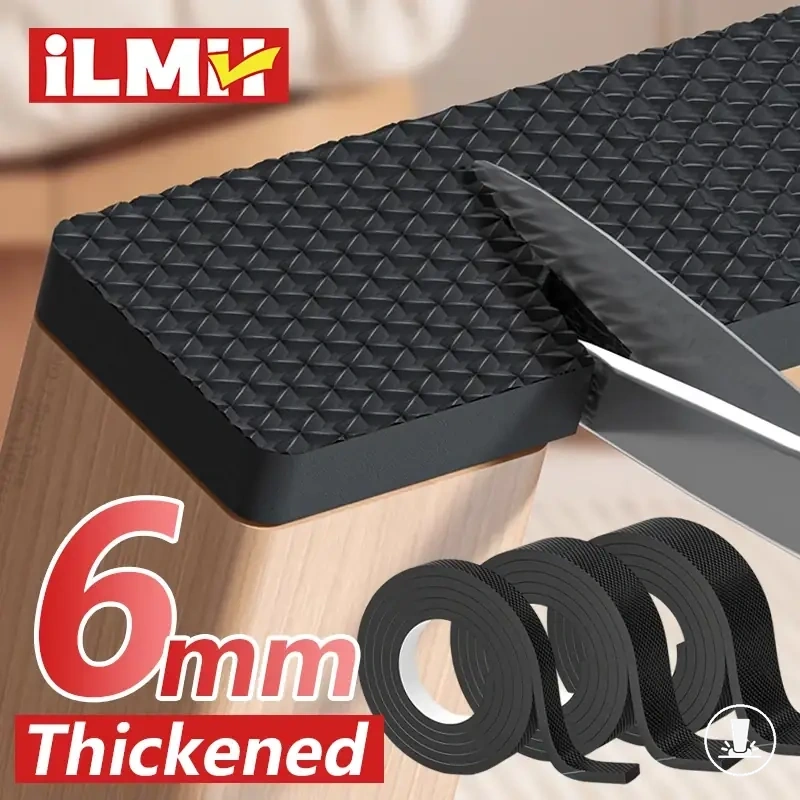
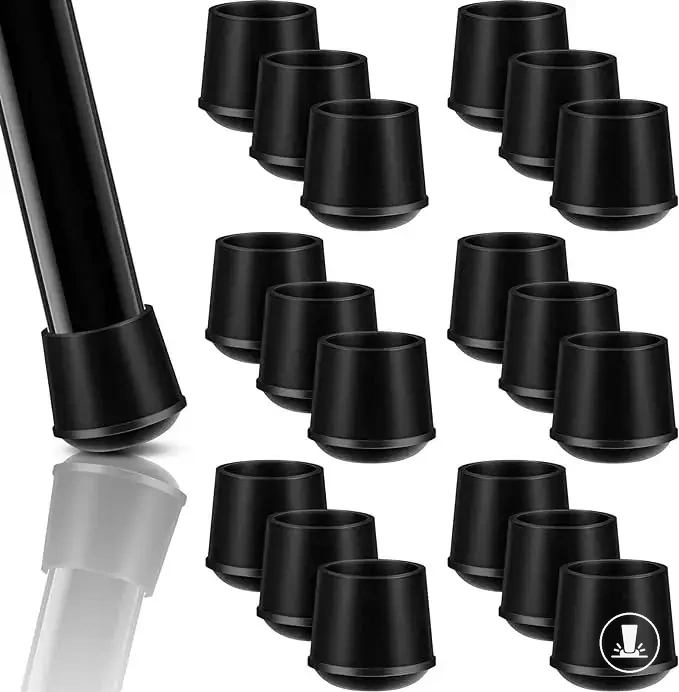
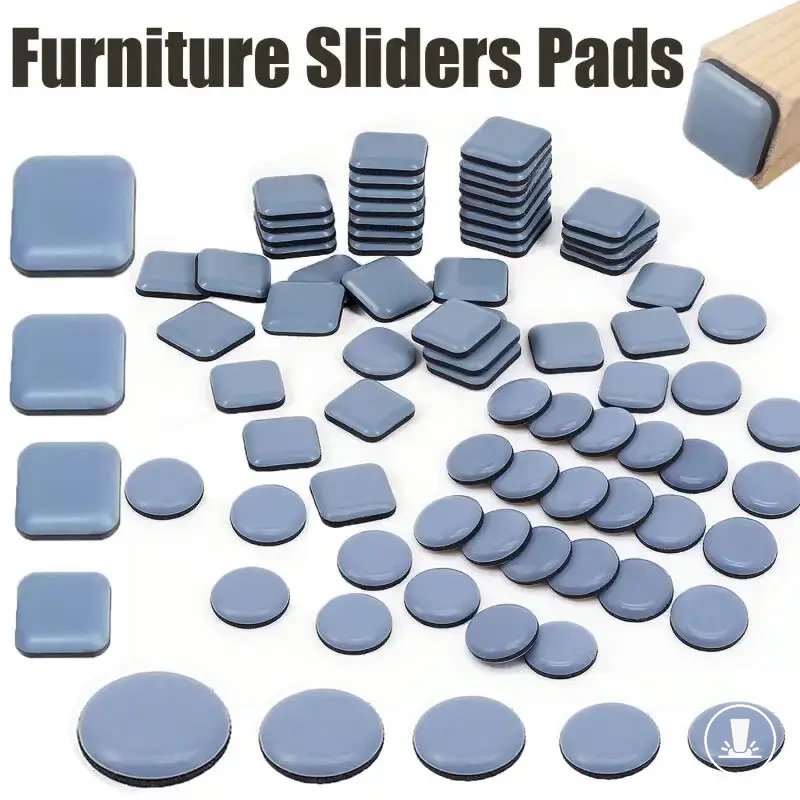
Here are product examples that may make comparison easier. Before buying, always review the compatibility criteria, essential features, and product details.
| Primary risk | Prioritize | Watch for | Decision cue |
|---|---|---|---|
| Scratches | Soft contact | Abrasion and debris | Choose scratch-first when surface marking is the main risk |
| Dents | Load spread | Pressure concentration | Choose dent-first when weight focuses on a small contact area |
| Noise | Cushioning | Scraping sounds | Choose noise-first when sound reduction is the main goal |
| Sliding | Grip | Reduced stability | Choose sliding-first when unwanted movement is the main concern |
| Mixed risks | Selection priority | Attribute trade-offs | Choose the attribute linked to the greater floor risk |
Scratch-first protector choices
Scratch-first protector choices depend on prioritizing soft contact, a clean pad, and stable positioning during chair movement. When scratch risk is the main concern, the protector criterion should focus on reducing abrasion at the floor-contact point. The selection priority is soft clean contact.
When chair movement creates repeated floor contact, anti-scratch pads, felt pads, or similar floor pads may help reduce abrasion if the contact surface remains clean and stable. Scratch-first selection should also account for conditions that can reverse the benefit, and the main caveat is grit or a worn pad.
Use these decision checks when scratch risk is the main concern:
- Choose soft contact when movement creates visible surface marking.
- Choose a clean pad when grit may increase abrasion.
- Choose stable placement when chair movement may cause protector shift.
- Replace a worn pad when the contact surface becomes rough and may increase abrasion.
Dent-first protector choices
Dent-first protector choices depend on prioritizing load spread before secondary attributes. When dent reduction is the main goal, wider contact width and compression resistance may matter more than soft cushioning alone. The selection priority is load spread.
When furniture weight is concentrated on a small contact point, pressure may increase on floors with greater floor softness or long time under load. Anti-dent pads, furniture cups, or large pads may help by increasing contact width and maintaining compression resistance, but outcomes still depend on furniture weight, floor softness, and duration. Wider and more load-bearing contact often matters before soft cushioning, especially when long-term pressure remains a factor.
- Check furniture weight and whether pressure is concentrated on a small area.
- Check contact width and whether the load is spread across a larger surface.
- Check floor softness and sensitivity to pressure-related marking.
- Check compression resistance and whether the contact area remains stable under load.
- Check time under load when furniture stays in one position for extended periods.
Noise-first and sliding-first protector choices
Noise-first and sliding-first protector choices depend on different priorities. Noise-first selection usually favors cushioning and sound dampening, while sliding-first selection usually favors grip and friction for movement control. The key decision is separating scraping noise from sliding.
When scraping noise is the main problem, a soft layer with cushioning may help reduce sound during movement. When unwanted sliding is the main problem, non-slip pads or furniture grippers may help increase stability through friction. A quieter protector may still slide, and a grippier protector may reduce movement without reducing every sound, creating a cushioning or friction trade-off.
Use the contrast below to match the main problem with the primary attribute:
| Noise-first | Sliding-first |
|---|---|
| Prioritize cushioning | Prioritize grip |
| Focus on scraping noise | Focus on stability |
| May allow more glide | May reduce glide |
| Sound dampening is the goal | Movement control is the goal |
When both scraping noise and sliding occur together, the choice may require balancing glide, grip, and cushioning. The preferred attribute depends on whether sound reduction or movement stability creates the greater concern, and that balance is often a practical trade-off.
Safe use checks before protectors create new floor problems
Safe use checks help identify protector conditions that may create scratches, marks, noise, or instability before those issues become more noticeable. A protector condition that shows wear, movement, or contamination can increase floor-contact risks under certain conditions. The most useful checks focus on clean contact, stable fit, correct load spread, and replacement timing.
Use the checklist below to verify common warning signs before they contribute to new floor-contact problems.
| Check | Warning sign | Action |
|---|---|---|
| Clean contact surface | Dirt buildup or trapped grit | Remove debris that may increase scratch risk |
| Adhesive condition | Adhesive residue near the contact area | Check for mark risk and use caution around the floor finish |
| Protector shape | Compressed pads under load | Verify load spread and consider replacement timing |
| Fit stability | Loose caps or shifting during movement | Check stable fit to reduce noise and scratch risk |
| Protector position | Uneven floor contact | Confirm the protector remains properly aligned |
Dirt buildup and adhesive residue deserve additional attention because both can create new floor-contact issues. Dirt and grit may increase scratches during movement, while adhesive residue may increase mark risk on certain floor finishes. A maintenance check focused on visible residue and clean contact can help identify these warning signs early.
Compressed pads, loose caps, and protectors that shift during use may change how load and movement reach the floor surface. When these warning signs become noticeable, replacement timing and fit verification may help reduce instability, noise, or uneven pressure. Safe use checks provide a practical final verification layer, but outcomes still depend on protector condition and floor conditions.
Here are product examples that may make comparison easier. Before buying, always review the compatibility criteria, essential features, and product details.