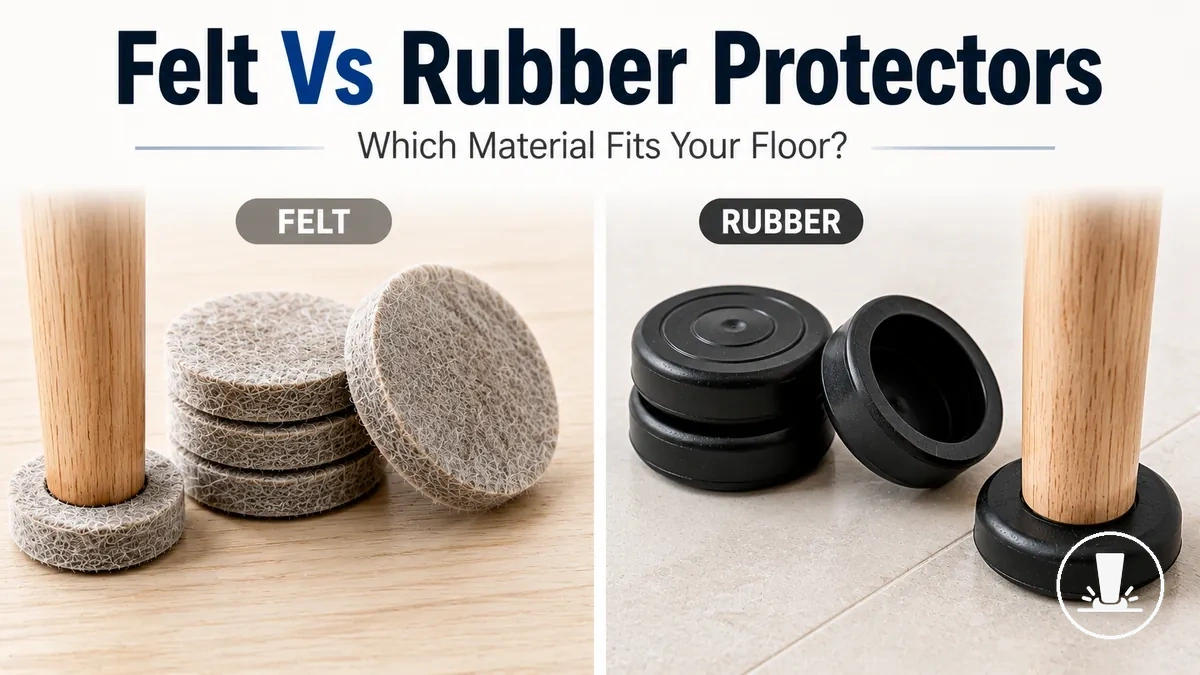
Felt vs Rubber Furniture Floor Protectors
Felt vs rubber furniture floor protectors is a material-choice comparison that depends on floor surface, furniture movement, grip needs, and marking risk. Felt furniture pads and rubber furniture pads interact with floors differently, so the better option often changes by use case. Floor finish sensitivity, sliding frequency, and the condition of chair legs can all influence results. Neither material is a universal winner because protection and risk outcomes vary by surface conditions and furniture use.
Felt furniture pads usually support smoother movement, while rubber furniture pads usually provide stronger grip and sliding resistance. On hardwood floors and other scratch-sensitive surfaces, the choice may depend on how often furniture moves, how clean the pad remains, and how much pressure is placed on the contact point. Felt pads are often associated with easier movement under chair legs, while rubber grippers are often chosen when stability matters more than movement. furniture floor protectors are floor-contact materials designed to reduce direct contact between furniture and the floor surface.
When furniture moves frequently across a floor surface, felt pads can support smoother movement and may help reduce scratches when kept clean. When furniture is intended to remain stationary, non-slip pads made from rubber can provide stronger grip. Felt vs Rubber Furniture Floor Protectors can be compared through movement, grip, surface contact, and risk signals, and this comparison stays within furniture floor protector material choice while wider material categories and floor-specific guides remain supporting contexts. Felt movement and rubber grip are the first major contrast.
| Material | Main behavior | Better when | Watch for |
|---|---|---|---|
| Felt furniture pads | Smooth movement and lower friction | Furniture moves often and scratches are a concern | Dirt buildup, wear, and marks if the pad becomes damaged or contaminated |
| Rubber furniture pads | Higher grip and greater sliding resistance | Furniture should stay more stable and movement is limited | Possible marks or residue depending on floor finish, pressure, and material condition |
How Felt and Rubber Pads Behave at Floor Contact
If reducing friction is more important than grip, felt pads usually allow smoother sliding, while rubber pads usually increase resistance through added grip. Felt pads have a softer contact surface that can move more easily beneath furniture legs, whereas rubber pads rely on texture and compression to create stronger floor contact. Pressure, movement frequency, and surface finish can influence how each material behaves over time. These differences in surface behavior form the basis of the comparison.
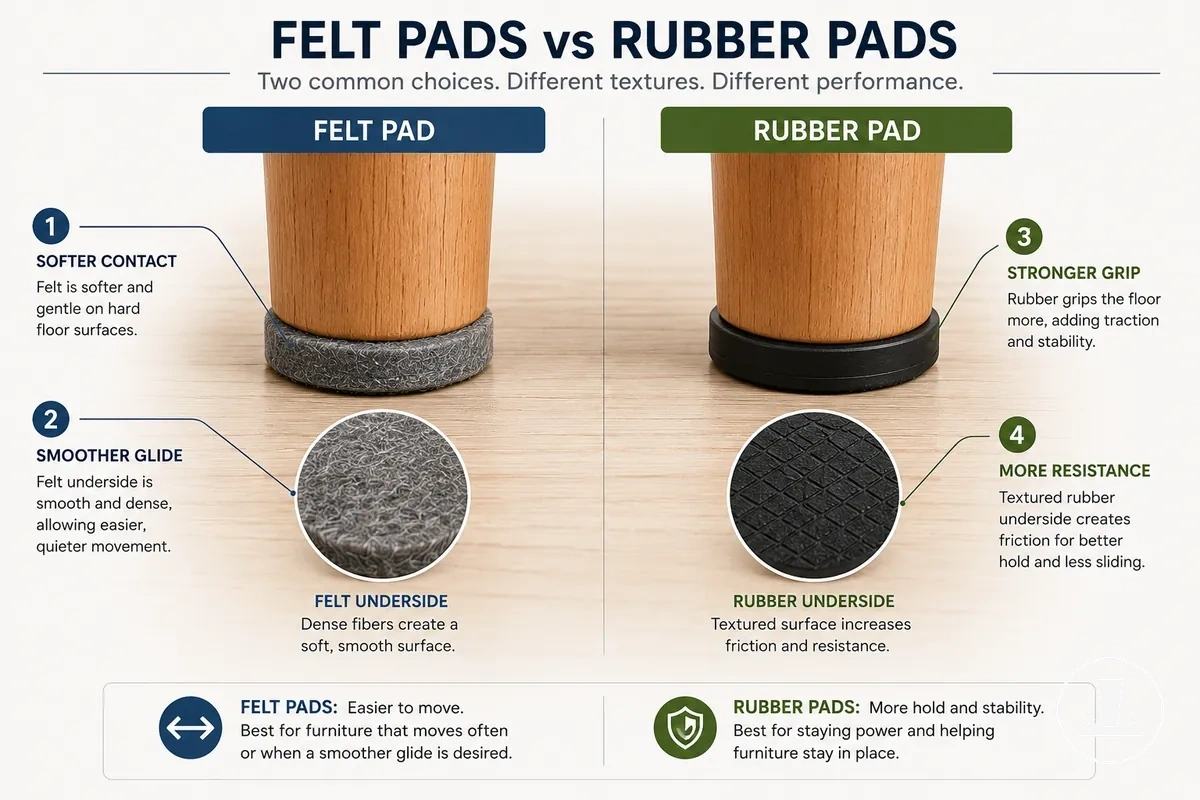
When chair movement happens often, felt pads can support smoother movement because friction at the contact surface is typically lower. For stationary furniture, rubber pads may help limit movement because grip and compression increase resistance. Debris can affect either material, and particles trapped beneath furniture pads may contribute to scratches or marks depending on the surface finish, cleaning habits, and movement frequency. These material behaviors provide context for comparing furniture floor protector materials.
When floor contact behavior is unclear, felt pads and rubber pads can appear similar even though friction, compression, debris pickup, and surface sensitivity affect them differently. How Felt and Rubber Pads Behave at Floor Contact depends on these material-level interactions, and the table below compares friction, grip, and pressure effects before moving into floor compatibility criteria.
| Material | Contact behavior | Practical effect | Main caution |
|---|---|---|---|
| Felt pads | Lower-friction contact surface with smoother movement | Furniture legs can slide more easily during repositioning | Debris pickup may increase scratch risk if the contact surface is not kept clean |
| Rubber pads | Higher-grip contact surface with greater compression | Furniture is more likely to remain stable during normal use | Marks may occur on some surface finishes depending on pressure and contact conditions |
Felt pads and smoother furniture movement
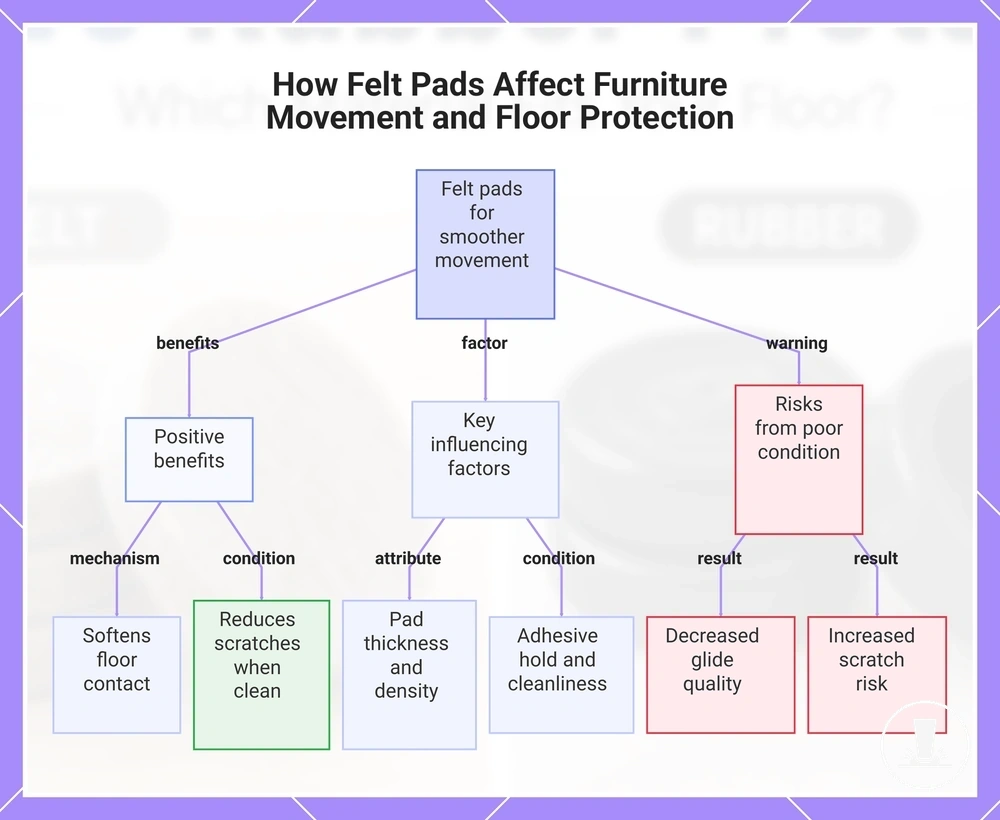
Felt pads usually support smoother movement by softening floor contact beneath chair legs, although the outcome depends on pad thickness, adhesive hold, dirt buildup, and furniture weight. Greater pad thickness and felt density can help maintain a more consistent glide, while thin or compressed felt may provide less cushioning during movement. Felt furniture pads can help reduce scratches when the contact surface remains clean and securely attached. Pad condition, cleanliness, and wear all affect results.
When dirt buildup or trapped grit develops within felt pads, smoother movement can decrease and the risk of scratches may increase. If adhesive hold weakens or the felt becomes worn, chair legs may not move as intended across hard floors. In these cases, the condition of the felt pads can reduce both movement quality and surface protection.
This chart explains how felt pads support smoother furniture movement, the factors that affect their performance, and the risks when pad condition degrades.
Rubber pads and stronger furniture grip
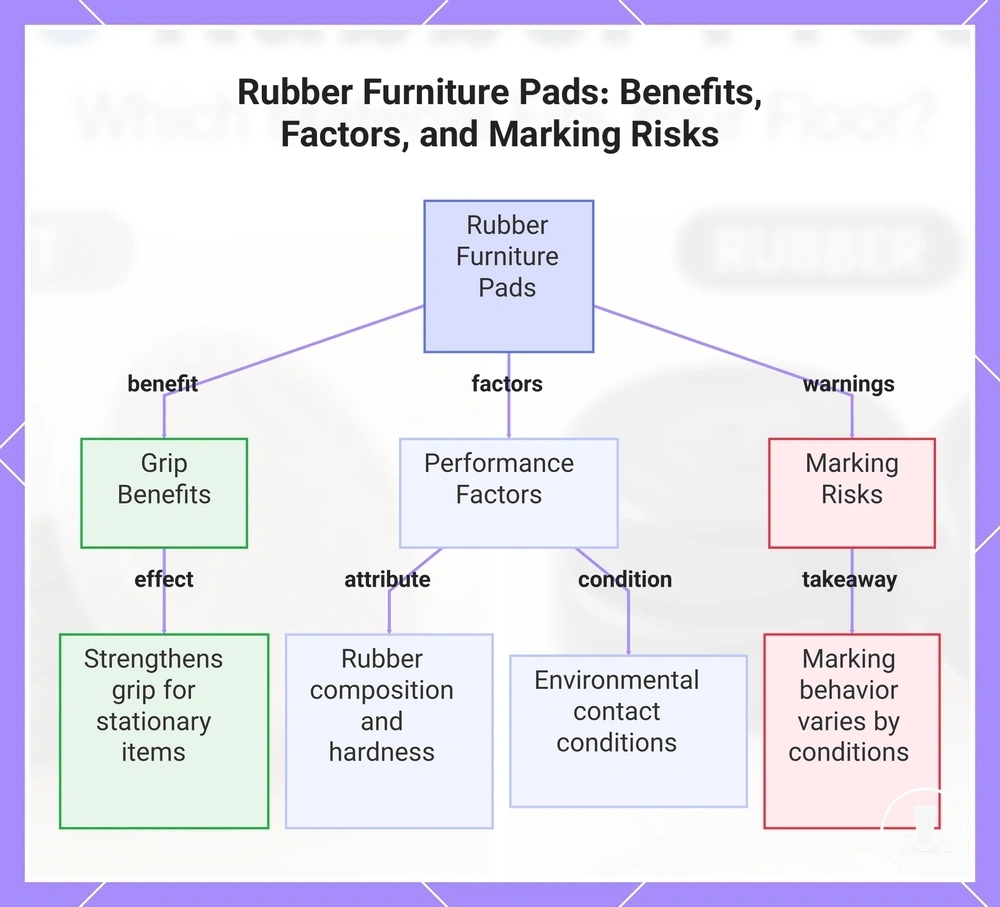
Rubber pads usually create stronger grip and greater sliding resistance because their contact surface increases friction beneath furniture. Rubber pads can improve stability for stationary furniture, although the result depends on rubber quality, non-slip texture, pressure, moisture, and floor finish sensitivity. Rubber hardness and compression influence how the material responds under weight, while longer dwell time may increase residue or marking risk on certain surfaces. The effect on a floor finish varies by rubber compound and contact conditions rather than by the material alone.
For stationary furniture, rubber furniture pads can help reduce unwanted movement by maintaining stronger grip at the contact point. Frequently moved chairs may experience more sliding resistance, which can make repositioning less smooth. Any residue or marking risk depends on rubber quality, floor finish, pressure, and dwell time, so rubber pads should not be assumed to be either non-marking or mark-forming in every situation.
This chart explains how rubber furniture pads provide grip, what factors influence their performance, and the potential marking risks to consider.
Floor Compatibility for Felt and Rubber Protectors
Floor compatibility depends on the floor surface, floor finish, friction needs, and mark tolerance. Felt protectors are often a better material fit when furniture movement and finish sensitivity are the primary concerns, while rubber protectors may be considered when grip and stability are more important. Furniture weight, cleaning condition, and pad condition can change how each material behaves on hard floors. Checking floor condition before choosing is more reliable than relying on a one-size-fits-all choice.
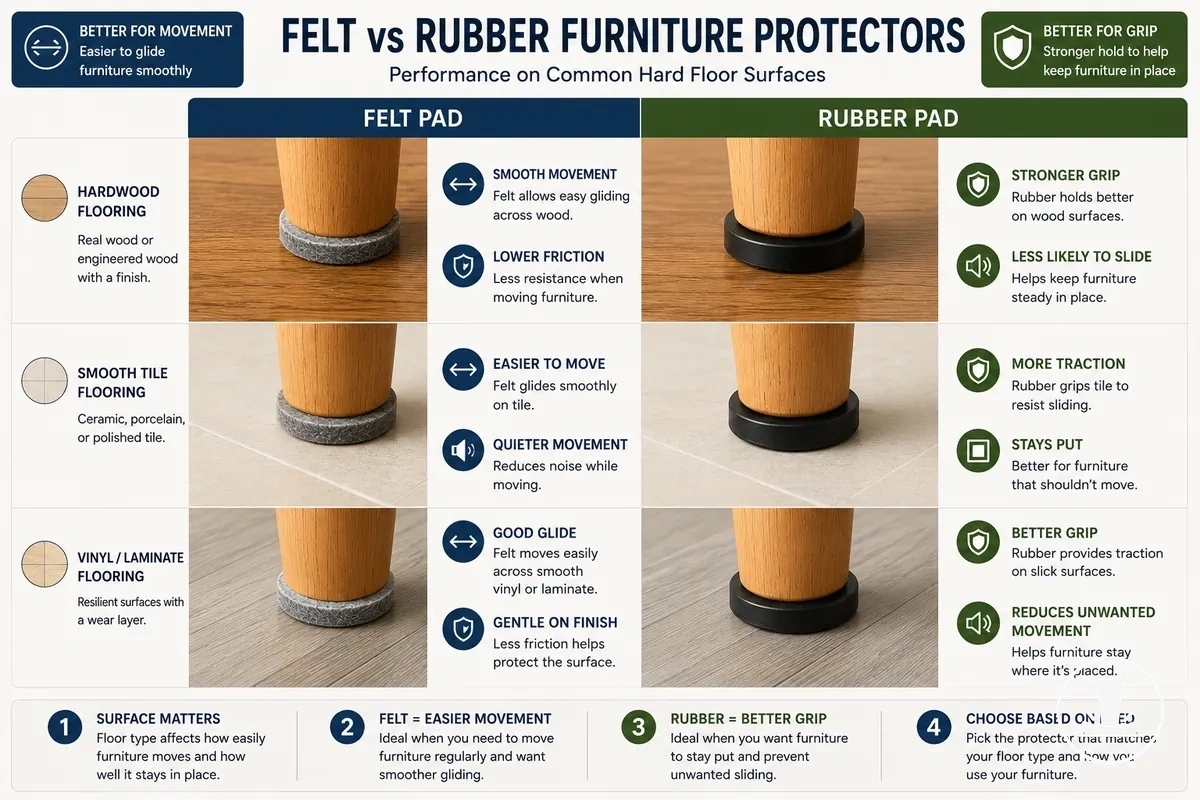
When hardwood floors or other scratch-sensitive hard floors are involved, felt protectors are often considered because they can support furniture movement with lower friction. Floor finish sensitivity, debris buildup, and furniture weight may still affect the outcome. Material fit should be evaluated against scratch risk and finish condition rather than by floor type alone.
When vinyl, laminate, tile, or mixed-use floors are involved, floor compatibility often depends on balancing movement with stability. Smooth tile surfaces may increase the need for grip, while laminate surfaces may place greater emphasis on furniture movement and surface hardness. Vinyl can respond differently depending on floor finish, pressure, moisture, and material quality, so mark tolerance should remain part of the decision.
When the material fit is unclear, separating movement needs from grip needs can simplify the choice. Readers who need deeper hardwood-specific guidance can review furniture floor protectors for hardwood floors. Choose felt when movement and scratch sensitivity dominate; consider rubber when grip and stability dominate, while keeping floor finish, furniture weight, and mark tolerance in mind before comparing risks.
Floor Compatibility for Felt and Rubber Protectors can be organized by floor condition, material tendency, and the key factor to check before choosing.
| Floor condition | Felt tendency | Rubber tendency | Check before choosing |
|---|---|---|---|
| Hardwood or scratch-sensitive hard floors | Often supports easier movement | May increase grip | Floor finish sensitivity and debris control |
| Vinyl | May reduce friction during movement | May provide more stability | Mark tolerance, pressure, and surface response |
| Laminate | Often supports furniture movement | May help limit sliding | Surface hardness and movement frequency |
| Tile | May allow smoother repositioning | Often considered when grip is needed | Friction requirements and floor condition |
| Mixed-use floors | Can support movement across surfaces | Can support stability in fixed positions | Material fit across all floor areas |
Hardwood and other scratch-sensitive hard floors
Hardwood and other scratch-sensitive floors usually favor clean, well-fitted soft contact when chair movement is frequent. Clean, correctly sized felt pads are often considered on hardwood when movement and floor finish sensitivity are the primary concerns, although the outcome depends on pad fit, pressure, and surface condition. Polished hard floors and different finish coatings can respond differently to friction and contact pressure, so material implications remain conditional. Scratch-sensitive floors are influenced by pad condition, chair movement, and surface cleanliness as much as by the choice between felt pads and rubber pads.
- Check floor finish sensitivity before choosing between felt pads and rubber pads.
- Keep pad contact surfaces clean to reduce grit-related scratch risk.
- Consider how often chair movement occurs across the floor surface.
- Review pressure from furniture weight and contact points.
- Replace worn pads when fit and contact quality decline.
When grit becomes trapped beneath chair legs or protector surfaces, scratches may occur regardless of material choice. Floor finish sensitivity and pressure can increase risk when pads are dirty, worn, or poorly fitted, and rubber pads may require additional attention where mark risk is a concern. Readers needing deeper floor-specific guidance can review furniture floor protectors for hardwood floors, where broader fit, material, and risk considerations are covered in more detail.
Vinyl, laminate, tile, and mixed floor conditions
When vinyl, laminate, tile, and mixed floors are involved, friction, moisture exposure, sliding behavior, and mark tolerance can vary by surface condition. Hard floor surfaces may respond differently to furniture movement, while resilient flooring and smooth tile can shift the balance between movement and grip. Material behavior should be evaluated through local conditions rather than assuming the same outcome across all floor types.
- Vinyl: Rubber interaction may vary with product quality, moisture exposure, pressure, and manufacturer guidance, so mark tolerance remains an important qualification.
- Laminate: Surface hardness and furniture movement can make felt pads a common material tendency when sliding occurs frequently.
- Tile: Smooth tile may increase the value of grip, while rubber pads can be considered when controlling sliding is more important than movement ease.
- Mixed floors: Furniture movement across different surfaces can change material behavior, making movement patterns an important decision signal.
Material tendencies are usually conditional: felt may suit frequently moved chairs where smoother movement is preferred, while rubber may be considered for stationary furniture where added grip is useful. Movement frequency often becomes the main local decision variable because it influences how moisture exposure, surface hardness, sliding, noise, and mark tolerance affect the felt-versus-rubber choice.
Scratch, Mark, and Stain Risk by Material
Felt pads are usually associated with reducing scratches, while rubber pads are often associated with improving grip, but both materials require condition checks to avoid unwanted outcomes. Scratches, marks, stains, and scuffs depend on material condition, floor finish, pressure, dirt buildup, and surface contact over time. Dirty, worn, low-quality, or mismatched protectors can change risk regardless of whether felt pads or rubber pads are used.
Myth: scratches, marks, and stains are the same problem. Truth: scratches are physical surface damage, while marks, residue, and stains are visible changes that may occur without surface scratches. This distinction helps separate material-related wear from floor-finish appearance changes and reduces confusion about non-marking risk.
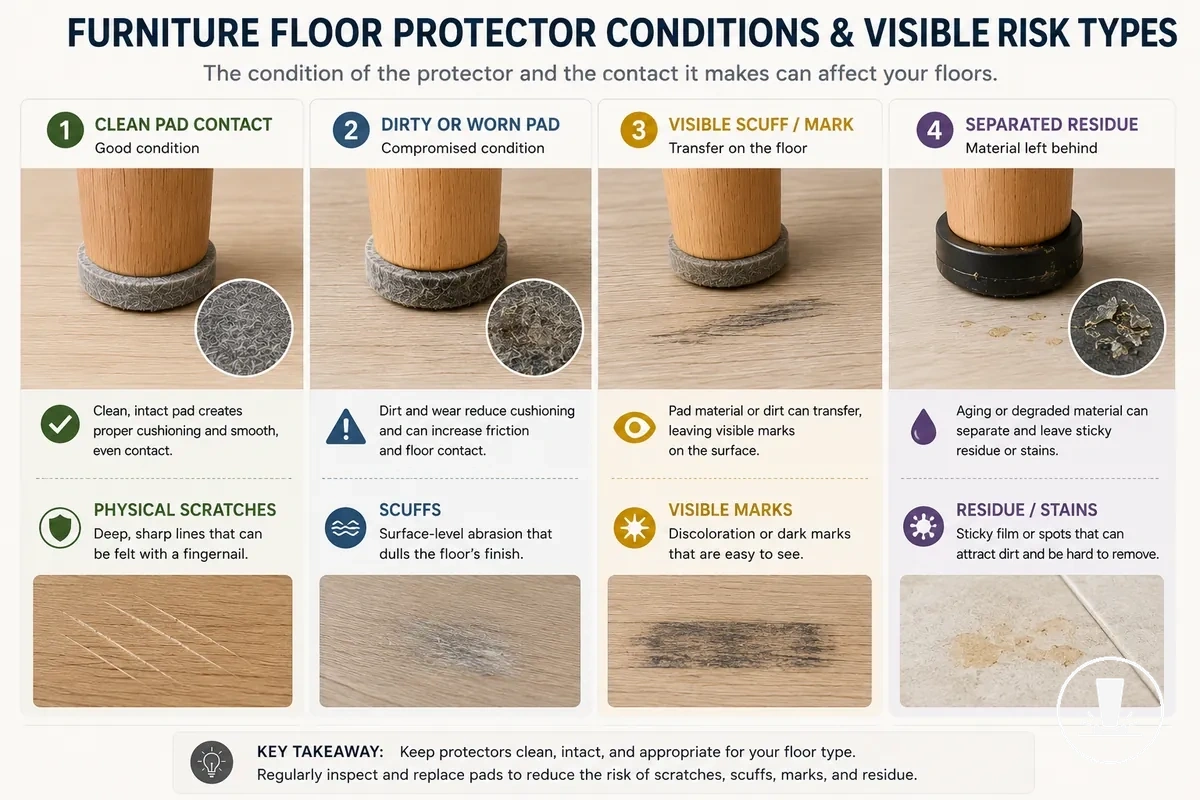
Problem to solution: Scratch, Mark, and Stain Risk by Material becomes easier to evaluate when physical scratching is separated from visible marking. The image above clarifies the difference between physical damage and visible marks. For related movement effects, see scratch noise and sliding protection, which explains how surface contact can influence scratches, noise, and sliding behavior.
| Risk type | Felt-related condition | Rubber-related condition | Safer check |
|---|---|---|---|
| Scratches | Dirt buildup trapped in felt pads | Hard particles trapped beneath contact points | Inspect and clean contact surfaces |
| Scuffs | Worn felt during repeated sliding | High-friction surface contact under pressure | Check wear and movement patterns |
| Visible marks | Compressed or deteriorated pad condition | Pressure-related floor marks | Monitor contact areas regularly |
| Residue or stains | Moisture and floor finish sensitivity may affect outcomes | Residue may appear under certain conditions | Review floor finish guidance |
| Dirt buildup | Embedded debris may increase scratches | Debris can affect contact quality | Replace heavily contaminated protectors |
Scenario-first, dirt buildup, pressure, residue, and time can change how felt pads and rubber pads interact with a floor finish. Residue and stains may become more noticeable when material condition declines or when moisture and pressure remain present for longer periods. Visible outcomes depend on conditions rather than on the material alone.
Problem to solution: understanding whether the concern is scratches, scuffs, marks, residue, or stains helps narrow the likely cause before replacement decisions are made. Readers seeking broader troubleshooting context can review marks from furniture floor protectors. Regular inspection can help identify dirt buildup, compression, wear, or residue before replacement becomes necessary.
Sliding Control, Furniture Weight, and Pad Durability
Sliding control depends on movement frequency, furniture weight, grip need, and wear tolerance rather than on material choice alone. Rubber grip may be more relevant when stability is the priority, while felt wear may become a larger consideration when furniture moves often. Furniture weight, pressure distribution, pad compression, and adhesive stress can all influence pad durability over time.
Scenario-first, light chairs and frequently moved furniture often place repeated movement demands on chair legs and contact surfaces. Higher movement frequency can increase felt wear and adhesive stress, which may become replacement signals when pad edges loosen, thin, or lose consistent contact. Pad durability depends on use pattern, pressure distribution, and surface conditions rather than on movement alone.
Scenario-first, stationary furniture and heavier furniture often create greater pressure distribution and compression at the contact point. Rubber grip may support sliding control where stability is important, but pad durability can still depend on compression, fit, and adhesive stress. Increased furniture weight affects pad performance, making periodic condition checks useful when pressure remains concentrated in the same area.
Problem to solution: Sliding Control, Furniture Weight, and Pad Durability becomes easier to evaluate when weight, movement, and wear tolerance are viewed together. The table below organizes decision signals around movement frequency, pressure distribution, and long-term pad condition. For broader floor-safety context where sliding control intersects with movement-related protection, see scratch noise and sliding protection. Replacement may be worth considering when felt wear, compression, peeling, pad failure, or reduced stability become noticeable.
| Furniture condition | Material tendency | Durability concern | Decision signal |
|---|---|---|---|
| Frequently moved furniture | Felt may support smoother movement | Felt wear and adhesive stress | Movement frequency is high |
| Light chairs | Material choice depends on grip need | Edge wear and fit changes | Frequent repositioning |
| Stationary furniture | Rubber grip may support stability | Compression over time | Non-slip need is higher |
| Heavier furniture | Material choice depends on pressure distribution | Compression and pad durability | Furniture weight increases contact pressure |
| Furniture that must not slide | Grip-oriented material tendency | Adhesive stress and fit | Stability is the priority |
Chair Leg Fit, Adhesion, and Wear Over Time
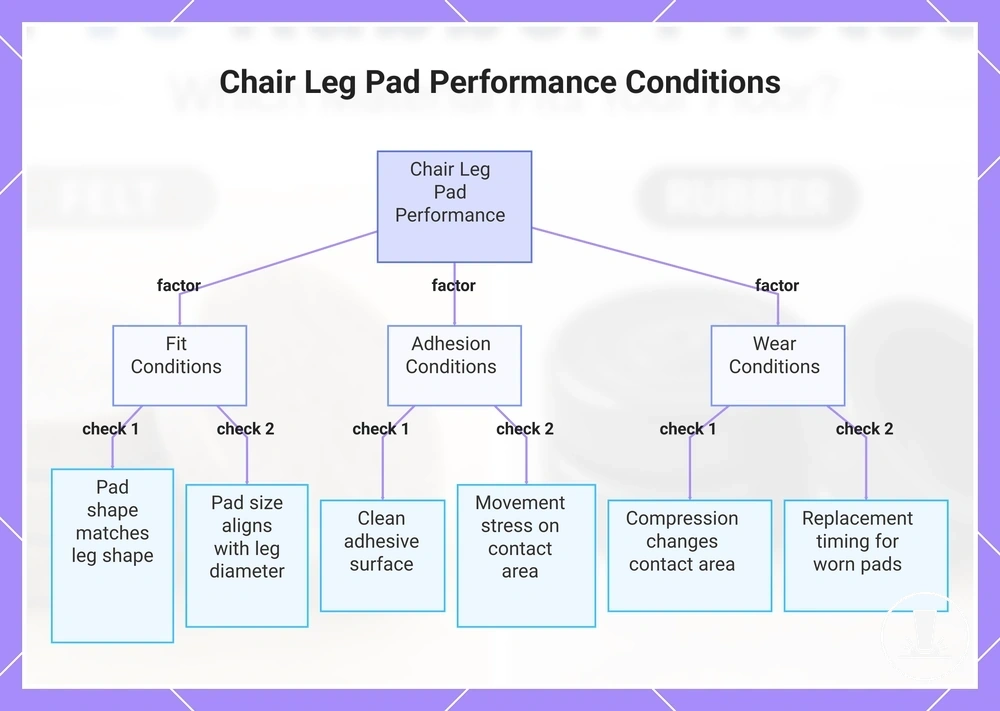
Chair leg fit depends on adhesion, pad shape, and wear because material choice alone is not enough when a protector does not stay centered, clean, and properly attached. Poor chair leg fit reduces performance for both felt pads and rubber pads because contact area and adhesive hold can change during use. Chair leg fit, adhesion, and wear should be evaluated together rather than as separate conditions.
Problem to solution: chair leg fit depends on leg shape, pad size, attachment surface, movement pattern, and replacement timing. The checklist below highlights the main conditions that influence whether adhesive pads continue working as intended after installation.
- Verify that pad shape matches the leg shape and contact area.
- Check that pad size aligns with the leg diameter and furniture leg fit.
- Confirm that the adhesive surface is clean and suitable for adhesion.
- Consider whether the movement pattern places repeated stress on the same contact area.
- Look for compression that changes pad shape or reduces contact quality.
- Review replacement timing when wear, peeling, or uneven contact becomes noticeable.
Scenario-first, angled legs, small contact areas, and frequent dragging can increase adhesive stress and raise failure risk. Adhesion may weaken when surface preparation is limited or when movement repeatedly pulls on one edge of the protector. Peeling is often influenced by movement, pressure, and contact conditions rather than by material choice alone.
Problem to solution: wear can reduce performance when compression changes contact area or when adhesive hold declines over time. Felt pads and rubber pads may both be affected by wear, especially when movement patterns create repeated stress on the same location. Replacement timing may become appropriate when worn pads, peeling, or reduced chair leg fit make consistent floor contact more difficult to maintain.
This chart shows the main conditions that influence chair leg pad performance, including fit, adhesion, and wear factors.
When Felt Pads Are the Better Choice
Felt furniture pads are usually the better choice when smooth movement and scratch reduction matter more than grip. The selection depends on floor sensitivity, furniture movement, pad cleanliness, and replacement frequency rather than on material alone. Felt pads for chair legs are often considered when chair legs move regularly across smooth hard floors and low-friction movement is preferred.
- Choose felt furniture pads when smooth hard floors require easier movement, but maintain debris control because trapped particles may reduce protection.
- Choose felt pads for chair legs when chairs move frequently, but check pad cleanliness because dirt can affect performance over time.
- Choose felt pads when light-to-medium furniture is repositioned often, but review adhesive quality because repeated movement can increase attachment stress.
- Choose felt pads when floor sensitivity is a concern, but inspect chair legs regularly because worn pads may provide less consistent contact.
- Choose felt pads when pad thickness supports smoother movement, but monitor compression because changing thickness can affect fit.
- Choose felt pads when regular replacement is acceptable, but replace worn pads when debris control or contact quality declines.
Scenario-first, frequently moved chairs and desks often suit felt furniture pads because smooth movement can make repositioning easier across hard floors. Furniture movement, adhesive quality, and contact conditions can influence how well felt pads continue performing. The selection depends on movement frequency and fit rather than on the material alone.
Problem to solution: scratch-sensitive floors often benefit from strong debris control and pad cleanliness. Felt furniture pads may support scratch reduction when the contact surface remains clean, but embedded debris can change how felt pads interact with the floor. Regular inspection can help maintain the intended contact condition.
Scenario-first, adhesive quality, pad thickness, and replacement timing become more important as furniture movement continues over time. Felt pads may compress, wear, or lose attachment quality depending on use conditions and fit. Felt furniture pads are usually the stronger choice when smooth movement, scratch reduction, floor sensitivity, and ongoing debris control matter more than grip, provided pad condition and replacement timing remain part of the decision.
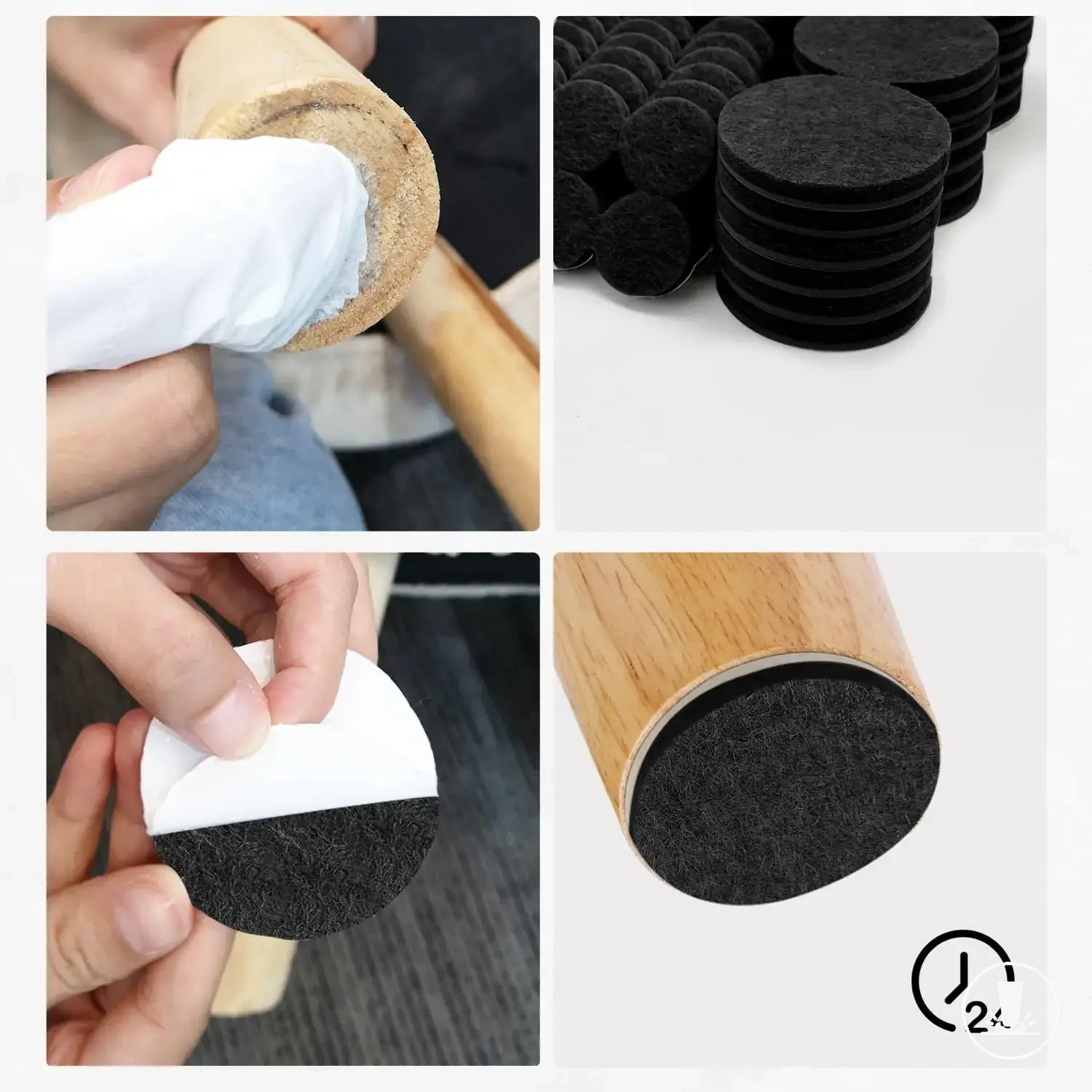
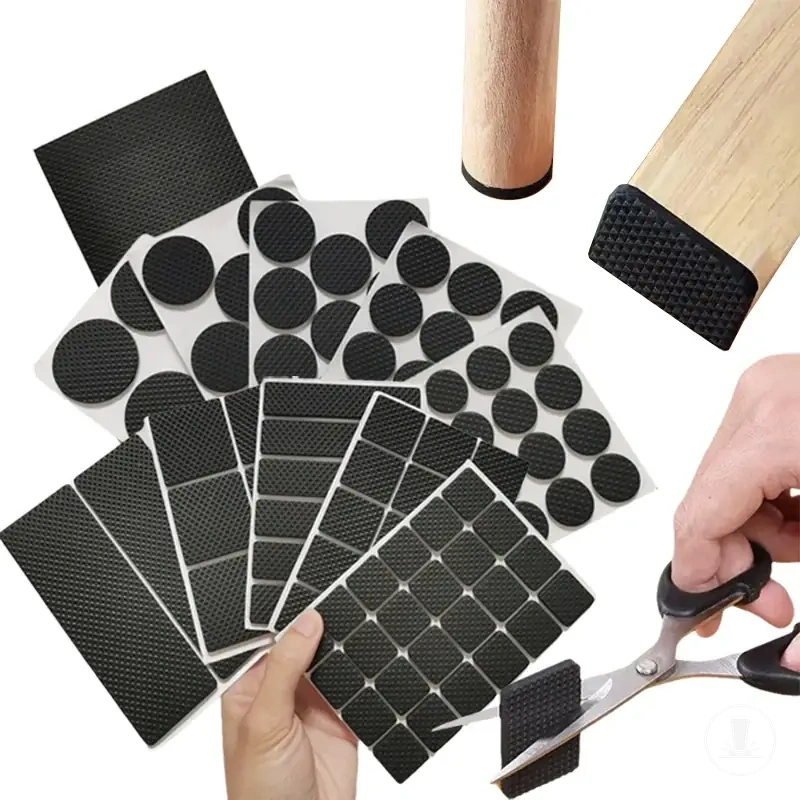
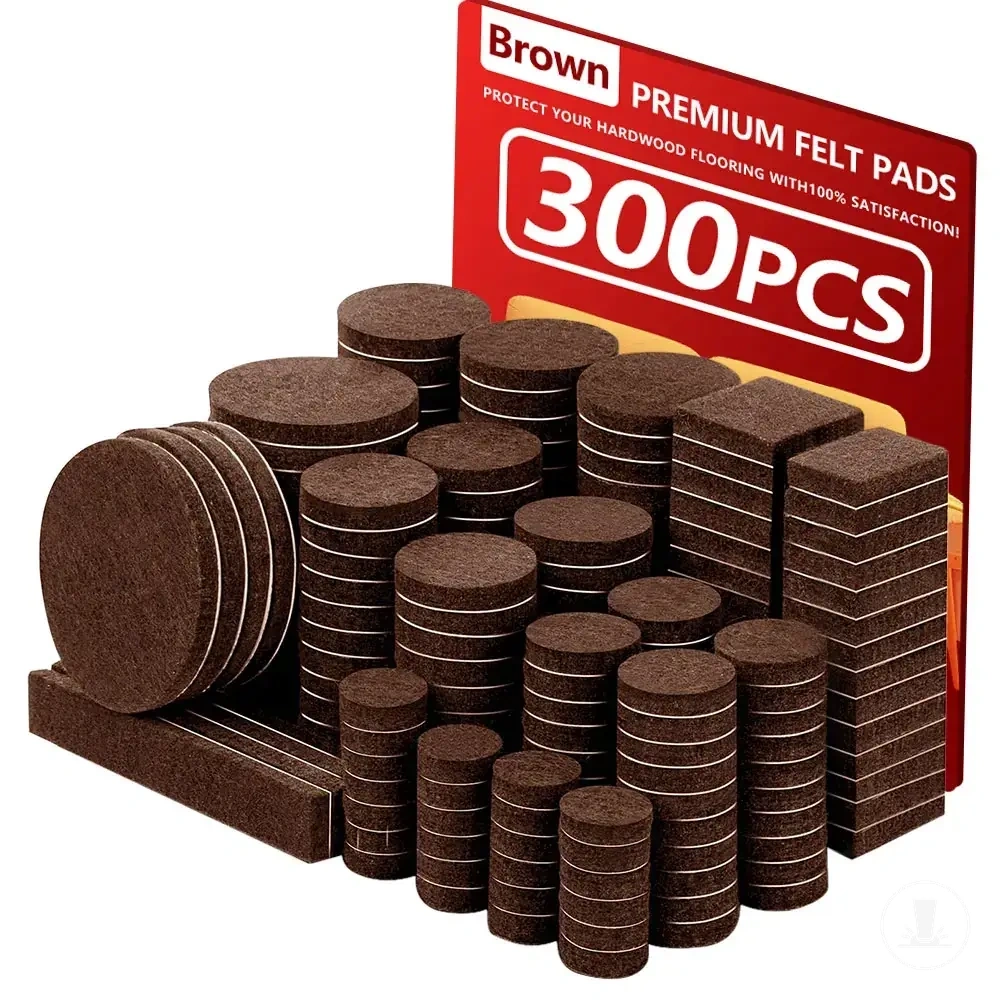
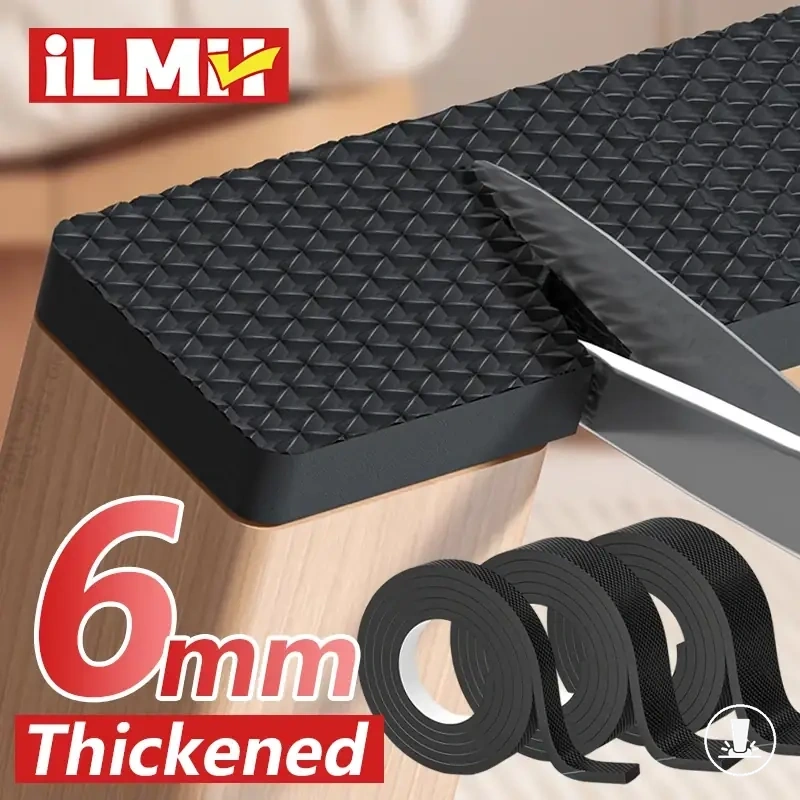
The products below are useful examples for comparing available options. Before buying, check that the compatibility criteria, key features, and product details match your needs.
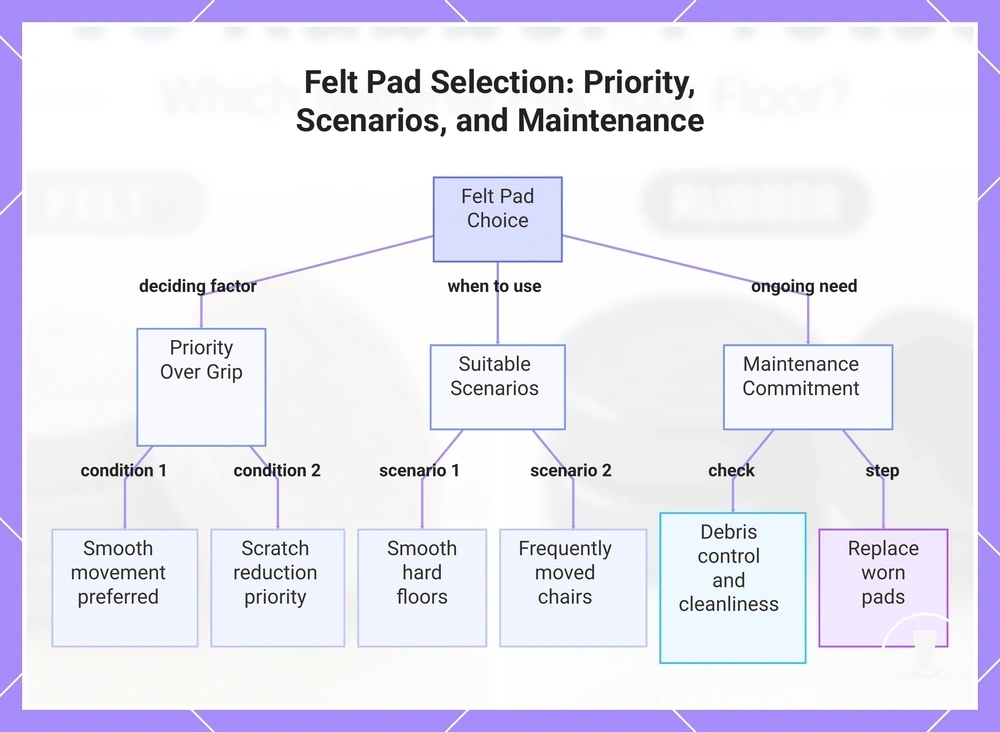
This chart outlines the three main factors that determine when felt pads are the better choice: priority over grip, suitable usage scenarios, and ongoing maintenance requirements.
When Rubber Pads Are the Better Choice
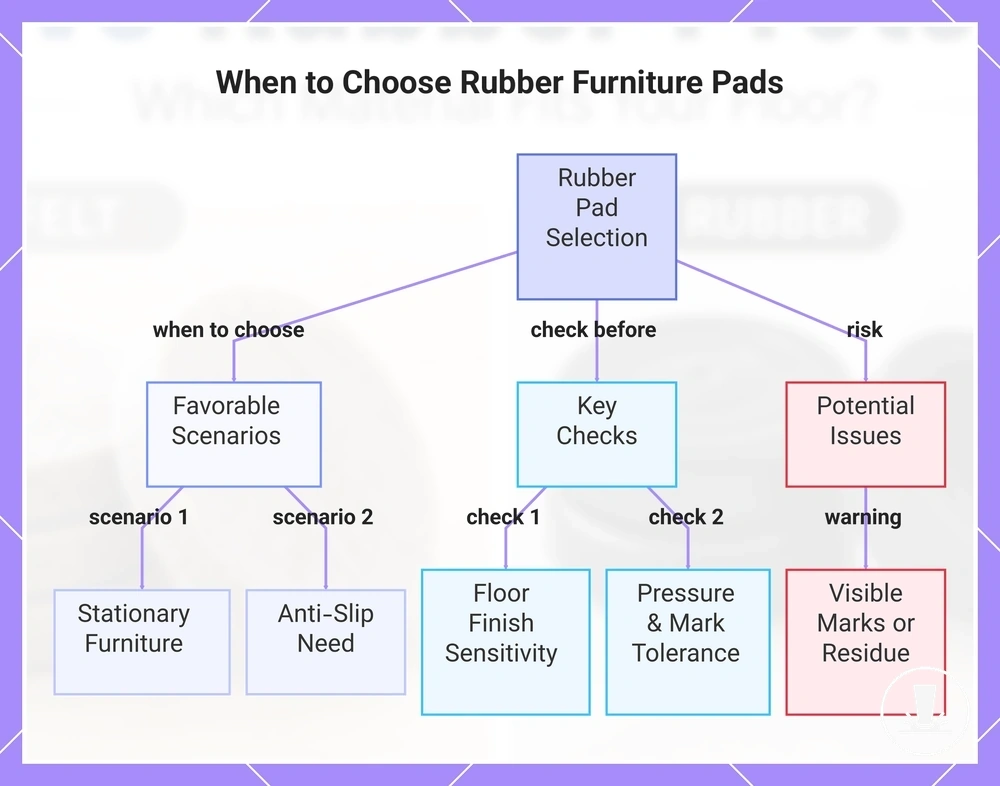
Rubber furniture pads are usually the better choice when grip, stability, and sliding resistance matter more than smooth movement. The selection depends on floor type, non-slip need, rubber quality, pressure, and mark tolerance rather than on material alone. Rubber pads for furniture legs are often considered when furniture stability is a higher priority than frequent repositioning.
- Choose rubber furniture pads for stationary furniture when added grip can help reduce unwanted movement, but check floor finish sensitivity before installation.
- Choose non slip rubber furniture pads on smooth tile when sliding resistance is the main goal, but consider mark tolerance because surface response can vary.
- Choose rubber pads for furniture legs when furniture stability matters more than movement ease, but review pressure at contact points.
- Choose rubber protectors when non-slip control is preferred, but inspect surfaces periodically for possible residue or visible marks.
- Choose rubber grippers when furniture remains in one position for long periods, but consider floor finish condition and contact pressure.
- Choose non-slip pads when grip is the primary requirement, but avoid assuming the same outcome across every floor type.
Scenario-first, stationary furniture and anti-slip needs often make rubber furniture pads a stronger material choice. Non slip rubber furniture pads may provide greater sliding resistance on smooth tile and similar hard surfaces when furniture movement is limited. Performance can still depend on rubber quality, pressure, and contact conditions.
Problem to solution: floor finish, pressure, and mark tolerance should be evaluated alongside grip requirements. Rubber pads for furniture legs may leave visible marks or residue under certain conditions, while other floor surfaces may show little visible change. The decision depends on balancing furniture stability against floor finish sensitivity rather than focusing on grip alone.
Direct answer first, rubber furniture pads are usually the stronger choice when grip, stability, sliding resistance, floor type, and mark tolerance align with the need for a more secure furniture position. For additional context about visible surface effects, see marks from furniture floor protectors. Rubber selection remains conditional because floor finish, pressure, residue potential, and contact conditions can influence the outcome.
The products below are useful examples for comparing available options. Before buying, check that the compatibility criteria, key features, and product details match your needs.
This chart shows the main scenarios, checks, and risks for selecting rubber furniture pads.