Furniture Floor Protectors FAQ for Common Fit, Floor, and Wear Questions
Furniture floor protectors are floor-contact barriers placed under furniture legs or bases to help manage wear between furniture and a floor surface. This FAQ focuses on common questions about furniture floor protectors, including how they relate to floor protection, fit, material choice, and everyday floor contact. The answers address fit, floor contact, marks, noise, grip, and wear as conditional questions that can vary by surface condition and protector type.
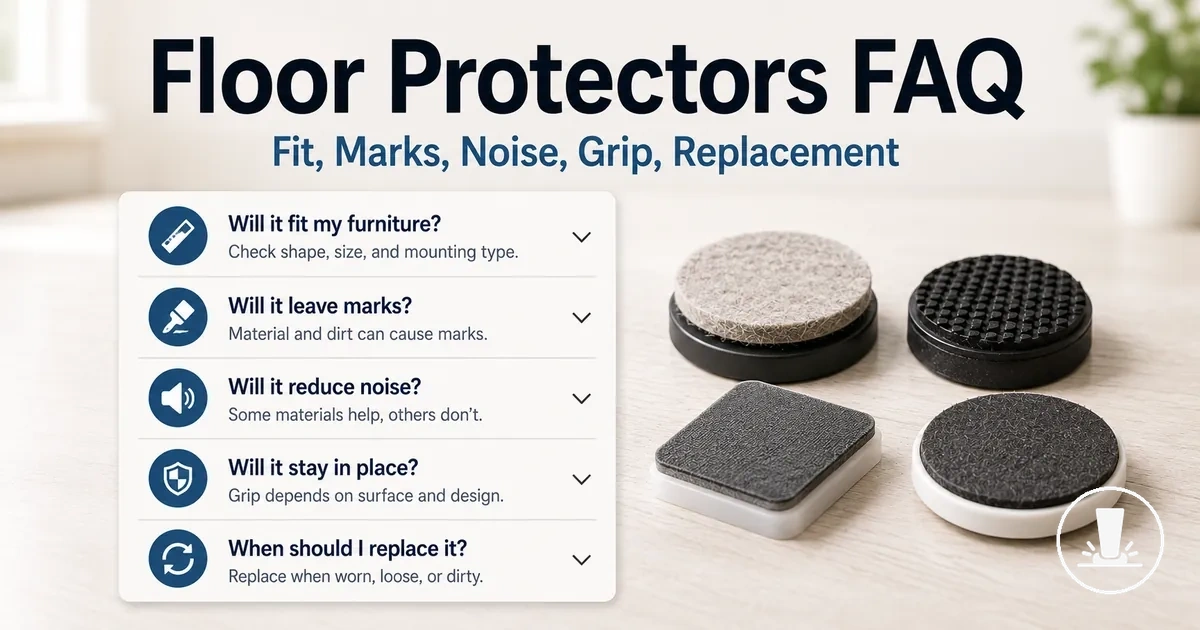
Furniture Floor Protectors FAQ for Common Fit, Floor, and Wear Questions shows the protector forms discussed throughout the page and the conditions that may influence their performance. The image below represents common pads, caps, glides, and other floor-contact barriers used under furniture legs and bases.
Most answers depend on material, size, attachment method, floor finish, furniture weight, cleanliness, and wear. Furniture pads, chair leg protectors, furniture glides, furniture caps, and grippers can behave differently when floor type, pressure, dirt buildup, adhesive condition, or movement changes. Furniture floor protectors can reduce common floor-contact risks, but outcomes depend on fit, surface condition, and wear, and they do not guarantee complete damage prevention.
What are furniture floor protectors used for?
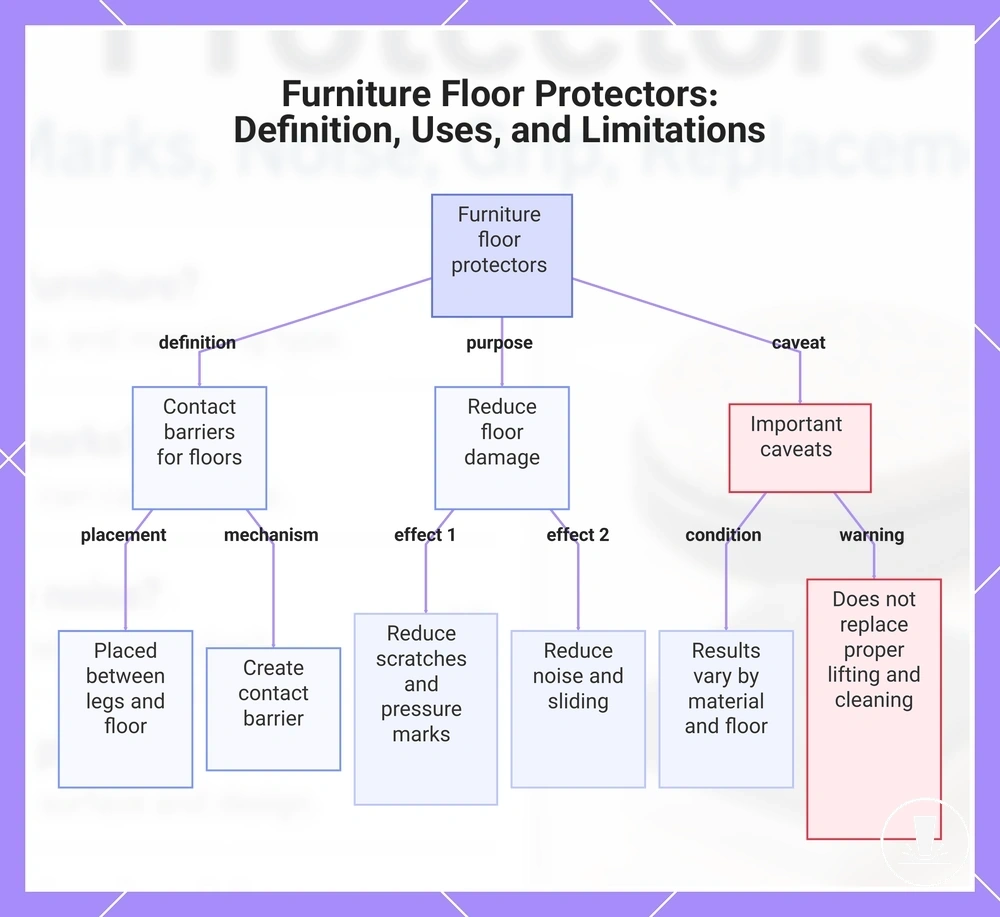
Furniture floor protectors are pads, caps, glides, cups, or similar contact barriers placed between furniture legs or bases and a floor surface. Furniture floor protectors create a contact barrier that helps separate furniture from direct floor contact during everyday use. Their main purpose is to reduce contact-related wear and lower the risk of marks caused by movement, pressure, or friction.
Furniture floor protectors are commonly used to help reduce scratches, noise, sliding, pressure marks, and wear, although results depend on protector material, attachment method, floor type, floor surface condition, and how furniture is moved. Pads may help limit scuffs when debris is removed from the contact area, while caps and furniture glides can influence grip, stability, and floor contact depending on fit and leg shape. Furniture floor protectors reduce contact risk, but they do not replace proper lifting practices, floor cleaning, or floor-safe material selection.
This chart explains what furniture floor protectors are, their main purposes, and key limitations to consider.
What can you put under furniture to protect floors?
What can you put under furniture to protect floors? Common options include furniture pads, chair leg caps, furniture cups, glides, sliders, and grippers placed between a furniture base and the floor-contact surface. Each option changes floor contact in a different way, so suitability depends on how the furniture is used and moved.
What can you put under furniture to protect floors is easier to understand when protector forms are grouped by contact behavior rather than by product type. The image below shows common protector categories and where they sit between furniture and the floor.
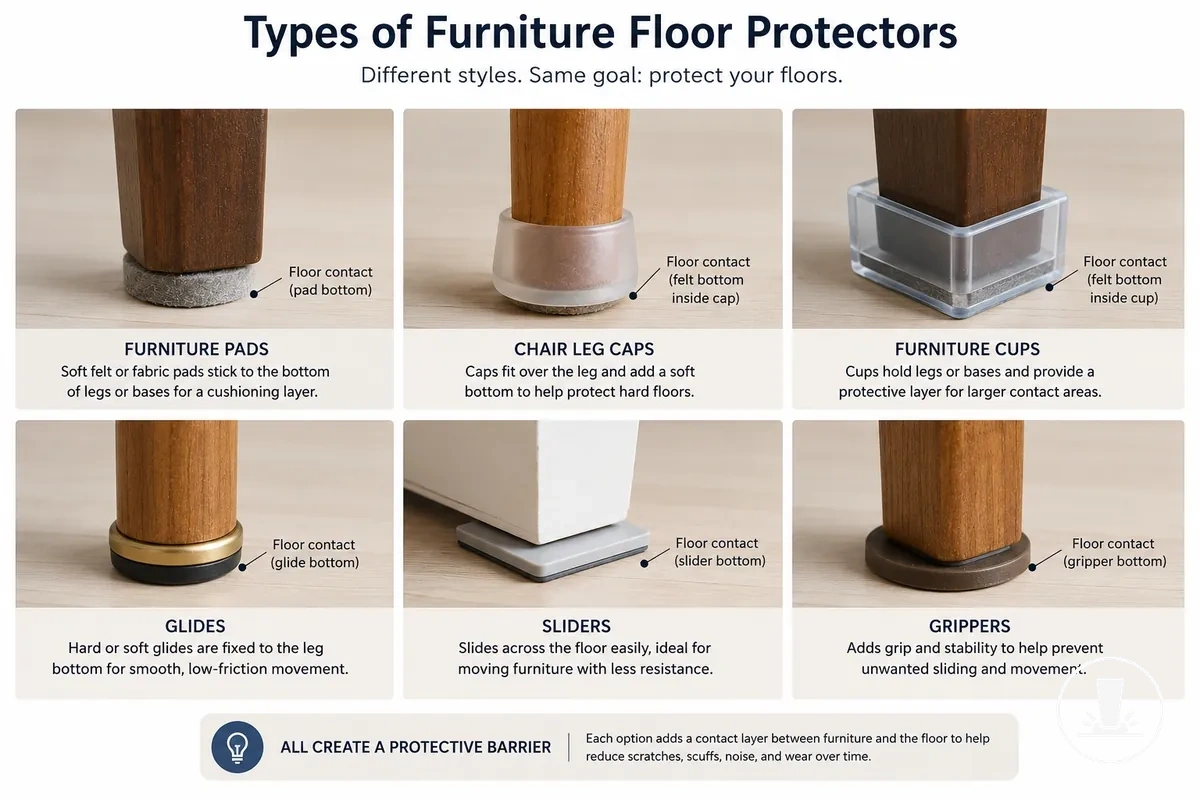
- Furniture pads sit under furniture legs and may help reduce floor contact friction and noise during regular movement.
- Chair leg caps fit over chair legs and can provide a controlled contact point when leg shape and fit are appropriate.
- Furniture cups sit under heavy furniture and may help distribute pressure while improving stability in stationary use.
- Glides sit under a furniture base or leg and can support smoother movement when furniture is moved across a floor surface.
- Sliders are often used under movable furniture when temporary or repeated gliding is needed across carpet or hard floors.
- Grippers or non-slip pads sit under furniture legs or bases and may increase grip when unwanted sliding is a concern.
Chair legs, heavy furniture, and movable furniture often benefit from different protector behavior. Furniture cups may suit stationary heavy furniture when pressure and stability are the main concerns, while sliders and glides may be more suitable when regular movement is expected. No single protector form fits every furniture base or floor protection need, so floor type, contact conditions, and movement patterns can influence the outcome.
How do you know furniture floor protectors are the right size?
The right size depends on matching the protector to the furniture leg or base dimensions and the attachment style. A protector size that matches the visible shape and measured contact area is more likely to remain positioned as intended during use. Measurement and attachment fit are the key checks.
How do you know furniture floor protectors are the right size? The image below highlights the fit points that affect sizing, including shape, diameter, width, depth, and contact area.
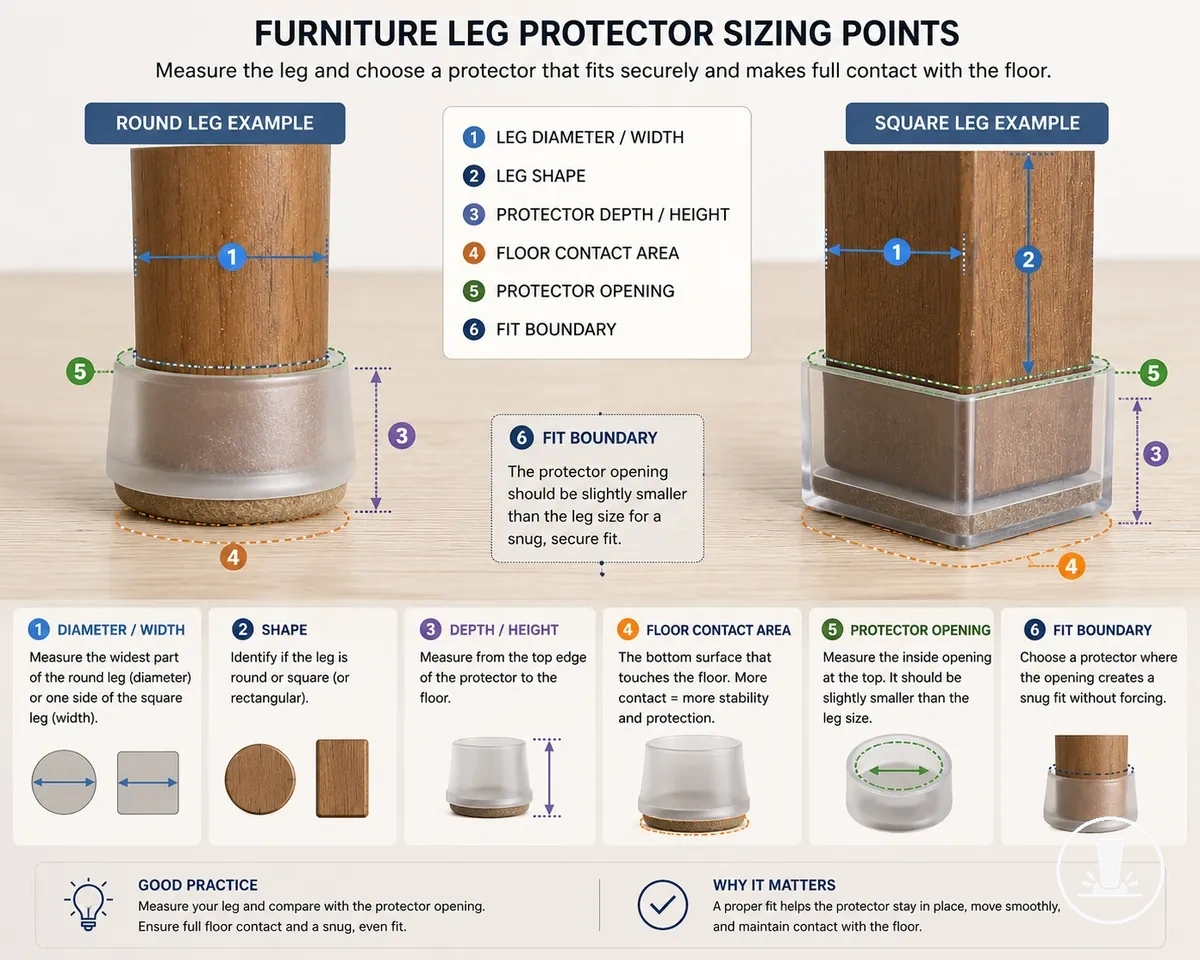
Use this checklist to organize fit by shape, width, depth, diameter, contact area, and attachment style:
- Match the furniture leg shape to the protector opening, such as round, square, angled, or irregular.
- Check the diameter for round legs and compare it with the intended protector size or fit range.
- Check width and depth for square or rectangular legs so the protector size aligns with the measured contact area.
- Verify that the contact area rests evenly against the floor surface without obvious gaps or uneven pressure.
- Confirm that the attachment style matches the furniture leg or base so grip and stability remain appropriate during movement.
- Consider leg angle and movement patterns, as unusual angles or frequent movement may increase fall-off risk when fit is not secure.
Round legs, square legs, angled legs, and irregular legs may require different fit conditions even when overall dimensions appear similar. A protector that is too loose may shift during use, while a protector that is too tight may not seat correctly on the furniture leg.
Direct answer: the right size comes from matching measured dimensions and shape attributes rather than assuming compatibility. For deeper measuring guidance, you can measure furniture legs using a dedicated resource without relying on universal size assumptions.
Do furniture pads prevent scratches, dents, and scuffs?
Furniture pads can help reduce scratches, dents, and scuffs when the material, size, cleanliness, and furniture weight match the floor finish and usage conditions. Floor risks differ based on pressure, movement frequency, debris, and material hardness. Furniture pads may reduce floor damage under suitable conditions, but they do not provide complete protection in every situation.
| Floor risk | Common cause | Pad factor | Safer interpretation |
|---|---|---|---|
| Scratches | Movement with debris or grit | Clean pad surface and suitable material | May reduce scratch marks when debris is removed regularly |
| Dents | Pressure from heavy furniture | Contact area and furniture weight | May reduce pressure dents when weight is distributed more evenly |
| Scuffs | Dragging and repeated floor contact | Pad condition and movement frequency | May reduce surface scuffs when pads remain in good condition |
Scratches, dents, and scuffs result from different causes and may require different expectations. Scratches are often associated with movement and debris across a floor finish, while dents are more closely related to pressure, furniture weight, and contact area. Scuffs are commonly linked to dragging, surface condition, and material hardness, so pad performance can vary by the type of floor risk.
When debris collects on the pad surface, furniture weight is high, floors are soft, or worn protectors remain in use, furniture pads may become less effective. Dirty floor pads can increase abrasion, and worn material may no longer support the same floor-contact conditions. Cleanliness, pad condition, floor finish, and movement frequency can all influence the level of risk reduction.
Do felt pads reduce furniture noise?
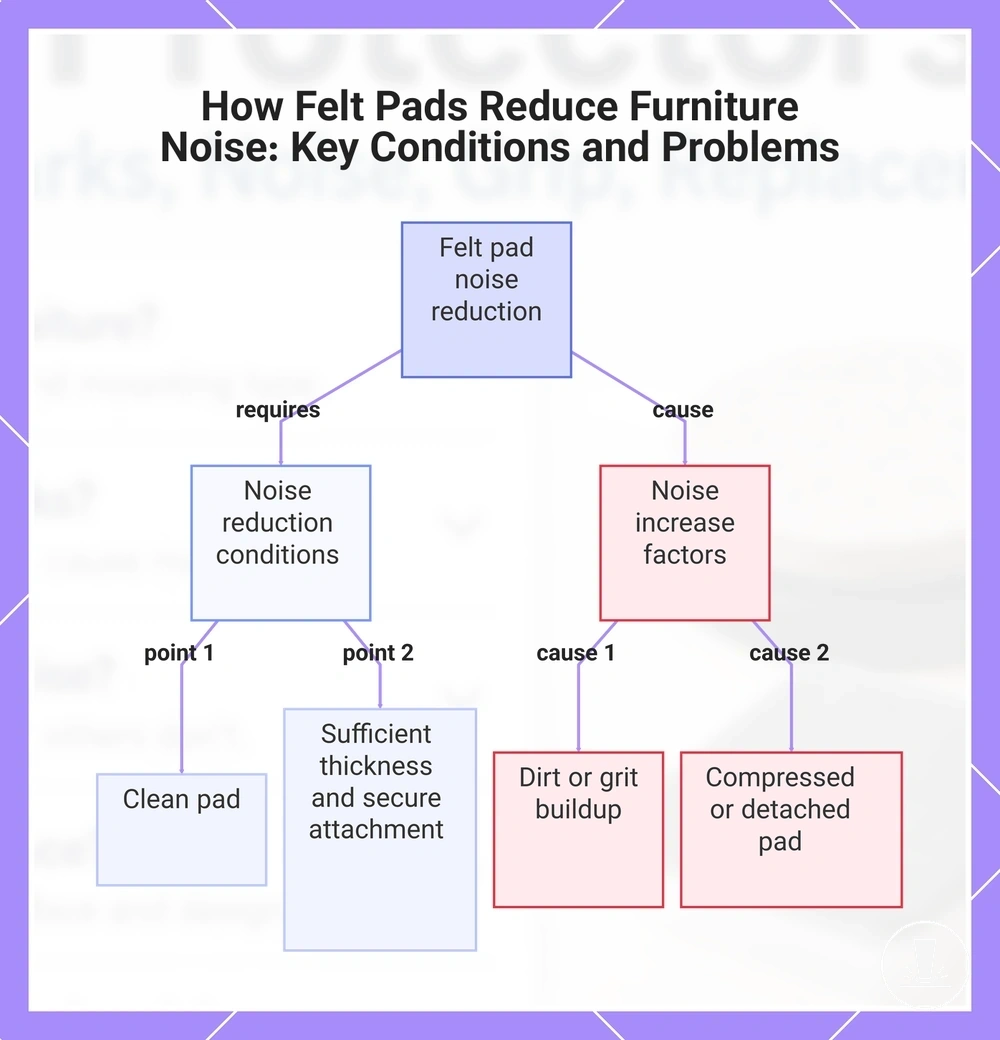
Felt pads can reduce noise from scraping and sliding when they stay clean, thick enough for the furniture load, and properly attached. Felt pads cushion contact between furniture and the floor, which may help reduce noise during movement. Noise reduction depends on felt condition, thickness, cleanliness, attachment condition, and furniture movement.
Scraping and sliding noise often occur when furniture moves across a hard floor surface, while vibration-related noise may be influenced by how securely the felt pad remains attached. Felt thickness and compression can affect how much cushioning remains during use, especially as wear increases over time. Dirt buildup, grit, or a loose pad may increase noise because the contact surface becomes less consistent and can create additional friction during dragging.
A clean felt pad may reduce scraping and sliding noise more effectively than a worn pad with dirt buildup or embedded debris. When felt becomes compressed, worn, or partially detached, noise may return because furniture movement creates less cushioned contact and more direct interaction with the floor surface.
This chart shows the main conditions for effective noise reduction with felt pads and the factors that cause noise to return.
Should you use felt or rubber furniture pads?
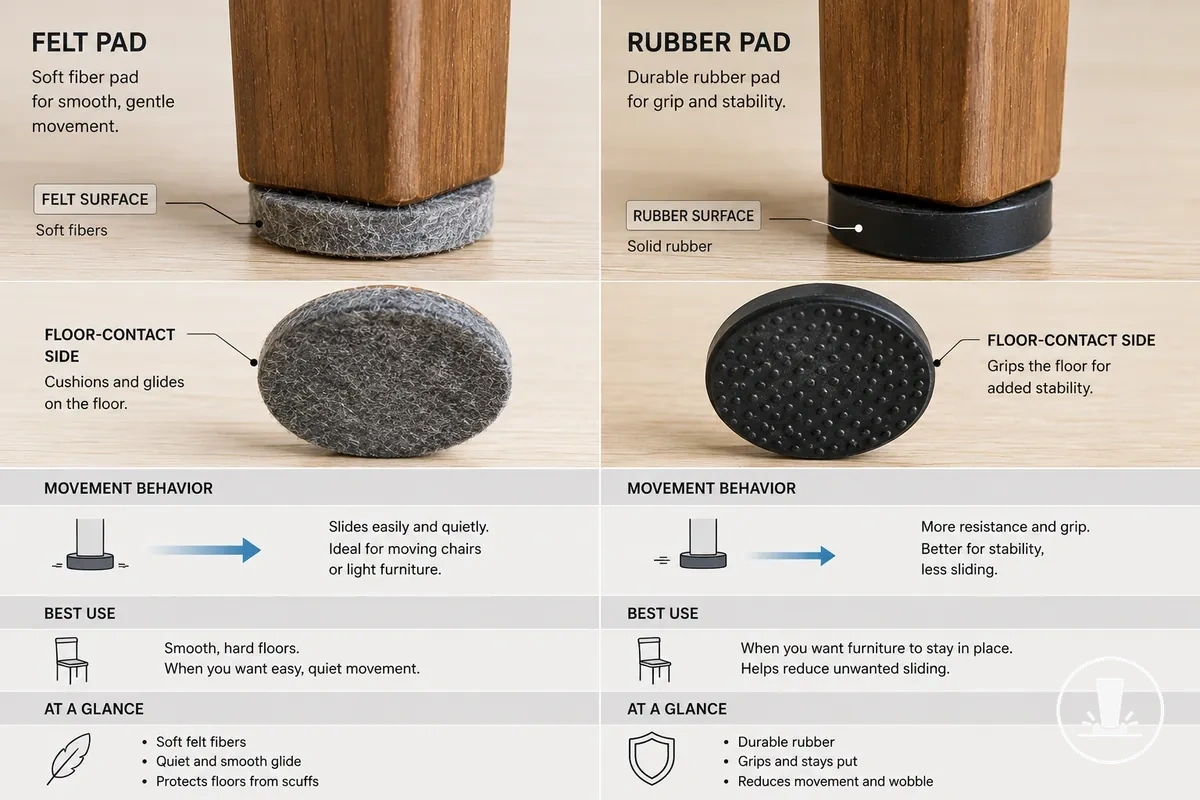
Felt pads usually suit smoother glide and noise reduction, while rubber pads often suit grip and stability. The better choice depends on floor finish, furniture weight, movement behavior, marking risk, and residue risk. Material choice should match the amount of movement and the level of grip needed for the furniture and floor.
Should you use felt or rubber furniture pads? The image below compares surface texture and floor-contact behavior to show how felt pads and rubber pads may perform differently under similar furniture conditions.
| Material | Main strength | Main limitation | Better when | Be careful when |
|---|---|---|---|---|
| Felt pads | Glide and noise reduction | Less grip during movement | Smooth floors and frequent movement | Extra stability is needed |
| Rubber pads | Grip and stability | May increase drag or marking risk | Sliding is a concern | Floor finish compatibility is uncertain |
Felt pads are not automatically the better choice for every floor, and rubber pads are not automatically the better choice for every stability issue. Floor compatibility can vary with floor finish, furniture weight, moisture, pressure, and surface condition. A material that improves glide and noise reduction may provide less grip, while a material that improves grip may create more resistance to movement or increase marking risk in certain conditions.
When furniture moves often and smoother movement is preferred, felt pads may be more suitable because they can support glide across the floor surface. When reducing sliding and increasing stability are the main goals, rubber pads may be more suitable, but residue risk, marking risk, and floor compatibility should still be considered.
Can rubber or felt furniture pads leave marks?
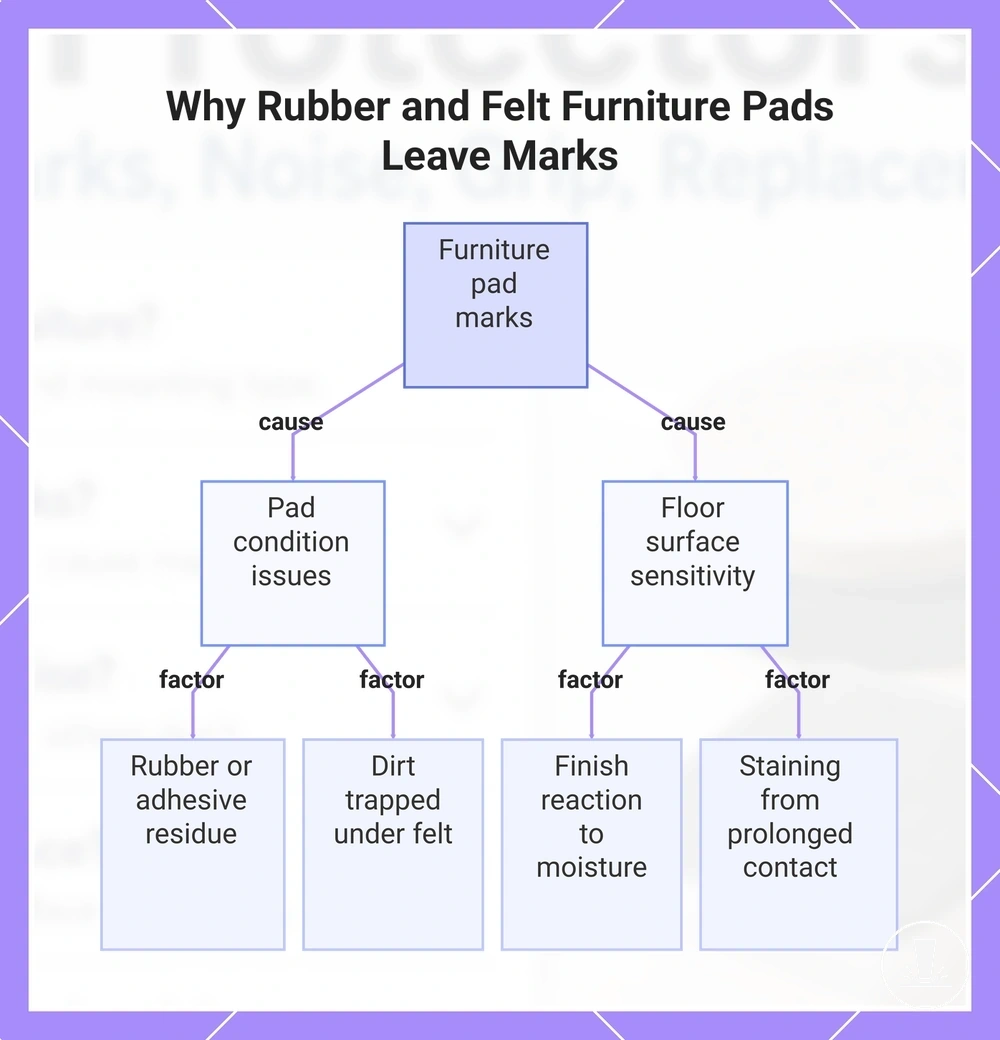
\nYes, rubber pads and felt pads can leave marks when material condition, dirt buildup, moisture, pressure, worn adhesive, or floor finish sensitivity creates residue, abrasion, staining, or discoloration. Marks depend on both pad condition and floor surface condition rather than the material alone. The most common contributing factors are residue, dirt transfer, moisture exposure, pressure, and adhesive deterioration.
\n- \n
- Residue marks: Often associated with material transfer, moisture, pressure, or aging pad surfaces. \n
- Scuff marks: May occur when dirt buildup or debris becomes trapped under felt pads and creates abrasion during movement. \n
- Staining or discoloration: Can develop when floor finish sensitivity interacts with residue, moisture, or prolonged contact. \n
- Adhesive-related marks: May appear when worn adhesive transfers material to the floor surface. \n
Residue, staining, scuffing, and dirt transfer are different symptoms and may require different troubleshooting approaches. Rubber pads may leave residue marks under certain moisture, pressure, or floor-finish conditions, while felt pads may contribute to abrasion when dirt buildup remains trapped beneath the contact surface. Cleaning, inspection, and replacement can help reduce recurring floor marks when pad condition has deteriorated.
\nWhen marks remain after cleaning or continue to return, deeper troubleshooting may be needed because the cause can involve both the furniture pad and the floor finish condition. For more detailed diagnosis of protectors leaving marks, use the dedicated troubleshooting resource.
"}This chart shows the two main cause categories behind floor marks from rubber and felt furniture pads, based on pad condition and floor surface factors.
Why do furniture pads fall off or stop gripping?
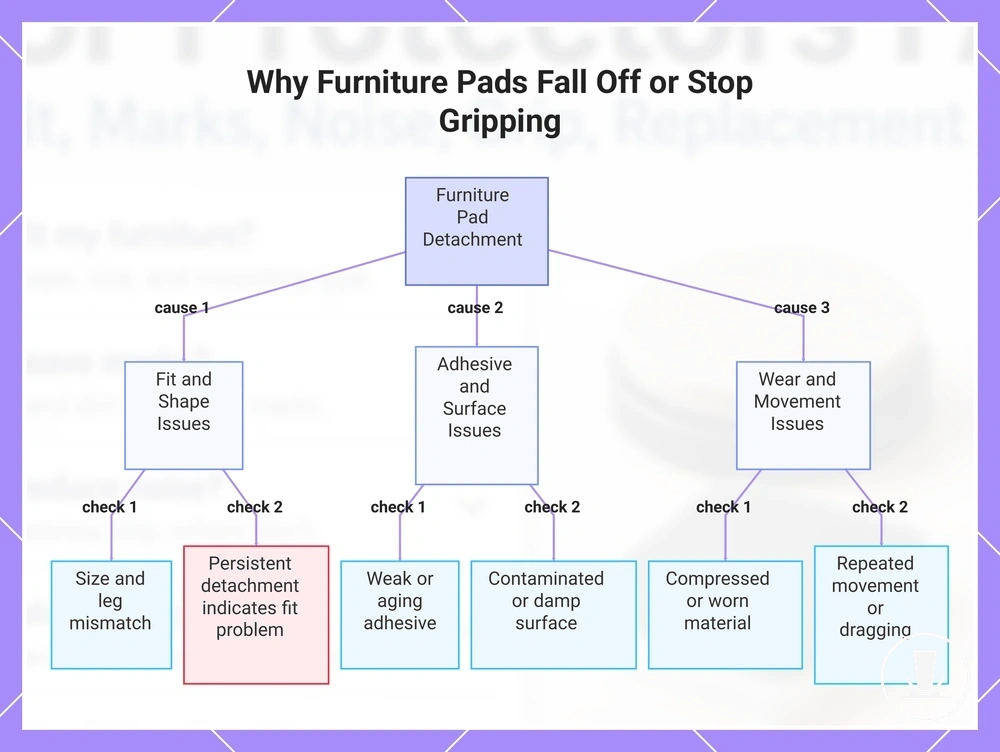
Furniture pads usually fall off or stop gripping because of poor fit, weak adhesive, a dirty surface, worn material, moisture, pressure, or repeated movement. Detachment can originate from the protector itself, the furniture leg, the floor-contact pressure, or the installation surface. The most common cause categories are fit problems, adhesive failure, surface contamination, material wear, and movement-related stress.
- Poor fit: Check whether the protector size and leg shape match; a mismatch may increase detachment risk.
- Weak adhesive: Check for aging or lifting adhesive; reduced adhesion may cause furniture pads to fall off.
- Dirty surface: Check for dust, residue, or oils on the furniture leg; contamination may reduce grip.
- Moisture exposure: Check for damp conditions or trapped moisture; moisture may weaken attachment.
- Worn material: Check for compression, wear, or damage; worn material may lose grip more easily.
- Repeated movement: Check how often furniture is dragged or repositioned; frequent movement can increase friction and loosen attachment.
Falling off and stop gripping are often linked to different causes even when they appear together. Poor fit and leg shape may prevent stable attachment, while weak adhesive, dirt, moisture, floor-contact pressure, and attachment method may gradually reduce holding strength. Worn material and repeated movement can further increase the chance that loose pads detach over time.
When furniture pads continue to detach after the same conditions return, the issue may involve the protector type or fit rather than reattachment alone. For deeper troubleshooting of protectors that fall off, use the dedicated diagnostic resource.
This chart shows the common causes of furniture pad detachment and the key checks to identify each cause.
When should furniture floor protectors be replaced?
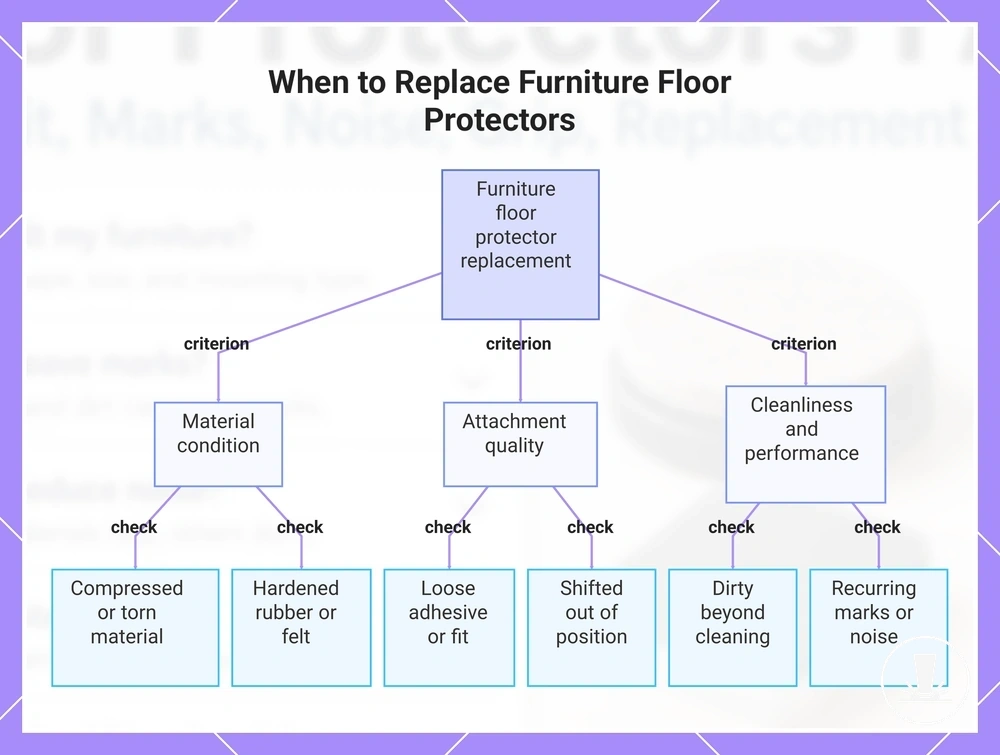
Furniture floor protectors should be replaced when they are compressed, torn, dirty beyond cleaning, loose, hardened, shifted, or no longer reducing floor contact risk. Replacement timing depends on visible wear signs rather than a fixed calendar date. Worn protectors are usually best evaluated by material condition, adhesive strength, thickness, cleanliness, and furniture movement.
Use this checklist to identify replacement signs by condition rather than by schedule:
- Compressed: Check whether the protector has flattened; reduced thickness may increase direct floor contact.
- Torn: Check for split or damaged material; wear may reduce consistent floor protection.
- Dirty beyond cleaning: Check for embedded grit or debris; trapped particles may contribute to marks, noise, or abrasion.
- Loose: Check adhesive strength or attachment fit; loose protectors may shift during movement.
- Hardened: Check whether rubber or similar material has stiffened; hardened protectors may provide less cushioning or grip.
- Shifted: Check whether the protector still covers the contact area; shifted placement may expose the floor surface.
- Recurring marks: Check whether marks return after cleaning; recurring problems may indicate worn protectors.
- Recurring noise: Check whether noise returns during movement; recurring noise may indicate flattened, loose, or worn furniture pads.
Felt flattening, rubber hardening, adhesive failure, and dirt beyond cleaning can signal different types of material wear. A flattened felt pad may lose thickness, while a hardened rubber pad may change how it contacts the floor. Adhesive failure and repeated movement can also cause protectors to become loose or shifted over time.
Direct answer: visible wear, loss of function, and recurring floor-contact problems are the main criteria to replace furniture floor protectors. Cleaning may help when dirt is superficial, but replacement may be needed when material condition, attachment quality, or floor-contact performance has deteriorated.
This chart shows the main replacement criteria based on material condition, attachment quality, and cleanliness or recurring performance issues.