Chair leg floor protectors for shape, size, and secure fit compatibility
Chair leg floor protectors depend on how well the protector matches the chair leg and how the bottom surface interacts with the floor. A suitable option is usually determined by the leg profile, measured dimensions, attachment behavior, and the way the chair moves during use. For clear decision-making, leg fit and floor-contact outcome should be evaluated separately because shape, size, protector format, and floor-contact behavior are the main controlling factors.
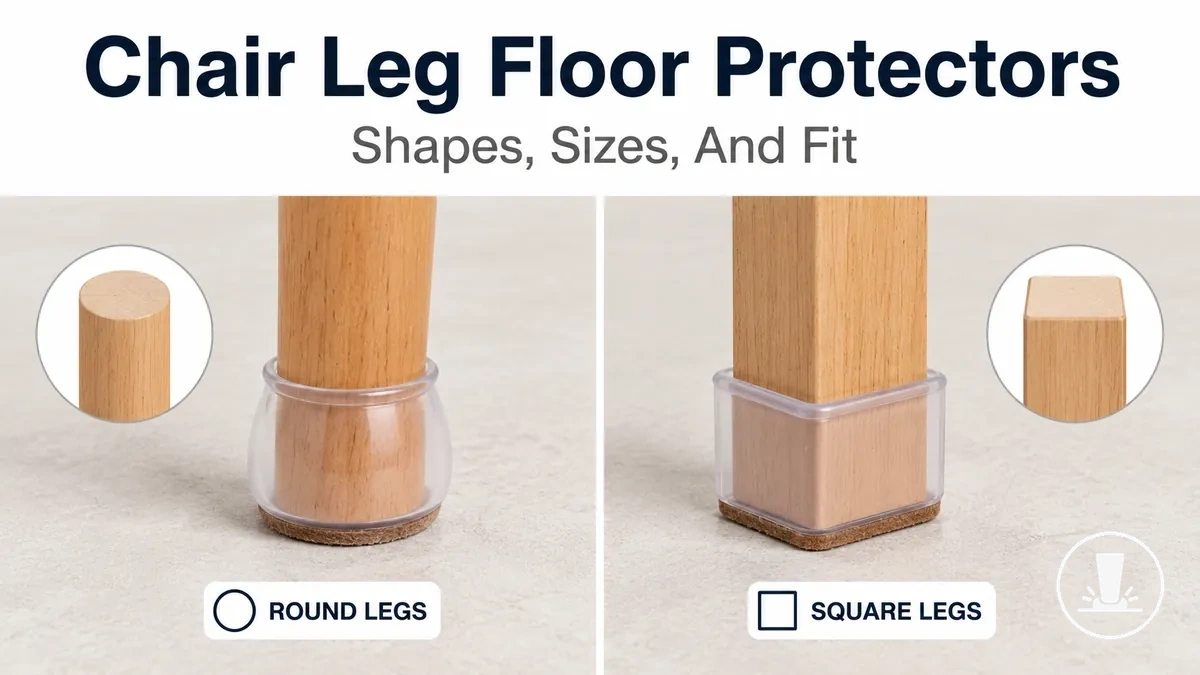
Chair leg floor protectors for shape, size, and secure fit compatibility are easier to understand when the chair leg and the protector can be viewed together. The image context for this page focuses on how protector fit changes across visible leg shapes and floor-contact surfaces, including common round and square chair legs.
Chair legs can have different shapes, contact points, and movement patterns. A round chair leg uses diameter as the primary size reference, while a square chair leg uses width. Some chairs move frequently across the floor, while others remain mostly stationary. These differences often shift the focus from visual fit to measured fit.
A one-size claim may not reflect how chair leg floor protectors behave in real-world conditions. A protector that fits one chair-leg shape may stretch, loosen, tilt, or attach differently on another shape with similar dimensions. Silicone chair leg caps, felt-bottom covers, and chair glides can respond differently to movement, floor surface, and attachment conditions. For that reason, secure fit is usually based on criteria rather than broad compatibility claims.
Chair leg floor protectors are available in multiple protector formats, including caps, covers, pads, tips, and glides. Each protector format uses a different attachment approach and floor-contact design, which can influence fit security, movement behavior, noise characteristics, and wear patterns. Understanding these formats as fit solutions rather than product categories creates a clear transition into more detailed compatibility decisions.
Chair leg floor protectors, caps, covers, and glides
Chair leg floor protectors are formats designed to sit around or under the contact point between a chair leg and the floor. Common formats include caps, covers, pads, tips, and glides. These formats protect the same chair-leg contact area through different attachment styles and contact materials.
Caps and chair leg covers usually attach around the outside of a chair leg, while pads are commonly applied to the bottom contact area. Tips typically fit onto the end of a chair leg, and glides create a defined floor-contact point that may influence movement behavior depending on the floor surface and use pattern. Within the broader category of furniture floor protectors, these formats are mainly distinguished by attachment style, contact material, and fit dependency.
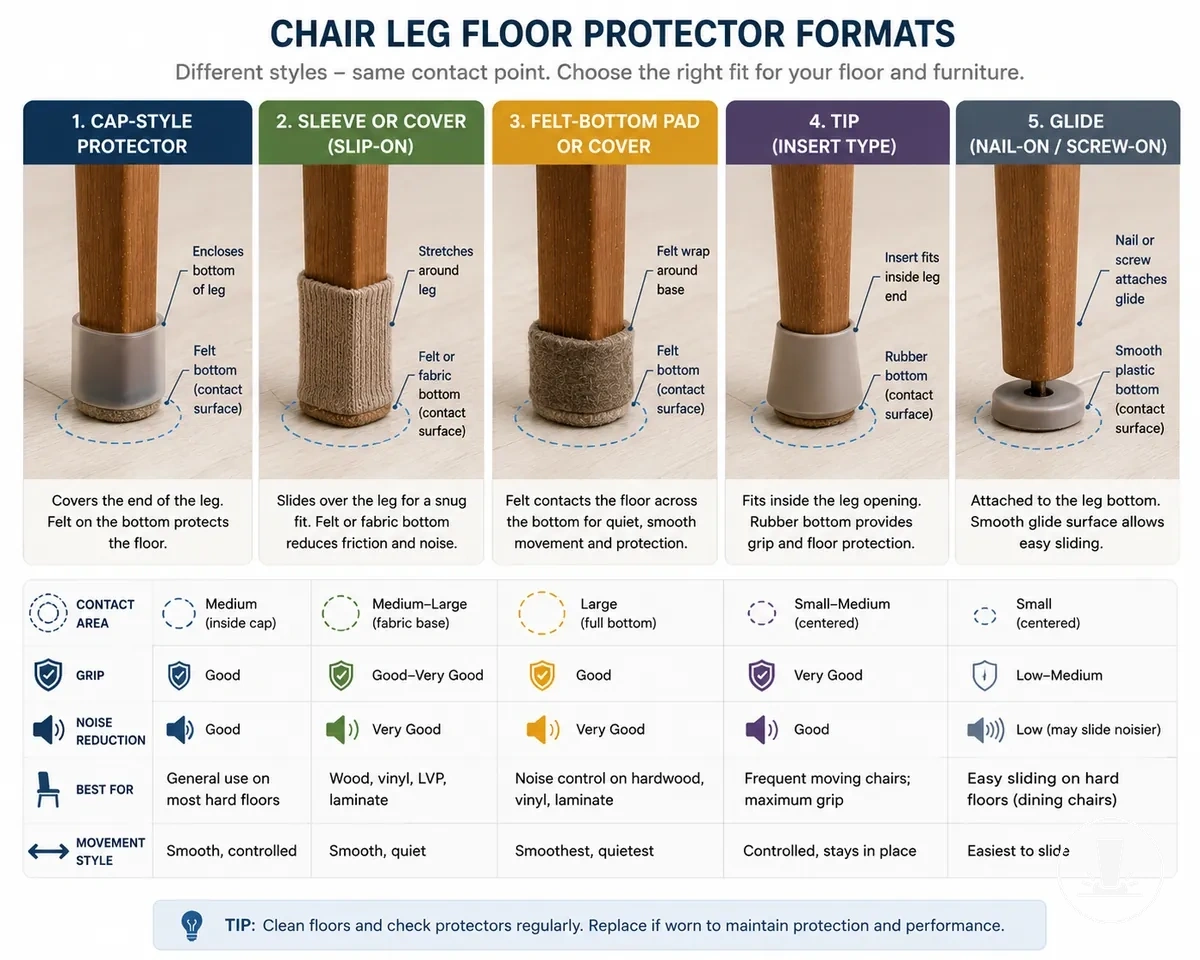
Chair leg floor protectors, caps, covers, and glides can appear similar at a glance, but they connect to chair legs in different ways. The comparison below organizes the formats by attachment behavior and fit dependency rather than ranking one format over another.
- Caps: Usually stretch, slide, or fit over a chair leg and depend on chair-leg shape and measured size for a secure fit.
- Covers: Enclose part of the chair leg and often depend on shape compatibility and attachment tolerance.
- Pads: Attach to the contact area beneath the chair leg and depend on available surface area and attachment condition.
- Tips: Fit onto the end of a chair leg and depend on matching the leg-end profile.
- Glides: Create a floor-contact point intended for movement and depend on floor-contact conditions and chair-leg compatibility.
This section treats these formats through chair-leg fit and compatibility rather than as a complete product-type reference. Detailed differences in sizing, materials, and performance are covered in later sections where those attributes directly affect fit decisions. For broader format coverage beyond this compatibility-focused overview, see floor protector types for chair legs.
Chair leg shapes that change protector fit
Chair leg shape affects how a protector grips, aligns, and contacts the floor. The contact profile and edge geometry influence how evenly a protector sits against the leg and contact surface. Because of these shape-related differences, size alone may not fully explain fit.
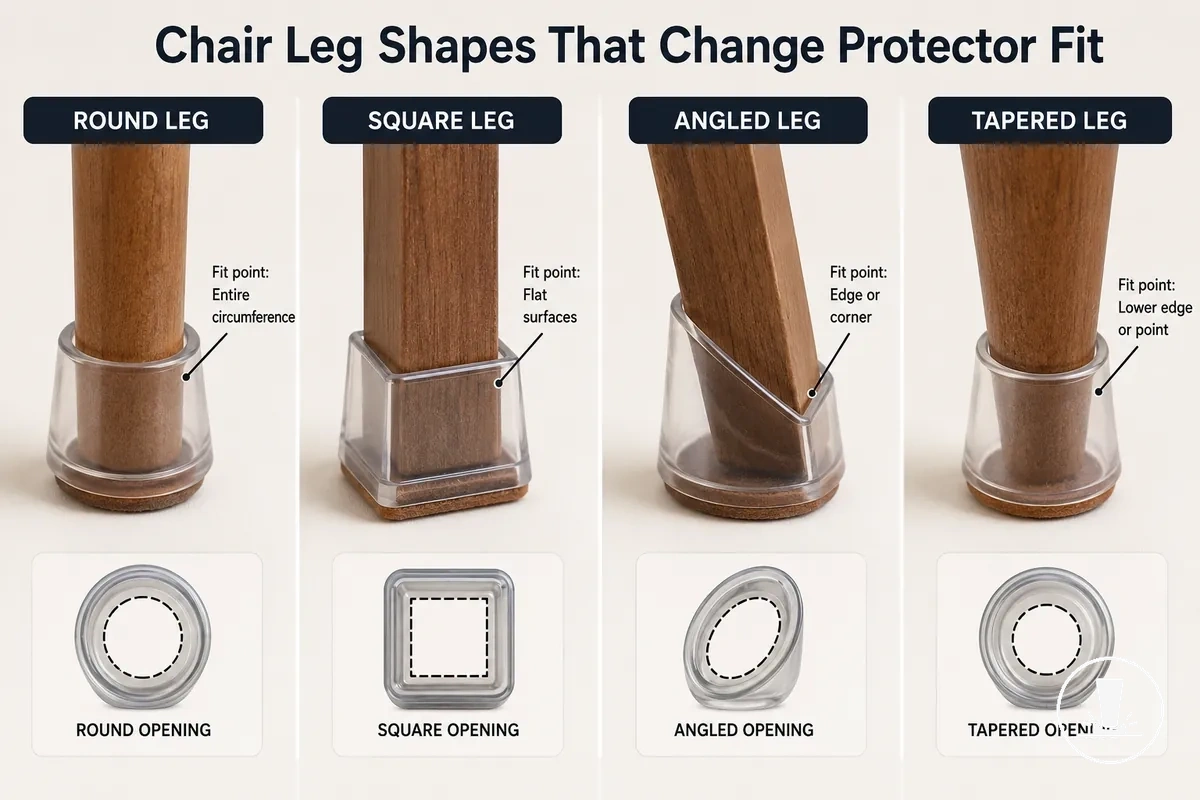
Chair leg shapes that change protector fit are easier to evaluate when visible geometry is considered before dimensions. Round chair legs, square chair legs, angled legs, tapered legs, and metal chair legs create different contact profiles and contact edges. A round leg with the same nominal measurement as a square leg may interact with a protector differently because the contact shape changes. The table below highlights how common shape groups influence fit conditions and secure alignment.
| Chair leg shape | Fit attribute | Common condition | Fit effect |
|---|---|---|---|
| Round chair legs | Diameter-based contact profile | Centered cap opening | May support more even alignment when dimensions match |
| Square chair legs | Edge geometry and corners | Protector corner contact | May affect seating around edges |
| Rectangular legs | Unequal side dimensions | Different width relationships | May require closer alignment across contact edges |
| Angled legs | Contact angle | Non-vertical leg position | May increase tilting risk when alignment changes |
| Tapered legs | Changing width | Reduced contact area | Can increase slippage potential |
| Sled-base legs | Extended contact profile | Continuous floor contact | May change pressure distribution at contact points |
| Metal chair legs | Hard surface profile | Lower grip surface interaction | Fit behavior may depend on attachment method |
A mismatch between chair leg shape and protector design can appear as slipping, stretching, tilting, or reduced secure alignment. For example, a tapered leg profile may create a different grip condition than a straight profile with a similar nominal size. The outcome can vary depending on protector design, leg surface characteristics, and floor-contact conditions.
Round and square chair legs
Round chair legs and square chair legs use different measurement references. Round chair legs are measured by diameter, while square chair legs are measured by width. This distinction affects how the protector opening relates to the leg profile and floor-contact alignment.
When a protector opening is shaped for a round chair leg, it may align differently on a square chair leg with a similar nominal measurement. Square chair legs depend more on corner alignment and edge contact, while round chair legs depend on the relationship between diameter and opening shape. As a result, fit security may vary when the leg profile and protector opening do not correspond closely.
| Round legs | Square legs |
|---|---|
| Measurement reference: diameter | Measurement reference: width |
| Fit risk: opening shape may affect grip consistency | Fit risk: corner alignment may affect seating |
Angled, tapered, sled-base, and metal chair legs
Compatibility with angled legs, tapered legs, sled-base legs, and metal chair legs depends on more than visible size because these leg forms can change the usable grip surface. Contact angle, changing leg geometry, and material hardness may influence how a protector attaches and remains positioned during use. Fit risk should therefore be assessed in relation to the leg form as well as the apparent size.
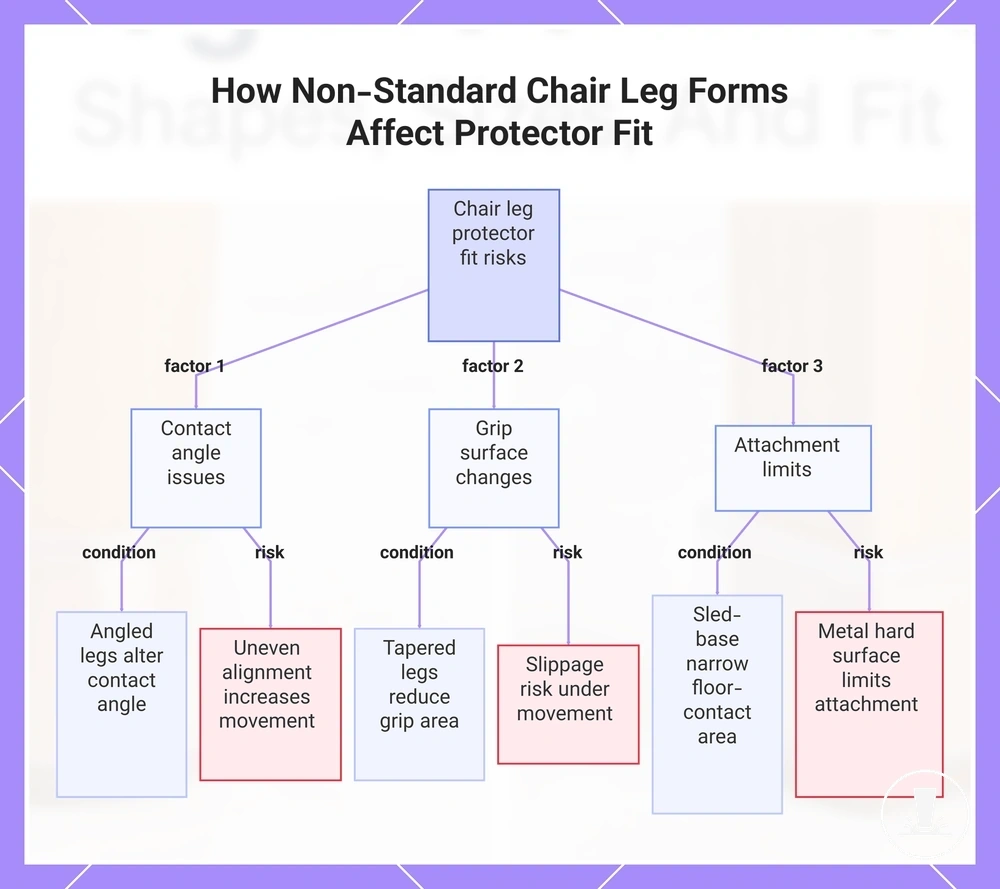
When non-standard chair legs are involved, the usable grip point may differ from the expected contact area. Angled legs alter the contact angle, tapered legs change the available grip surface, and sled-base legs or metal chair legs can introduce attachment limits. The following points highlight common local constraints and their potential fit risks.
- Angled legs can create a different contact angle, which may increase protector movement when alignment is uneven.
- Tapered legs have a changing width that can reduce grip surface area and may increase slippage risk under movement.
- Sled-base legs often use a narrow floor-contact area, which may affect floor-contact alignment and protector stability.
- Metal chair legs can present a hard grip surface that may limit attachment strength depending on available contact area.
- Non-standard chair legs may appear close in size to standard profiles, yet differences in leg form can still affect fit security.
This chart shows the main fit risks for leg protectors when used with angled, tapered, sled-base, and metal chair legs.
Chair leg protector sizes and measurement fit
Chair leg protector sizes and measurement fit should be interpreted from measured dimensions rather than visual estimation. Diameter, width, and contact-point measurements provide the reference needed to compare a chair leg with a protector size range. These measurements help identify a potential size match, but measurement and final fit are not always the same outcome.
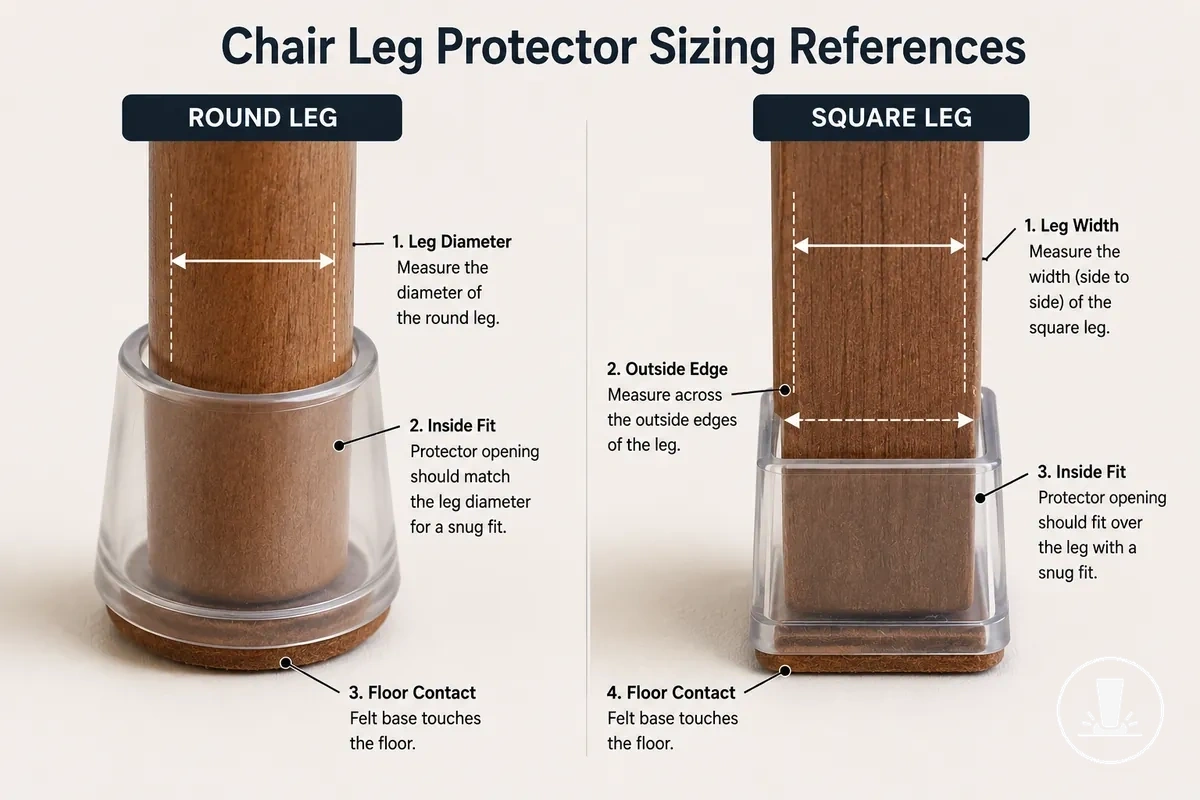
Diameter is the primary reference for a round chair leg, while width is the primary reference for a square or rectangular profile. The outside edge helps define the usable dimensions of the leg profile. The contact point identifies where the chair leg meets the floor and where alignment matters most. Together, these references help interpret size range and fit tolerance before evaluating fit results.
Chair leg protector sizes and measurement fit become easier to understand when the measurement references are viewed together. The diagram below labels the measurement points that help interpret size range and fit tolerance without replacing a dedicated measuring guide.
- Confirm whether the chair leg uses diameter or width as the primary size reference.
- Check the outside edge when the leg profile includes corners or flat sides.
- Identify the contact point where floor contact and alignment occur.
- Compare measured dimensions with the protector size range rather than visual appearance.
- Consider fit tolerance because different protector formats may allow different fit ranges.
- Treat looseness, slipping, or overstretched material as potential signs of a size mismatch.
A loose fit can occur when measured dimensions fall outside the practical fit tolerance of the protector opening. A snug fit may support more stable positioning when the protector size and chair leg dimensions correspond appropriately. An overstretched fit can increase stress on the protector and may affect retention, depending on the protector format and leg shape.
This section focuses on interpreting measured dimensions and fit outcomes rather than the detailed measuring process itself. For a dedicated measurement workflow, see measure furniture legs for protectors.
Measurement fit depends on how diameter, width, outside edge, and contact-point references relate to the protector size range and fit tolerance. Using measured dimensions as the primary reference can reduce uncertainty when evaluating loose, snug, or overstretched fit conditions.
Diameter, width, and outside-edge measurements
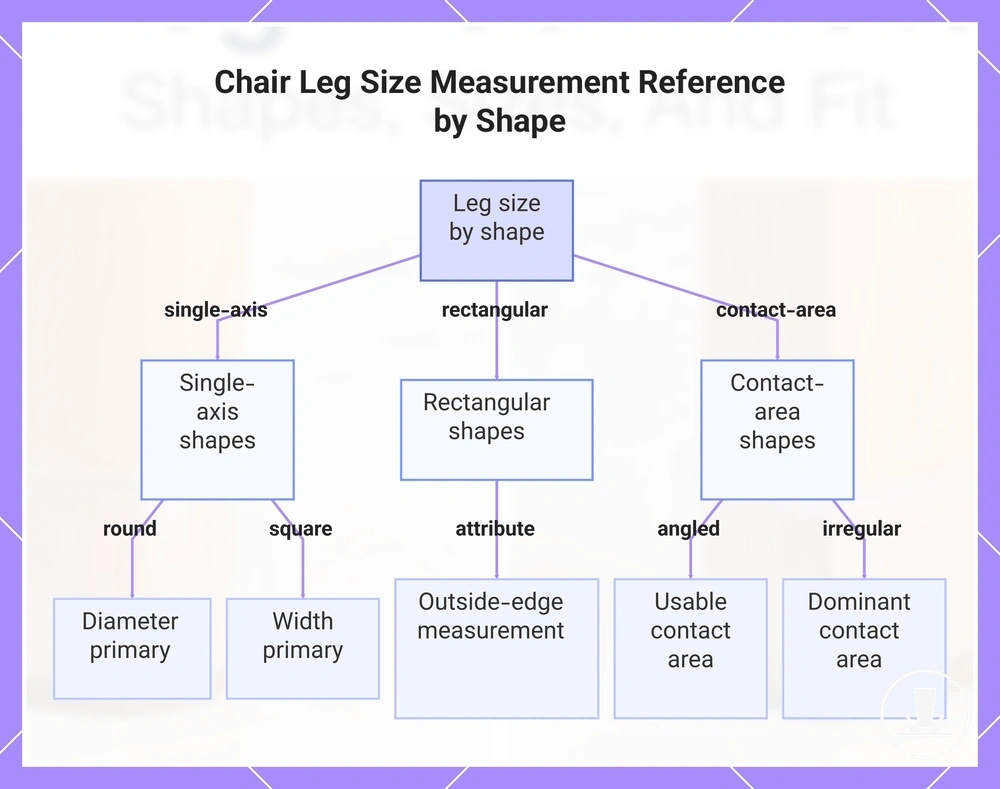
Diameter, width, and outside-edge measurements are the correct reference points for interpreting chair leg size by shape. Round legs use diameter, square legs use width, and rectangular legs use outside-edge measurements to reflect the leg profile. The appropriate measurement point depends on the chair leg shape rather than a nominal protector size.
When a leg profile includes corners, unequal sides, or an angle, the measurement reference can influence how installed fit is interpreted. Outside-edge measurements help define the usable dimensions of rectangular legs, while the usable contact area can be relevant for angled legs because designs vary. The following references clarify which measurement point applies to each leg profile.
- Round leg: Diameter is the primary measurement point used to compare the leg profile with a cap size and potential snug fit.
- Square leg: Width is the primary reference, with edge alignment affecting how the opening shape relates to the leg profile.
- Rectangular legs: Outside-edge measurements help define edge-to-edge width and support contact-point alignment.
- Angled legs: Usable contact area may be more relevant than a single width measurement because leg angles and contact surfaces can vary.
- Irregular leg profiles: The measurement point should match the dominant contact area rather than an assumed installed fit.
This chart shows which measurement point to use for each chair leg profile to determine correct protector size.
Stretch range, size tolerance, and snug fit limits
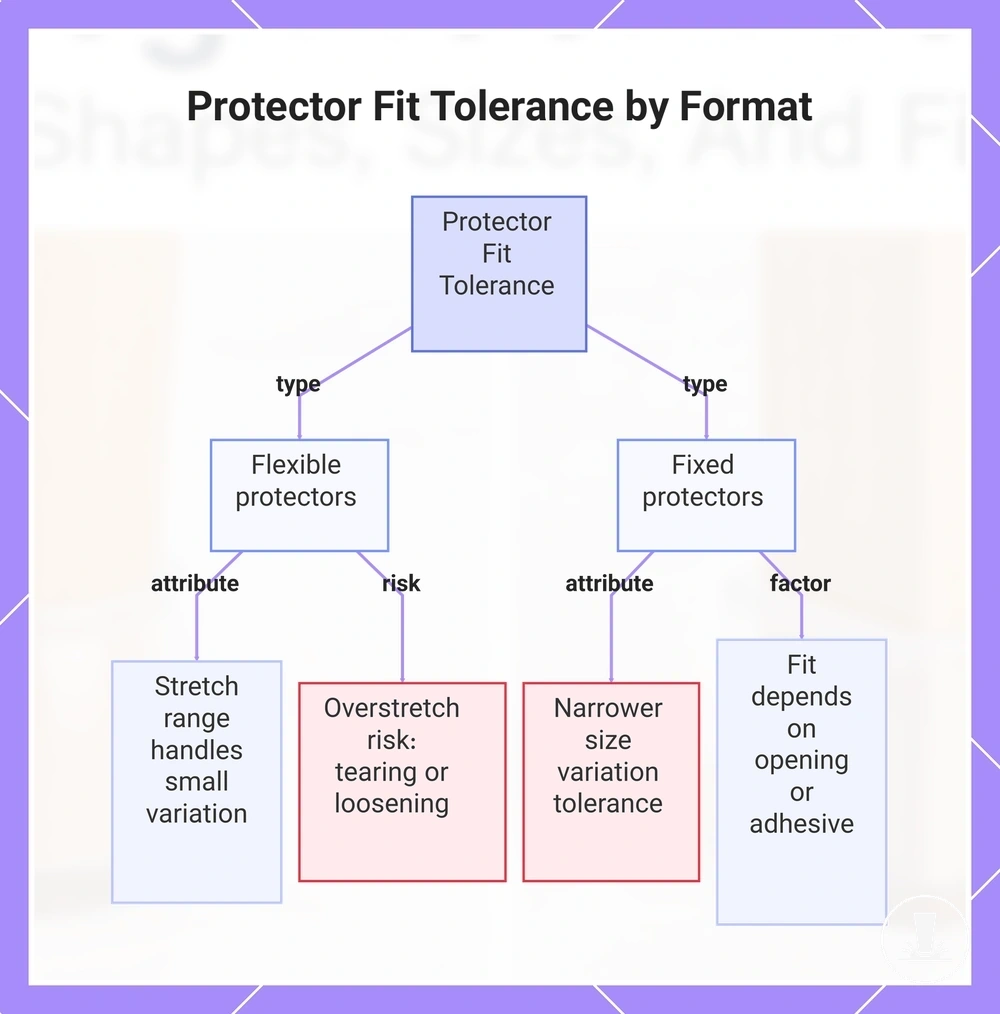
Stretch range, size tolerance, and snug fit limits depend on protector format. Flexible protectors may accommodate small size variation through stretch or compression, while fixed glides and formats with a rigid opening usually tolerate less mismatch. Flexibility can improve fit tolerance, but it is not the same as a guaranteed fit.
A loose fit can occur when the protector size exceeds the practical size tolerance of the chair leg. An overstretched fit can increase material stress and may raise the risk of tearing or loosening, while a tilted fit can result from a size mismatch or an opening that does not align with the leg profile. The checklist below highlights common tolerance signals.
- Snug fit: The protector remains stable without excessive stretching or visible looseness.
- Overstretched fit: Excessive tension can increase stress and may raise tearing risk in a flexible cap.
- Adhesive coverage: An adhesive pad depends on sufficient adhesive area and contact area to reduce edge lift.
- Tilt: A rigid glide with a rigid opening may tilt when the opening and leg profile do not align closely.
- Movement: Repeated movement can indicate a loose fit or a protector format operating outside its intended size tolerance.
Rigid glides and adhesive pads often rely more on opening dimensions or adhesive area than on stretch range. For that reason, acceptable size variation may be narrower than with flexible protectors, although fit outcomes still depend on leg shape, attachment conditions, and protector design.
This chart compares how flexible and fixed protector formats handle size variation, highlighting key attributes and risks.
Protector formats that fit chair legs differently
Protector formats that fit chair legs differently are mainly distinguished by attachment method, coverage, and floor contact. Format choice can influence fit behavior more than material name alone because protector formats attach to chair legs in different ways and interact with the floor differently. Attachment method, leg coverage, and floor contact are the primary comparison criteria.
When chair-leg compatibility is the focus, silicone caps, sleeve covers, felt-bottom covers, adhesive pads, tips, and glides can behave differently under similar conditions. A removable fit may depend on stretch or slip-on attachment, while other formats depend on adhesive area or a more rigid connection. Floor contact can also influence movement, sliding behavior, or alignment during use. The table below compares the main format differences.
| Protector format | How it fits the chair leg | Floor-contact behavior | Main tradeoff |
|---|---|---|---|
| Silicone caps | Slip-on fit using stretch around the leg profile | Bottom material varies by design | Fit may depend on leg shape and size variation |
| Clear sleeve covers | Sleeve-style coverage around part of the leg | Depends on bottom material and floor contact | Coverage may not suit every leg profile |
| Felt-bottom covers | Cover-style fit with felt at the contact area | Often supports smoother sliding contact | Behavior may vary with surface conditions and wear |
| Adhesive pads | Attach through adhesive contact area beneath the leg | Floor contact occurs through the pad material | Performance may depend on adhesive area and attachment condition |
| Tips | Fit onto the end of the chair leg | Floor contact occurs through the tip surface | Compatibility depends on the leg-end profile |
| Glides | Use a more rigid attachment or fixed connection | Designed around movement and floor contact | Size mismatch may affect alignment or movement behavior |
Each protector format balances attachment method, bottom material, and floor-contact behavior differently. Flexible formats may support a more removable fit, while fixed formats may depend more on attachment precision and contact conditions. For a focused comparison of slip-on and adhesive protectors, attachment differences can be evaluated separately from format-level compatibility. The tradeoff depends on chair-leg conditions rather than any overall format ranking.
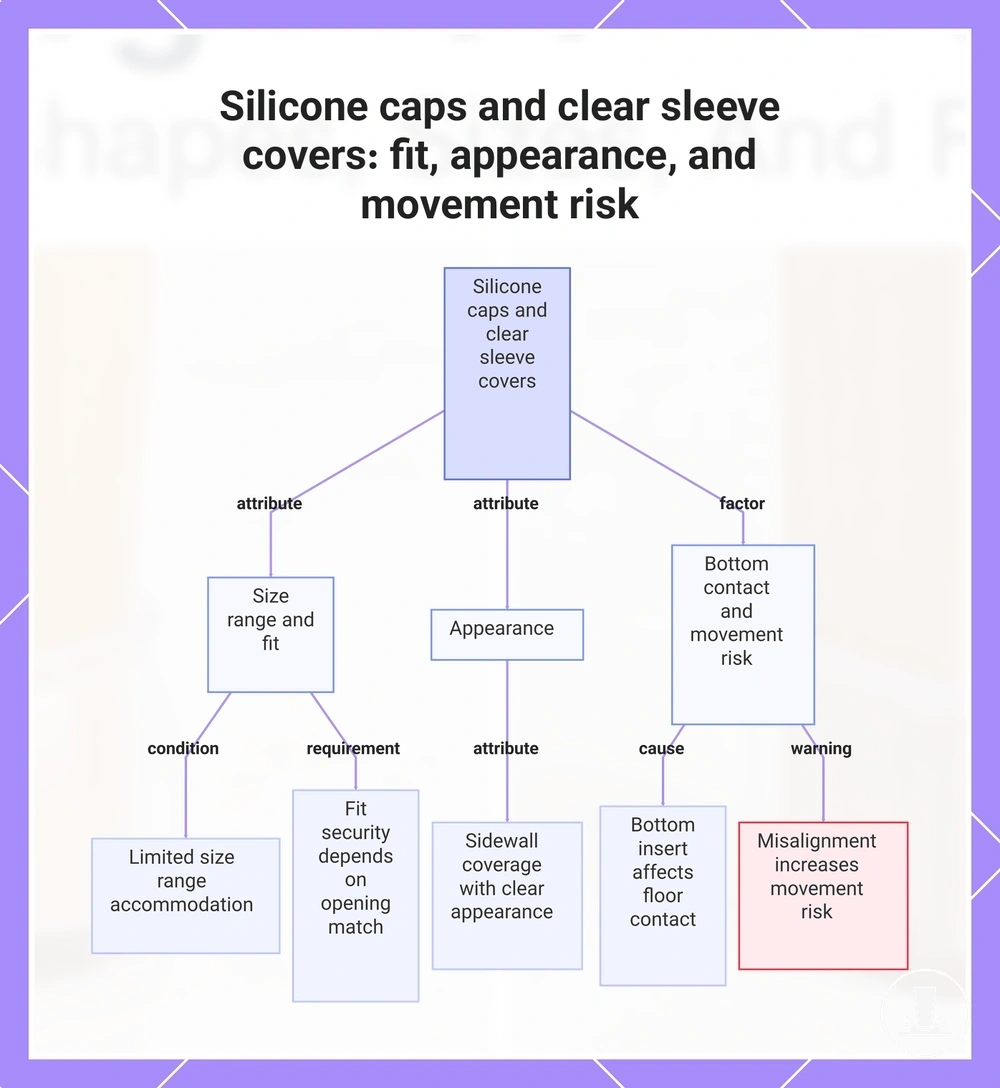
Silicone caps and clear sleeve covers
Silicone caps and clear sleeve covers use a flexible sleeve-style format that fits around the outside of a chair leg. A flexible grip may help these protectors adapt to a limited size range, while fit security still depends on the relationship between the chair leg and the protector opening. Stretch can accommodate small variation, but it does not remove size-range limits.
When chair legs remain visible as part of the furniture design, clear sleeve covers provide sidewall coverage while maintaining a clear appearance around the chair leg. Silicone caps and clear sleeve covers can also include a bottom insert that influences floor contact and movement behavior. If the size range, bottom insert, or chair movement pattern does not align well with the chair leg, movement risk may increase.
- Flexible grip: Silicone caps and flexible sleeve designs may adapt to limited size variation when the chair leg falls within the intended size range.
- Appearance: Clear sleeve covers provide sidewall coverage while allowing the chair leg to remain visible through the sleeve.
- Bottom contact: A bottom insert, including a felt bottom in some designs, can change floor-contact behavior and may influence movement risk depending on fit and use conditions.
This chart shows the key features and considerations of silicone caps and clear sleeve covers, including size fit, appearance, and bottom contact factors.
Felt-bottom covers, pads, tips, and chair glides
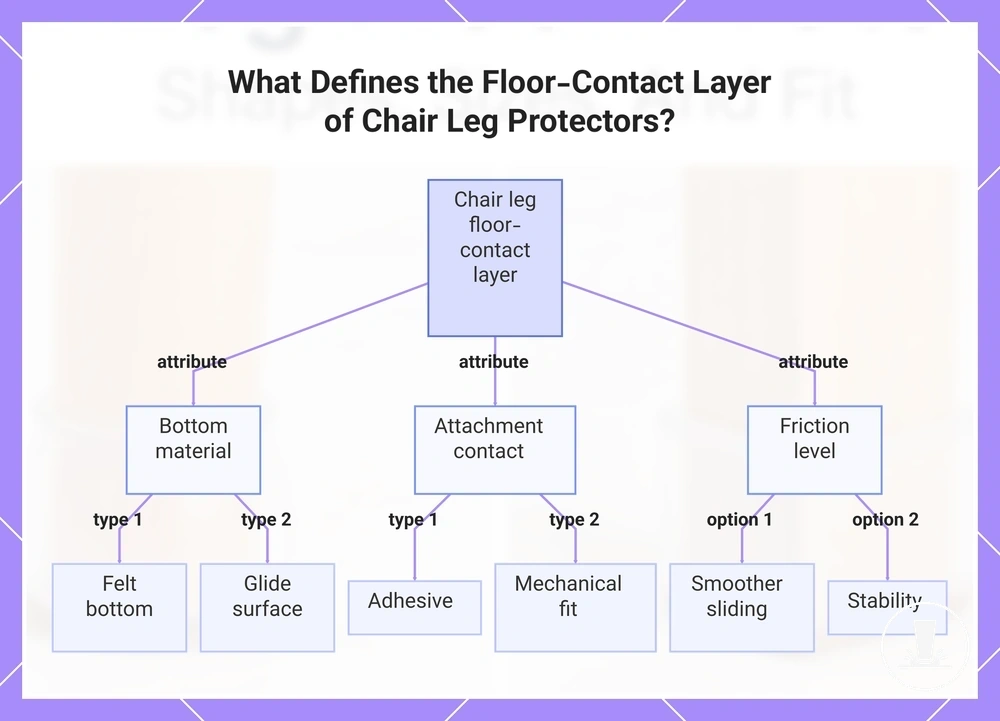
Felt-bottom covers, pads, tips, and chair glides differ mainly by the floor-contact layer they place beneath the chair leg. These options can serve a similar purpose while using different attachment contact methods and movement behavior. Their floor-contact layer is defined by bottom material, attachment contact, and friction level.
When smoother movement is preferred, felt-bottom covers or certain chair glides may support more sliding across the floor-contact layer. When stability is preferred, friction level and attachment contact can influence how the protector behaves during chair movement. Scratch, noise, sliding, and stability outcomes may vary with floor surface conditions, debris, wear, and movement patterns.
- Felt-bottom covers: Use a felt bottom as the floor-contact layer and may support smoother sliding with reduced noise, though debris can change contact behavior over time.
- Pads: Use adhesive attachment contact beneath the leg and create a low-profile contact layer, but edge lift or replacement needs may occur with use.
- Tips: Fit onto the leg end and create a defined floor-contact layer, with outcomes that depend on friction level and chair movement.
- Chair glides: Use a glide-style contact layer designed around movement, though hard contact surfaces may create limitations depending on floor conditions and wear.
This chart illustrates the three defining attributes of chair leg protector floor-contact layers: bottom material, attachment contact, and friction level, with examples and outcomes.
Floor-contact behavior under chair legs
Floor-contact behavior under chair legs depends on the protector’s bottom surface, the chair leg, and the floor surface beneath it. The bottom surface affects movement, sound, and how contact is distributed across the floor. Friction, glide, cushioning, and debris retention can influence outcomes, and those outcomes may vary with floor conditions and use patterns.
When a chair moves often, a bottom surface that supports glide may reduce movement resistance. When a chair should remain more stable, a higher friction level may provide more grip control. Cushioning and debris retention can also affect floor-contact behavior, as shown below.
| Contact behavior | Useful when | Watch for |
|---|---|---|
| Smooth sliding | Frequent chair movement | Sliding may increase on certain floor surfaces |
| Grip control | Greater stability is preferred | Higher friction can reduce glide |
| Cushioning | Noise reduction is desired | Movement behavior may vary with chair weight |
| Debris-sensitive contact | Cleaner contact layers are maintained | Debris retention may affect scratch risk and glide behavior |
The protector’s bottom surface creates tradeoffs between sliding, grip outcome, cushioning, and debris retention. A contact layer that supports noise reduction may behave differently from one focused on movement control. Floor-contact behavior can influence scratch risk, noise reduction, sliding, and stability, but it should not be treated as complete damage prevention because floor surface conditions, debris, wear, and chair use patterns can change results.
Scratch protection, noise reduction, and smooth sliding
Scratch protection, noise reduction, and smooth sliding may improve when chair-leg protectors use a bottom layer that suits the chair movement pattern. A softer bottom layer can help moderate contact between the chair leg and floor surface, while glide friction influences movement behavior and sound. These outcomes depend on contact cleanliness, floor finish, chair weight, and use conditions.
Trapped debris, worn felt, or repeated chair movement can reduce the intended effect of a protector. Debris pickup can introduce grit between the contact surface and floor finish, which may increase scratch risk even when a soft bottom layer is present. The checklist below highlights conditions that can influence the outcome.
- Verify contact cleanliness so debris pickup and trapped grit are less likely to affect the contact surface.
- Check that the bottom layer remains intact and has not become excessively worn.
- Match glide friction to the chair movement pattern rather than assuming smooth sliding in every situation.
- Consider chair weight because movement, sound, and glide behavior may vary under different loads.
- Account for floor finish sensitivity because scratch protection, noise reduction, and smooth sliding outcomes can differ by floor surface.
Grip control for chairs that should not slide
Grip control for chairs that should not slide depends on floor surface, chair use, bottom friction, and contact area. When movement control matters more than smooth sliding, a protector with a higher grip level may help limit unintended chair movement. The preferred balance between stable grip and controlled slide varies by use-case.
For chairs that remain mostly stationary, stable grip may be a higher priority than glide behavior. For chairs that move often, a controlled slide may reduce resistance while still supporting movement control. The conditions below help clarify when grip control may be the better compatibility choice.
- If a chair is used in a mostly fixed position, greater bottom friction may support more stable grip on the floor surface.
- If a dining chair moves frequently, a controlled slide may provide a better balance between movement and comfort than a higher grip level.
- If the floor surface already creates high friction, additional contact area and bottom friction may increase dragging risk during movement.
- If bottom friction is too high for the chair use pattern, dragging risk, protector wear, or movement limitations may become more noticeable.
Choosing chair leg protectors by fit priority
Choosing chair leg protectors by fit priority starts with identifying the strongest fit constraint rather than focusing on appearance alone. A chair leg may be limited by shape match, size tolerance, attachment security, floor-contact behavior, or replacement ease. Selection is usually clearer when shape, size, attachment, floor contact, and replacement needs are prioritized in that order of importance.
If a chair leg has an unusual profile, shape match may influence the decision more than other features. If dimensions are close to a fit boundary, size tolerance may become the limiting factor. Different chair-leg constraints can lead to different protector-format choices, as shown in the decision table below.
| Fit priority | Look for | Tradeoff to check |
|---|---|---|
| Shape match | Compatible protector format for a round leg or square leg | Other features may matter less if shape alignment is weak |
| Size tolerance | Support for a snug fit without excessive overstretch or loose fit | More flexibility may change fit consistency |
| Attachment security | Reliable leg contact for the intended chair use | Greater attachment focus may affect replacement ease |
| Floor-contact behavior | Felt bottom, glide, or grip characteristics that match movement needs | Movement control and glide can involve different tradeoffs |
| Replacement ease | Formats that can be changed with less effort when worn | Convenience may not address the primary fit constraint |
Tradeoffs often influence the decision outcome more than appearance. A round leg or square leg may require a stronger shape match, while size tolerance becomes more relevant when fit variation is expected. If attachment security is the limiting factor, prioritize formats with better leg contact before appearance. Floor-contact behavior may become the deciding factor when glide, felt-bottom movement, or grip needs are the primary concern.
Product examples should be interpreted as illustrative decision aids rather than rankings. Flexible caps may be considered when size tolerance is the main fit priority, while felt-bottom formats may be relevant when floor-contact behavior influences movement preferences. Glide-oriented and grip-focused formats should be evaluated through the fit constraint they address rather than as universal recommendations.
Fit priority, compatible protector format, and tradeoff should be evaluated together before making a decision. Shape match, size tolerance, attachment security, floor-contact behavior, and replacement ease each provide a distinct decision signal. The final decision outcome depends on which fit constraint has the greatest influence on chair-leg compatibility.
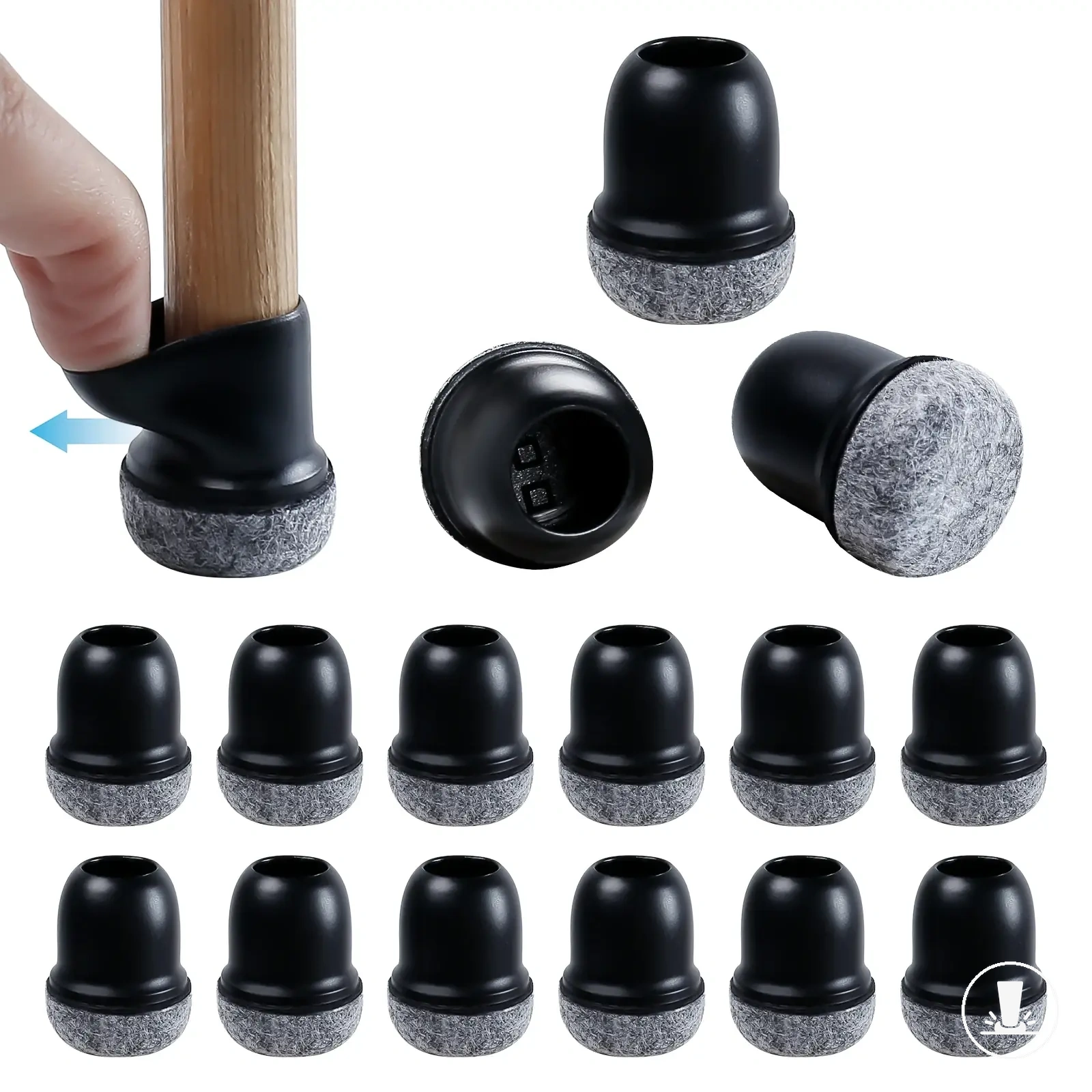
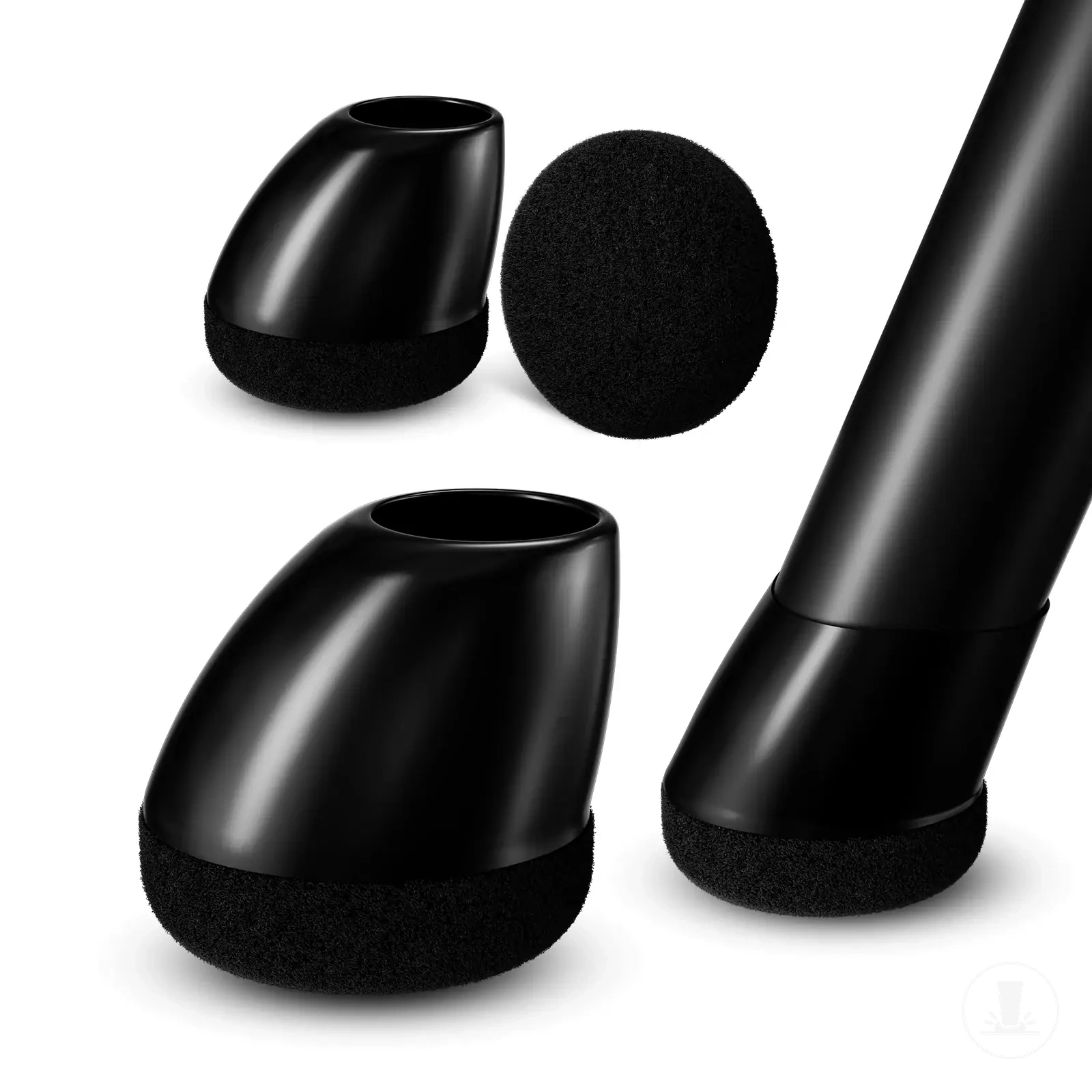
The products below are useful examples for comparing available options. Before buying, check that the compatibility criteria, key features, and product details match your needs.
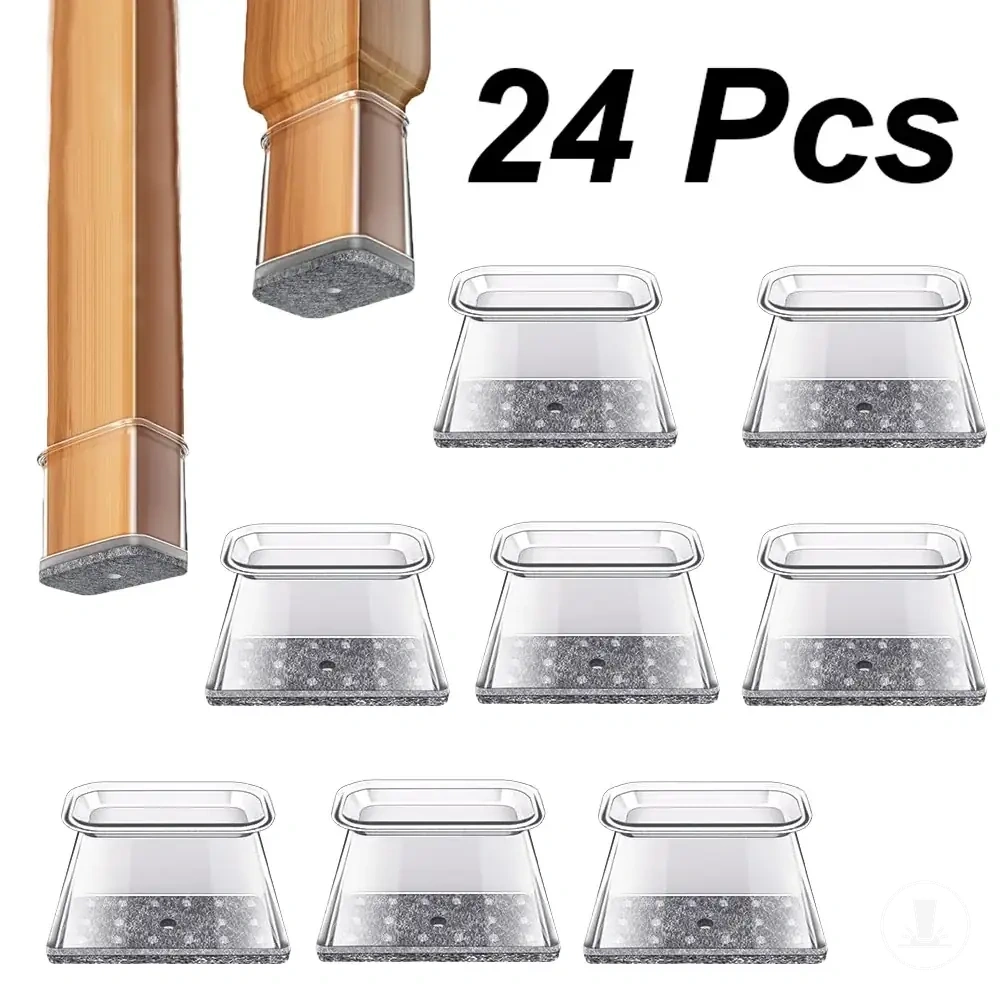
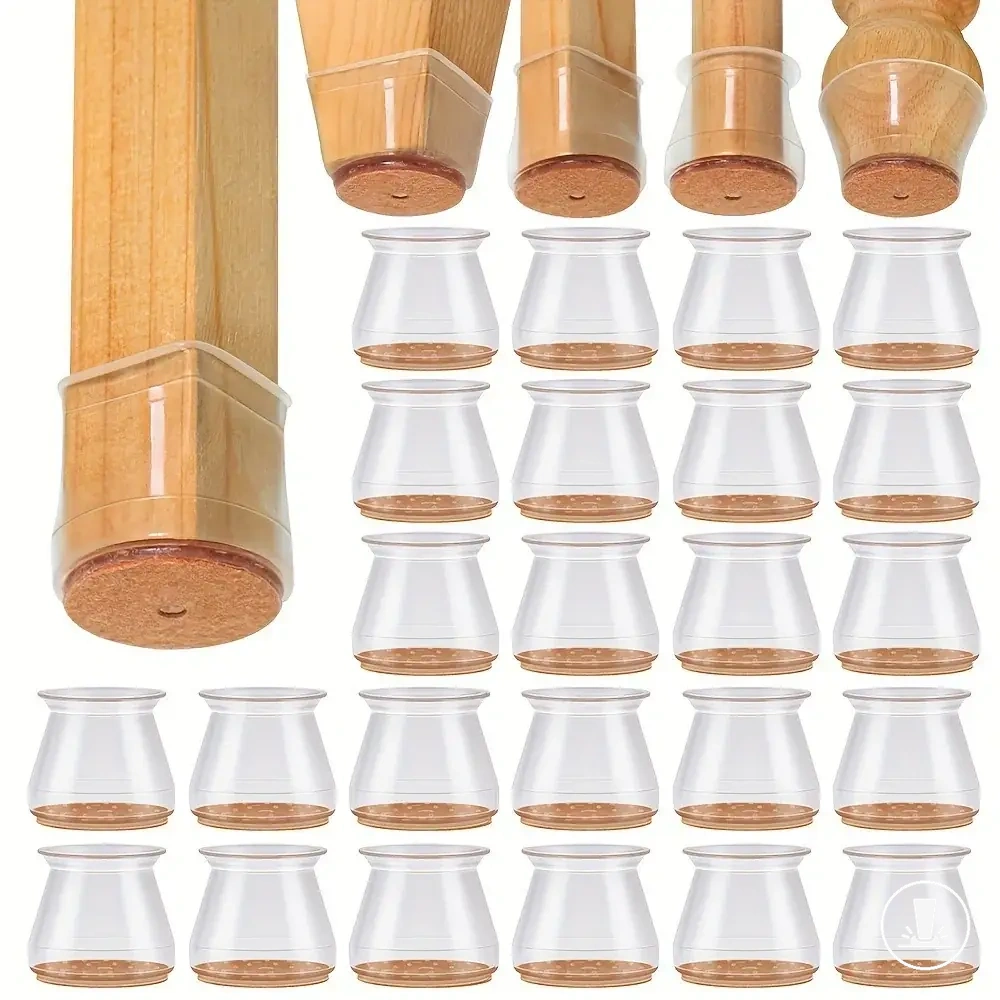
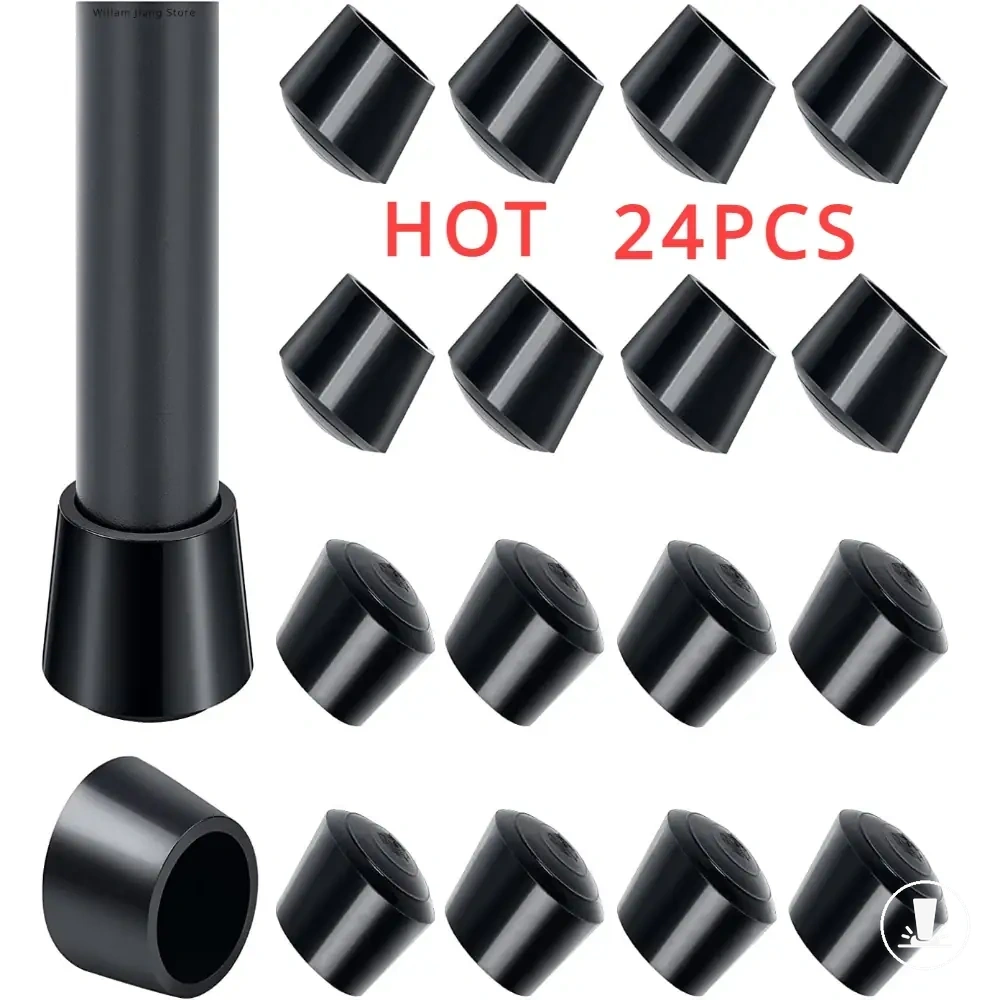
When chair leg protectors do not stay on or match the leg
When chair leg protectors do not stay on or match the leg, the cause is often a size mismatch, shape mismatch, attachment surface issue, or movement force that does not align with the leg and protector format. A loose fit, adhesive failure, or overstretched caps can create similar symptoms even when the underlying cause differs. The symptom should be diagnosed before a replacement decision is made.
A size mismatch can create a loose protector that shifts during use. A shape mismatch can cause slipping, especially on a tapered leg where contact changes across the leg profile. An attachment surface issue can reduce contact quality, while movement force can pull a protector loose over time. The table below helps separate these causes.
| Symptom | Likely fit cause | Check | What it means |
|---|---|---|---|
| Loose cap | Size mismatch | Check for movement around the leg | The opening may be too large for the leg profile |
| Overstretched cap | Poor fit range | Check for excessive tension or distortion | The protector may be operating beyond its intended size tolerance |
| Adhesive pad lifting | Adhesive failure | Check contact area and surface condition | Edge lift may indicate reduced attachment quality |
| Protector tilting | Shape mismatch | Check leg shape and contact alignment | The protector may not match the leg profile closely |
| Protector pulled off during movement | Movement force or floor friction | Check chair movement pattern and floor contact | Repeated movement may be overcoming attachment stability |
The safer adjustment depends on the diagnosed cause rather than the symptom alone. A loose fit may justify a replacement decision when size mismatch is the primary issue, while a tapered leg may require a format-change decision if shape mismatch continues to affect stability. Adhesive failure, overstretched caps, worn old pads, and floor friction should be evaluated individually because the appropriate response depends on the fit condition and protector format.
After identifying the likely fit cause, readers who need deeper symptom-specific guidance can review protectors that fall off for additional troubleshooting scenarios and condition-based checks.
Chair leg protectors that do not stay on or match the leg are usually easier to resolve when diagnosis follows symptom, cause, check, and meaning in sequence. Size mismatch, shape mismatch, attachment surface issues, movement force, adhesive failure, and overstretched caps can create similar fit failures while requiring different decisions. A replacement decision or format-change decision should follow the identified cause rather than the symptom alone.
The products below are useful examples for comparing available options. Before buying, check that the compatibility criteria, key features, and product details match your needs.